You have six weeks left before your CELPIP test, a target of CLB 9, and a stack of sample emails you've read three times. The examples look familiar. Yet when you close the document and start writing, you still hesitate over the opening, lose track of the task, and run out of time to edit.
The problem isn't necessarily effort. You may be practising recognition when you need independent performance. Understanding a model answer and producing your own clear response are different jobs.
The top study methods for CELPIP should address the problem you have:
- Weak skills: You need focused work on grammar, comprehension, organization, or spoken delivery.
- Limited study time: You need sessions that fit around work and family without becoming passive browsing.
- Unclear progress: You need evidence that you can perform better on an unfamiliar task, not just remember yesterday's answer.
Use active practice, timed rehearsal, and response-specific feedback together. You don't need to adopt every method at once. Start with a routine you can repeat, save your work, and judge improvement by what you can do without help.
1. Active Recall (Retrieval Practice)
Active recall means producing an answer before checking your notes. That might involve recalling vocabulary, writing an email opening, or explaining how you'll approach a reading question.
A major review of learning techniques identified practice testing and distributed practice as the techniques with the strongest empirical support. For CELPIP preparation, the practical distinction is simple: reading a useful expression isn't the same as retrieving it when you need it.

Practise without the safety net
Early in the week, review an email template, then close it. Write a complete response to a fresh prompt, including the purpose, requested details, and an appropriate closing.
Compare your response with the template only after finishing. Check whether you remembered a useful structure, not whether you reproduced identical wording.
- For vocabulary: Cover the definition, recall the meaning, and use the word in a relevant sentence.
- For speaking: Give your answer aloud before listening to a model.
- For review: Save missed phrases and retrieve them again during your next session.
Measure independent completion. Record which parts you produced without help and whether you addressed every instruction. If you still need the template open, reduce the task temporarily, practise the missing structure, and then return to a complete response.
2. Spaced Repetition
A workplace expression you remember tonight may disappear before your next speaking session. Spaced repetition gives you planned opportunities to retrieve it again instead of treating initial familiarity as mastery.
A meta-analysis of classroom learning found a moderate benefit for distributed over massed practice, with an effect size of d = 0.54. That supports spreading review across separate sessions, but it doesn't establish a universal schedule for every learner or phrase.
Build a usable phrase bank
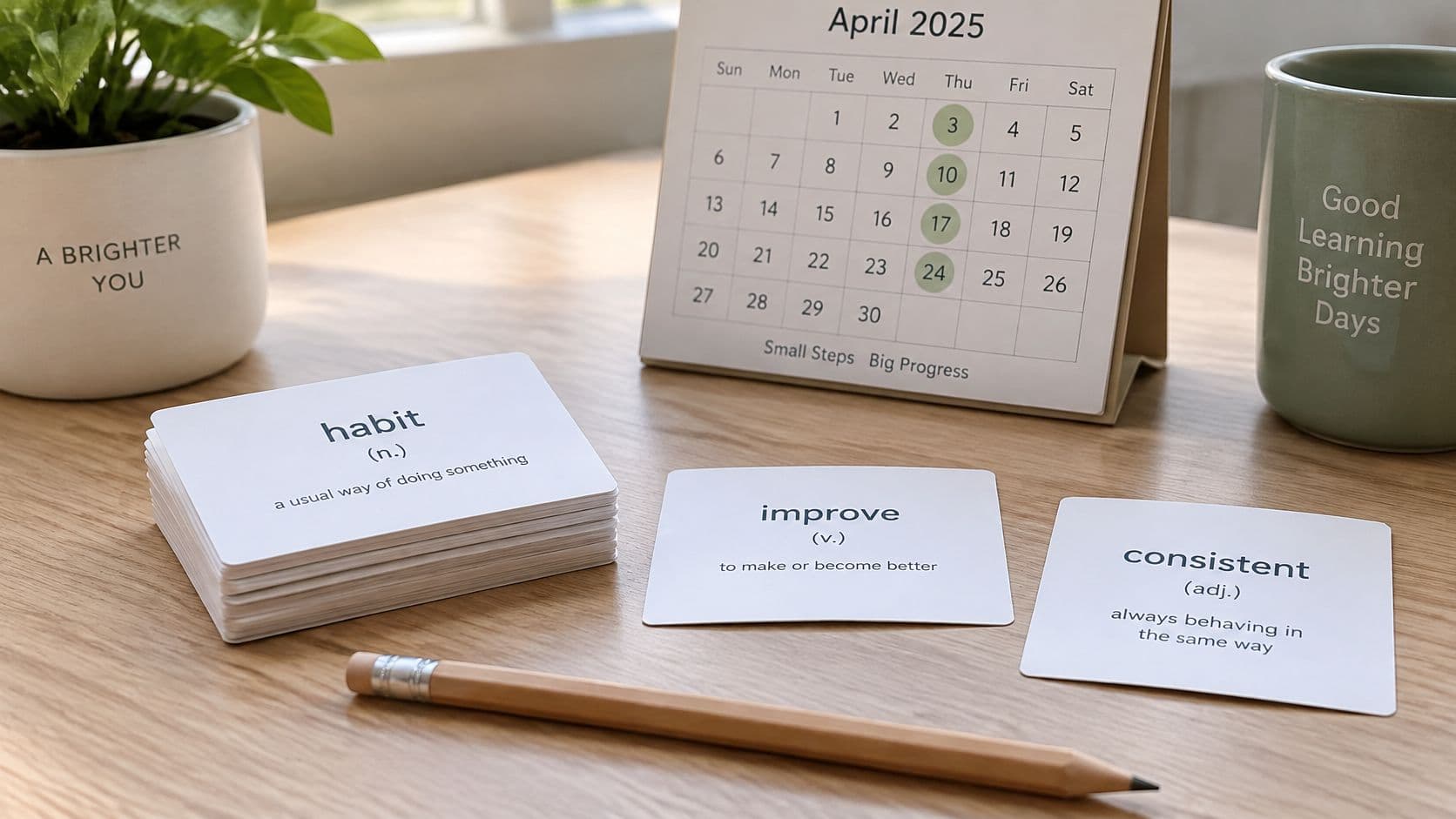
Use Anki, another flashcard app, or paper cards for vocabulary, collocations, and flexible sentence patterns. Put a situation on the front, such as requesting a repair politely, and a suitable expression on the back.
Review new cards during the week, then leave longer gaps when recall becomes reliable. Bring difficult cards back sooner, and add context when you repeatedly confuse similar expressions.
Practical rule: A phrase belongs in your usable vocabulary only when you can put it into a sentence without copying the example.
Reserve brief daily review periods for this work. Don't let flashcards replace listening, writing, or speaking practice.
Measure delayed use rather than card familiarity. At the weekend, write or record a fresh response using relevant phrases without opening the deck. Keep cards that support natural language; revise cards that encourage awkward, memorized sentences.
3. Deliberate Practice with Targeted Feedback
Completing another writing task won't necessarily fix unclear paragraphs. Deliberate practice means identifying a specific weakness, working on it directly, and applying feedback in another attempt.
A meta-analysis of formative assessment found an overall positive learning effect of 0.72, while results varied with feedback type and source. Treat feedback as material for revision, not as proof that merely submitting work will improve your score.

Choose a narrow weekly target
Say your survey responses contain opinions but weak supporting reasons. Spend the week practising how to connect each recommendation to a concrete consequence.
- Attempt: Write independently before requesting feedback.
- Inspect: Find comments about your chosen weakness and compare them with the actual sentences.
- Revise: Rewrite the response, then try a different prompt using the same correction.
Use this guide to AI essay feedback to build an attempt, review, and revision workflow. Don't ask a tool to write your answer first, and seek human review when automated comments conflict or remain unclear.
Measure transfer. A cleaner rewrite shows that you understood the correction. A stronger response to an unfamiliar prompt shows that you can apply it independently. Save both attempts so you can distinguish editing success from genuine skill growth.
4. Timed Practice Under Exam Conditions
Your untimed writing may be clear, but your timed response may end abruptly. That difference tells you to investigate pacing as well as language.
Timed practice means completing a task under its examination constraints, without pausing to consult notes, translate expressions, or inspect a model. A review of retrieval practice and feedback supports combining independent attempts with corrective information afterward.

Learn the task untimed first. Then use the task's stated test limit, remove distractions, and keep working until the timer ends.
Rehearse, then diagnose
Reserve a weekend session for a timed section or mock exam. Use this CELPIP mock-test practice guide to plan rehearsal and review rather than repeatedly taking tests without changing your approach.
Afterward, record where you stalled. Did you overplan, reread the same paragraph, search for impressive vocabulary, or leave editing until too late?
- For writing: Check whether all required points were completed.
- For reading: Separate unanswered questions from incorrect answers.
- For speaking: Listen for an unfinished conclusion or excessive opening detail.
Measure completion and quality together. Finishing faster isn't progress if your response becomes vague. Conversely, polished language doesn't solve a task you consistently leave incomplete. Use the timing record to choose your next focused practice session.
5. Interleaved Practice
An email followed by another email lets you reuse the same approach. Switching from an email to a survey response requires you to identify the task and choose an appropriate structure again.
That's the practical role of interleaved practice: mixing familiar task types so you practise choosing a strategy, not repeating it. It's useful when you can handle individual formats but become confused when the format changes.
Don't begin by mixing everything. If you're still learning how a diagram question works, practise that format on its own until you understand the instructions.
Mix formats with a reason
For a midweek reading session, alternate correspondence questions with diagram questions. Before answering, identify what you need to find: a stated detail, a relationship between labels, or an implied meaning.
For writing, switch between an email and a survey response across your practice sessions. Note the audience and purpose before you begin.
- Keep the mix controlled: Use related task types rather than jumping randomly across every skill.
- Name the strategy: State what you'll look for before answering.
- Review by category: Separate format confusion from vocabulary or comprehension mistakes.
Measure strategy selection. Track whether you correctly identified the task and chose a sensible approach before judging accuracy.
Interleaving can feel less smooth than repeating familiar exercises. If switching prevents you from understanding either format, return to focused practice, then reintroduce the mix.
6. Pomodoro Technique
You arrive home tired, open a preparation video, and spend the evening moving between tabs. A timer won't teach English, but it can give an otherwise vague study session a clear boundary.
The Pomodoro Technique alternates focused work with breaks. For next week, try a 25-minute work interval followed by a short break, adjusting the interval when your task needs a different length.
Use the timer to protect active work, not to make passive browsing look organized. Write the intended output before starting: a recorded advice response, a revised paragraph, or a reviewed set of reading mistakes.
A completed focus interval is a time-management result. An improved independent answer is a learning result.
Fit the interval to the task
Schedule writing intervals on workdays when you can reliably protect them. Use a separate interval to review feedback rather than squeezing correction into the final moments.
- Before starting: Close unrelated tabs and silence notifications.
- During the break: Leave the screen instead of opening another feed.
- For mock exams: Follow examination timing rather than interrupting the task for a break.
This guide to managing CELPIP study time can help you organize sessions around existing commitments.
Measure useful output per session. Log what you finished and what you corrected. If you repeatedly complete timers without producing answers, change the task, not just the timer length.
7. Feynman Technique
Read a passage about a proposed neighbourhood change, close it, and explain the writer's position in plain English. If your explanation becomes vague, return to the exact sentence you couldn't explain.
The Feynman Technique uses simple explanation to expose gaps in understanding. For CELPIP candidates, it's a practical way to check reading comprehension and practise clear spoken organization without hiding behind copied wording.
Simplification must preserve meaning. Saying that a writer dislikes change isn't an adequate explanation if the actual concern is the cost of a particular proposal.
Explain, check, and repair
During a reading session, choose a passage with a clear viewpoint. Explain the main position, supporting reason, and relevant qualification aloud without looking.
Then reopen the passage and compare your account with the text. Correct missing relationships, not just missing words.
- For listening: Summarize the speakers' problem and proposed solution after the recording ends.
- For speaking: Explain your recommendation as if your listener knows nothing about the situation.
- For grammar: Explain what changes in meaning when you change the tense or modal verb.
Measure faithful clarity. Save your recording and check whether a listener could identify the main idea and reasoning from your explanation alone.
Use this method during the week when comprehension feels uncertain. Don't turn it into memorizing a polished summary. The useful work happens when you discover what you couldn't explain and repair that gap.
8. Self-Explanation and Elaboration
Choosing the correct reading option is useful. Explaining why it's correct, and why the alternatives fail, gives you a more actionable review.
Self-explanation means making your reasoning explicit. Elaboration means connecting new material to knowledge or situations you already understand.
For example, when reviewing an email to a building manager, explain why the request needs a courteous but direct tone. Connect that choice to the relationship and purpose, rather than memorizing that every email must sound formal.
Add reasoning to answer review
After a midweek practice session, select answers you guessed or found difficult. Write a brief explanation of the evidence behind each choice.
For reading, identify the relevant passage and the mismatch in each rejected option. For writing, explain how a sentence supports the purpose or addresses an instruction.
- Explain the correction: State why the revised grammar fits the intended meaning.
- Change the context: Consider how the phrase would differ when speaking to a friend.
- Extend carefully: Add a concrete example that supports your point without drifting away from the prompt.
Measure the quality of your explanation. It should identify evidence, meaning, or task requirements, not merely repeat the answer key.
The trade-off is time. Don't explain every obvious answer at length. Concentrate on uncertain decisions and recurring mistakes, then test the same reasoning on a new task later in the week.
9. Error Analysis and Mistake Logs
A score tells you how an attempt went. A mistake log helps you decide what to practise next.
A synthesis of formative assessment and reading achievement found a positive effect of ES = +0.19 across K–12 studies. That isn't a CELPIP score forecast, but it supports using assessment during learning to identify gaps and adjust instruction rather than treating each result as an endpoint.
Record the cause, not just the correction
Use a spreadsheet or notebook with fields for the task, original error, corrected version, likely cause, and review date. Keep entries short enough that you'll revisit them.
Suppose you miss a viewpoint question. Recording the correct option isn't enough: identify whether you confused the author's position with someone else's, missed a qualifier, or guessed because time was running out.
- Language gap: Practise the vocabulary or grammar in context.
- Process mistake: Change how you read instructions or check evidence.
- Timing problem: Rehearse the relevant task under a limit.
Review the log at the weekend and choose the most persistent cause for focused practice. Later, retrieve the correction without opening the original explanation.
Measure recurrence on fresh tasks. Fewer repeated errors matter more than a longer log. If entries accumulate without changing your study plan, simplify the record and spend more time applying corrections.
10. Dual Coding
A paragraph can describe a process clearly, but a simple flowchart may make its sequence easier to inspect. Dual coding combines words with meaningful visual representations, such as maps, diagrams, and comparison layouts.
Use it for relationships that benefit from being visible. For CELPIP preparation, that might mean connecting locations in a reading diagram or organizing reasons before a speaking response.
Decorative notes aren't the point. Colouring a page without showing a relationship adds work without giving you a better practice task.
Draw only what you need
During a reading session, sketch how an announcement's key details relate: who is affected, what changes, and what action is required. Close the passage and explain the sketch from memory, then check its accuracy.
For speaking practice, make a compact idea map with a recommendation, supporting reasons, and an example. Record the answer from that map without writing a complete script.
- Keep labels brief: Use keywords rather than copied paragraphs.
- Make relationships explicit: Use arrows for sequence or cause.
- Test retrieval: Redraw or explain the structure without looking.
Measure organization and accuracy. Check whether your response follows a clear order and preserves the original information. If drawing consumes your available planning time, reduce the map to essential keywords.
Use the video alongside a practical exercise, then return to producing your own explanation.
How the top study methods compare for CELPIP preparation
| Item | Best For | Skills Covered | Session Length | Main Drawback |
|---|---|---|---|---|
| Active Recall (Retrieval Practice) | Strengthening recall and spotting knowledge gaps | Vocabulary, grammar, email phrasing, reading strategies; all four CELPIP skills | Short, flexible sessions | Can feel difficult and requires effective questions |
| Spaced Repetition | Retaining vocabulary and useful phrases over time | Vocabulary, collocations, template phrases | 10–15 minutes daily | Requires consistent review |
| Deliberate Practice with Targeted Feedback | Improving specific weak areas | Writing coherence, speaking intonation, grammar, fluency | Flexible; focused on one task or weakness | Requires reliable feedback and can be mentally demanding |
| Timed Practice Under Exam Conditions | Building pacing and test-day readiness | Timing, task familiarity, decision-making, stamina | Section-length or full-length practice | Full mock exams require substantial uninterrupted time |
| Interleaved Practice | Switching effectively between task types | Reading question types, email and survey writing, varied skills | Flexible mixed practice sessions | Can confuse beginners who have not learned each task type |
| Pomodoro Technique | Fitting focused study into a busy schedule | Study focus and time management; combines with other methods | Usually 25-minute work intervals with breaks | Fixed intervals may interrupt longer tasks |
| Feynman Technique | Clarifying understanding and explaining ideas | Reading comprehension, listening summaries, clear speaking | Flexible; can take time for large topics | Less useful for memorizing isolated vocabulary |
| Self-Explanation and Elaboration | Understanding why answers and language choices work | Grammar, tone, reading reasoning, speaking and writing | Flexible; may be slow for large amounts of material | Explanations may be inaccurate without feedback |
| Error Analysis and Mistake Logs | Finding and correcting recurring problems | Grammar, vocabulary, reading accuracy, timing, task completion | Ongoing logging with regular review | Logs require discipline and can go unused |
| Dual Coding | Organizing and recalling structured information | Reading diagrams, speaking and writing idea organization | Flexible; keep diagrams simple | Can become time-consuming or replace active practice |
Turn These Methods Into a Weekly CELPIP Routine
Start this week with a skill-building method and a time-management method. Deliberate practice plus protected focus intervals works well when writing weaknesses are clear but study time is scarce. Self-explanation plus timed practice is a sensible combination when reading answers make sense afterward but remain difficult during the task.
Don't divide your available time equally to cover everything. Give your weakest component focused attention while keeping the other skills active through shorter maintenance sessions.
Build the week around evidence
Begin with an independent task in the component you most need to improve. Save the response or recording before reviewing explanations, then identify a weakness specific enough to practise.
A workable weekly sequence looks like this:
- Monday: Complete a baseline task and identify the main limitation.
- Tuesday: Practise that limitation with targeted feedback and revision.
- Wednesday: Retrieve useful vocabulary and explain difficult corrections.
- Thursday: Apply the correction to an unfamiliar prompt.
- Weekend: Complete timed practice and review the week's saved work.
Adapt the days to your work shifts and family responsibilities. The important feature is the sequence: attempt, diagnose, practise, transfer, and review.
Keep a brief session record containing the task, conditions, main error, and next action. Review progress every seven days, comparing tasks completed under similar conditions.
Decide what to change
If quality improves untimed but falls under pressure, work on pacing and simplify your planning. If the same grammar mistake appears in every response, pause broad practice and address that pattern directly.
If revised answers improve but unfamiliar answers don't, you need more independent application. If feedback seems inconsistent, inspect the response against the relevant criteria and seek clarification instead of treating every automated suggestion as authoritative.
Progress test: Can you produce a clearer, more complete answer to a new prompt without extra help?
Watch component-level trends, but also inspect the work behind them. Better task completion, more accurate evidence selection, and fewer recurring errors give you concrete reasons to keep or change a routine.
The top study methods aren't competing systems you must follow perfectly. Use them as tools for specific problems, and keep the ones that improve independent performance. Consistent, measured practice is a better use of preparation time than long sessions without a clear task or review process.
Celprep offers interactive CELPIP practice, timed mock exams, and personalized automated feedback across writing, reading, speaking, and listening. Visit Celprep to attempt a task independently, review your feedback, and use the progress tools to choose what to practise next.