You paste a 170-word CELPIP email into a chatbot. It gives you a reassuringly high score, praises your vocabulary, and fixes a handful of commas. Yet your email still doesn't state what you want, its tone doesn't suit the reader, and a required detail is missing.
That's the trap with AI essay feedback: a polished draft can still be an incomplete response. The useful question isn't whether the software likes your writing. It's whether each comment helps you answer the task more clearly, accurately, and independently.
What AI Essay Feedback Can and Cannot Judge
AI essay feedback means software-generated comments on a draft. You might receive highlighted errors, suggested rewrites, rubric-based observations, or a score estimate. These outputs aren't equally dependable.
Use this working rule: act on verifiable surface errors, but check claims about ideas, logic, and task fit against the prompt. Even a correct correction needs a quick reread to make sure it preserves your meaning.
What to do with each kind of AI essay feedback
| Category | Usually catches | Verify yourself | First move |
|---|---|---|---|
| Grammar, spelling, punctuation | Agreement, articles, spelling, comma splices | Flags on idioms or correct formal phrasing | Fix clear errors, then reread aloud |
| Sentences and connectors | Repetition and missing transitions | Rewrites that sound unnatural | Keep your meaning and vary one sentence |
| Task fulfillment | Off-purpose content, wrong tone, length problems when the prompt is supplied | Added ideas the task never asked for | Check each prompt requirement once |
| Organization | Abrupt jumps and one-block drafts | Weak logic between sound paragraphs | Give each main idea its own paragraph |
| Vocabulary | Repeated basic words | Synonyms that change meaning or register | Prefer a precise word you can control |
| Argument and evidence | Some unsupported claims | Missing reasons, thin examples, weak persuasion | Add one concrete detail per main idea |
A correction from the items was damaged to the items were damaged has a clear grammatical basis. A suggestion to begin a sentence with In addition requires more judgment: are you adding information, or explaining a consequence?
Task comments need the original instructions. For a CELPIP response with a 150–200 word requirement, check length alongside purpose, tone, and completeness. A missing subject line matters if the task requires one; it shouldn't become an invented requirement.
Organization, vocabulary, and persuasion need a slower reading. Separate paragraphs can still follow weak logic, and replacing request a refund with express dissatisfaction changes the action you're asking the reader to take.
First-pass rule: Keep the table beside your draft and apply only the clear, actionable fixes in the First move column. Leave judgment calls for a deliberate second pass.
How AI Essay Feedback Reads a Draft
Say you're writing to a building manager about an unreliable elevator. You paste your email into a chatbot and ask for feedback. Without the task, the tool can inspect your sentences, but it can't reliably know whether you were supposed to describe the problem, suggest a solution, or request compensation.
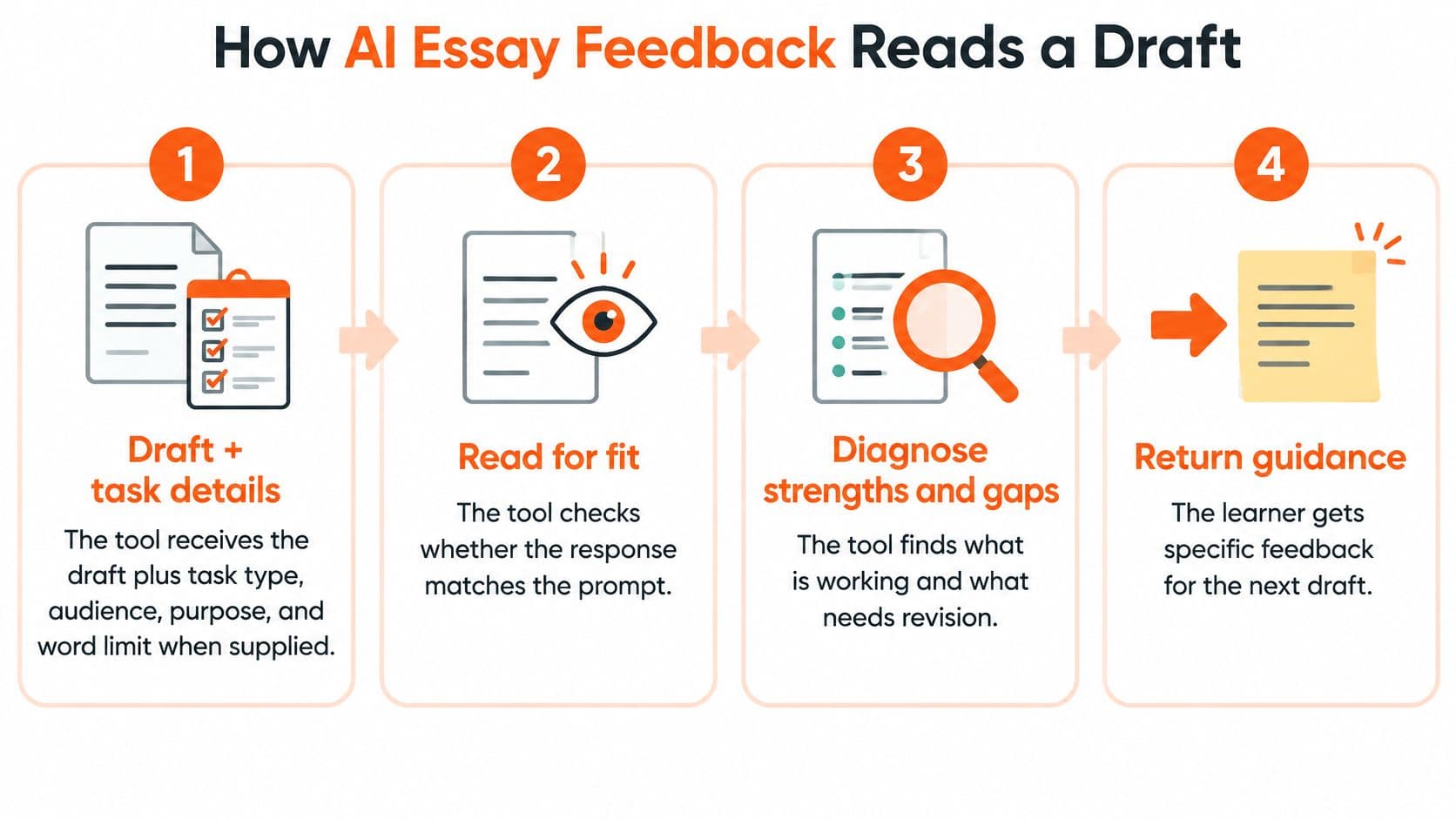
The process is easier to understand as a chain of reading decisions than as a technical lecture.
From draft to comments
- Receive the draft and task. The tool gets your text and whatever context you provide: email or survey response, audience, purpose, and word limit. Missing context can lead to misplaced advice.
- Inspect the language. Depending on the system, it separates sentences and paragraphs and identifies patterns such as spelling errors, agreement problems, and repeated words.
- Interpret strengths and gaps. A generative model uses patterns learned from text and the rubric language in your request to produce comments. It may suggest elaboration, reorganize a paragraph, or question the tone.
- Return guidance. You receive highlights, written comments, a score estimate, a rewrite, or some combination of these.
Think of it as a fast reader with a checklist and a huge memory of sample writing, not a teacher who necessarily remembers what you struggled with last week.
This flowchart summarizes the process.
The same draft can produce different comments on another run. A generative model can select different likely wording and observations rather than apply a single fixed marking procedure. A confident explanation doesn't make the result an official assessment.
Choose feedback that leaves you doing the writing
A highlight locates a possible problem. It's useful when you need to find a spelling error or a sentence fragment quickly.
A comment gives you a revision goal, such as adding a reason for your proposed solution. You still have to decide what to say. A full rewrite offers a model, but it can conceal whether you could produce those sentences yourself.
Before requesting comments, paste the task and use a request like this:
Official task: [paste the complete task]. Audience: [name the reader]. Length: 150–200 words. Assess Content/Coherence, Vocabulary, Readability, and Task Fulfillment. For every comment, quote the exact sentence and name the affected dimension. If something is missing, identify the unmet task requirement. Suggest a next move without rewriting my whole response.
Remove personal information before uploading practice text. Fictional names and order references work just as well for learning.
Four Writing Dimensions Worth Scoring
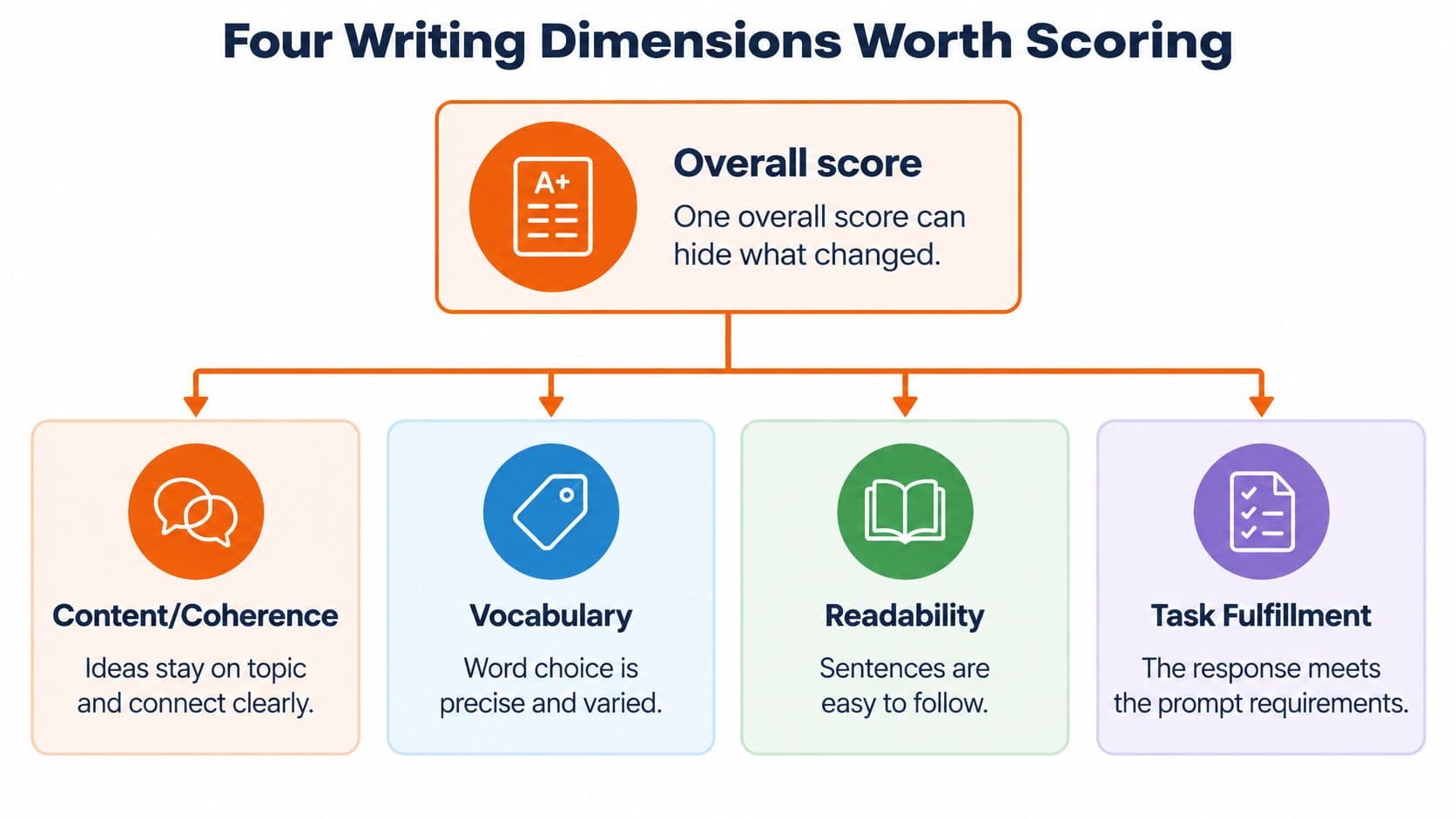
CELPIP writing is assessed across Content/Coherence, Vocabulary, Readability, and Task Fulfillment, according to the official CELPIP teacher guide, which defines the scope of each dimension. An overall score estimate can't tell you which part of your writing needs attention.
Suppose your email explains that a delivery arrived damaged. A vague comment praising the response while asking for more detail doesn't identify the problem. A useful comment names the missing action: Task Fulfillment: the email describes the damage but never asks for a replacement or refund.
The scoring dimensions help you separate these problems.
Ideas and word choice
Content/Coherence includes the number and quality of ideas, organization, examples, and supporting details. Ask whether the reader can follow your reasoning without supplying missing information.
For a survey response supporting longer library hours, saying that the change would be convenient isn't enough development. Explain who benefits and why: evening access would let employees use the library after work. That detail supports the preference rather than merely repeating it.
Vocabulary includes word choice, range, precision, and accuracy. Variety helps only when the alternatives fit.
A weak comment asks you to use advanced vocabulary. A useful comment identifies that broken is too broad when you mean a cracked handle. The improvement comes from precision, not rarity.
Readability and completing the task
Readability covers format, paragraphing, connectors, transitions, grammar, sentence structure, spelling, and punctuation. It is not only an error count.
If a sentence combines the delivery date, damage, safety concern, and requested action, split it where the purpose changes. That makes the reader's job easier even when the original sentence is technically grammatical.
Task Fulfillment includes relevance, completeness, tone, and word count. An email can be fluent yet incomplete because it never requests the action specified in the prompt.
- Check relevance. Does each paragraph help accomplish the assigned purpose?
- Check completeness. Can you point to where you've answered every required point?
- Check tone and length. For a task requiring 150–200 words, a practical drafting aim is about 170–190, leaving room for small revisions.
For advanced writing, look beyond clean grammar: meaningful transitions, developed support, controlled complex sentences, and an appropriate tone all deserve attention. Don't add a conditional merely to display complexity; use it when you're discussing an alternative or consequence.
The CELPIP writing tips offer a useful companion for planning this kind of rubric-led practice. Label every accepted revision with its scoring dimension so your session develops writing skills rather than becoming proofreading alone.
When to Trust or Double-Check a Comment
A 2026 meta-synthesis published by Springer, covering 11 reviews of research from 2015–2025, found that automated writing evaluation consistently helps with grammar and spelling but remains limited for higher-order skills such as argumentation; a study it cited reported 91.8% precision and 63.2% recall for ChatGPT feedback on argumentative writing.
Precision concerns how many flagged issues were valid. Recall concerns how many relevant issues the system found. These aren't exam scores, and they don't describe every writing tool.
For an exam candidate, the practical consequence is straightforward: many corrections may be useful while important weaknesses remain unmentioned. A grammatically clean survey response can still fail to make a clear choice.
Signals that a comment needs a human check
| Signal | What it usually means | Decision |
|---|---|---|
| Quotes your sentence and names a grammar or spelling rule | Verifiable surface error | Apply, then reread |
| Says be clearer or more persuasive with no quotation | Higher-order gap the tool may have missed or invented | Demand the sentence and the dimension |
| Rewrites the request, opinion, or audience | Meaning drift | Reject and restore your purpose |
| Swaps a natural phrase for a rare synonym | Style preference, not an error | Keep the clearer wording |
| Score rises or falls with no dimension named | Unsupported number | Ignore the score and mark the four dimensions yourself |
Sort comments into verifiable mechanics, task completion, organization, vocabulary, and subjective style. These are decision categories, not replacements for the official scoring dimensions. A preference for a more elaborate greeting belongs under subjective style unless the original greeting is inappropriate for the audience.
Put the comment through a practical check
Start by asking the tool to identify the exact wording and affected dimension. If it claims your reasoning is unclear, require it to locate the gap between your point and your explanation.
Then compare the proposed change with the prompt. Does it preserve your intended request, your audience, and your position? An email requesting a replacement shouldn't become a demand for compensation.
Finally, read the revision aloud. Reject ornate wording that makes a normal Canadian customer-service email sound ceremonial or hostile. There isn't a single correct Canadian voice; clear, courteous language is a safer guide than stereotypes about formality.
UNESCO's guidance on generative AI in education calls for validation of bias and human-centred educational use. Treat automated preferences about language and tone as suggestions to examine, and don't substitute an AI estimate for human judgment about high-stakes readiness.
Silence from the tool isn't proof that a paragraph is strong. Read for what's missing, not just what's highlighted.
A Revision Walkthrough of One Email
Consider a CELPIP-style email task: write 150–200 words to an online store about a damaged kettle, request a replacement, and maintain a polite tone with a clear deadline. The customer needs a usable product, not a dramatic complaint.
Keep that everyday purpose in mind while revising.

Sort the comments before changing the draft
A weak opening might read:
I am sorry to bother you about something that happened with my delivery because a damaged kettle were delivered and I was disappointed when I opened the package, so I hope you can help me with this matter soon.
The writer apologizes vaguely, leaves out the order reference, and squeezes everything into a long sentence. Suppose the tool returns these comments:
- Comment A, apply. Change a damaged kettle were delivered to a damaged kettle was delivered. This is a verifiable agreement correction under Readability.
- Comment B, reject. Replace kettle with apparatus. The proposed vocabulary change is less natural and less specific.
- Comment C, investigate. Add more detail. Check Task Fulfillment, then supply an order reference, the crack in the handle, and a request for replacement within seven days.
Rebuild around the reader's needs
Here's a revised version organized into purpose, problem, and action:
Dear Customer Service Team, I'm writing about the electric kettle delivered yesterday under order KT482. Unfortunately, it arrived damaged, and I would like to arrange a replacement. I bought it for everyday use in my kitchen, so I was disappointed to discover the problem before I could use it.
When I opened the package, I noticed a crack running along the handle near its attachment to the kettle. The handle feels loose when I lift the empty kettle. Because of that, I don't feel it would be safe to fill it with boiling water. I've kept the packaging and can send photographs showing the damage.
Could you please arrange for a replacement to arrive within seven days? Please also explain how I should return the damaged item and whether you can provide a prepaid return label. If a replacement is unavailable, I would accept a refund. Thank you for your help; I look forward to your reply. Kind regards, Alex.
The official CELPIP Level 10 description expects precise connections within and between paragraphs, appropriate tone, developed support, and control of complex and diverse grammar, including conditional and subjunctive forms. In this revision, because of that expresses consequence, the loose handle explains the safety concern, and the conditional introduces an acceptable alternative.
For comparison practice, use the CELPIP Writing Task 1 samples to examine how emails organize their purpose and requested action.
You can also use this video as a supplementary practice resource.
In a 2026 exploratory study published by Springer, 29 upper-division English-writing students produced significantly stronger final drafts after revision involving instructor, peer, and generative-AI feedback, and 25 participants said generative AI helped with both higher-order and language issues. That small, mixed-feedback study doesn't establish that AI alone raises CELPIP scores.
Finish with a 60-second self-check: purpose stated, two specific details, consistent tone, and length within the task's 150–200 word range.
Build a Routine That Survives Without the Tool
A polished email shows you can improve a draft with help. The separate question is whether you can write well on a fresh prompt with the tool closed. An accepted comment works like a spotter's hand on a barbell: it proves the lift happened with help, while the solo lift remains untested.
Before you re-test yourself, sort every comment you accepted into one of five kinds: verifiable mechanics (a grammar or spelling slip you can check against a rule), task completion (whether the email states its purpose and its request), organization (the order of ideas), vocabulary (word choice), and subjective style (tone judgments where reasonable writers differ). The first four each convert into a rule you can carry to the next task. Style comments need judgment: if you cannot explain why the suggested tone fits the reader, treat the change as optional.
Then run the test. In a timed practice session, allow the full official time limit for the task, then assess what you produced independently rather than comparing it with an AI-polished version.
Measure retention, not just revision
The Open Praxis discussion of writing-feedback evidence describes a 2025 study in which chatbot and teacher feedback both improved informative writing, but statistically significant improvement persisted only in the teacher-feedback group; it also describes 2025 findings that hybrid AI-plus-human feedback produced stronger gains in organization and critical thinking.
The same discussion reports a comparison in which ChatGPT supported stronger post-test writing than automated writing evaluation, while learners receiving automated evaluation reported a stronger ideal second-language writing self. Feeling more capable and performing better are two different outcomes, so measure the one that exam day will test.
Build your routine around independent production.

Use a repeatable practice cycle
- Revise selectively with the tool. Accept only comments you can justify, and label each one with its kind: mechanics, task completion, organization, vocabulary, or style. Keep your original draft so you can see what you wrote before receiving help.
- Record the lesson. Write a three-line error log: the scoring dimension, the old sentence, and the rule in your own words. For example, note that your request was implied rather than stated, then explain where the action sentence belongs.
- Delay the next test. Wait at least a day, then answer a fresh email or survey prompt without AI. A new topic reveals whether you learned a transferable skill or memorized a correction.
- Assess before asking. Mark the clean draft against the scoring dimensions yourself. Identify the weakest passage and predict what feedback it needs.
- Arrange periodic outside review. Every few tasks, ask a teacher or study partner to examine organization and task fit, or conduct a stricter rubric pass. Ask them to explain where your reasoning becomes difficult to follow.
Self-explanation means saying why you changed a sentence, not merely accepting its replacement. If you can't explain the change, write a simpler sentence you understand and can reproduce under time pressure.
For a manageable week, schedule three timed writings, an error log after each, and one delayed rewrite with the tool closed. Use English writing practice to keep the focus on producing responses rather than collecting advice.
At Celprep, our Writing coach provides email and survey-response practice with detailed grammar and tone feedback. Our AI feedback is trained specifically on CELPIP scoring criteria, including coherence, vocabulary range, grammar accuracy, and task completion, and presents one response, a specific weakness, and an achievable correction.
Readiness test: Your clean timed draft already states its purpose, supports it with relevant detail, and maintains an appropriate tone before software suggests changes.
Visit Celprep to practise an email or survey response, turn the feedback on one attempt into a concrete revision goal, and then test the same skill on a fresh task without assistance.