You finish your first recording, press submit, and see a score below what you expected. You understood the question. You knew the words. Yet your answer wandered, you paused while searching for another idea, and the timer stopped before you reached a conclusion.
A disappointing first English speaking test online doesn't automatically mean your English is weak. Treat it first as a diagnostic question: did you lack the language, or did you lack a usable structure? With timed recordings and a simple practice log, you can separate those problems and choose a change that actually helps.
How an Online English Speaking Test Works
Say your screen asks you to advise a friend about a workplace problem. You read the situation, watch the preparation countdown, and then speak into your microphone while the recording timer runs. After submission, you receive feedback or a practice score.
That's the recorded-response format used in CELPIP-style practice, not a description of every online language exam. There isn't an examiner reacting to your answer, asking follow-up questions, or helping you recover. During an exam-style attempt, you don't restart when a sentence goes wrong.
Follow the screen sequence
- Check your equipment. Make a short microphone recording in a quiet room and play it back.
- Identify the task. Decide whether you're advising, describing, predicting, or recounting an experience.
- Plan your points. Write brief keywords rather than sentences you'll try to read aloud.
- Record to the timer. Develop your answer and leave room to finish.
- Submit and review. Listen to the recording alongside the feedback.
CELPIP-style Speaking practice covers eight tasks, mixing advice, personal experience, prediction, and picture-based description. Read the specific directions each time rather than assuming every prompt needs the same response.
You're not alone if speaking feels harder than understanding English. The 2025 EF English Proficiency Index announcement identified speaking as the weakest English skill in more than half of the 123 countries and regions measured. Strong reading or listening doesn't remove the need to practise producing an answer yourself.
Prepare for the right examination
Our English proficiency test guide can help you understand the assessment context. We help candidates prepare for CELPIP, which is one of the steps to permanent residency in Canada, and we're an independent preparation resource rather than the official test provider.
Before your first attempt, have a working headset, a visible timer, and a notebook ready. You'll need the notebook to assess what happened, not to script every word beforehand.
The Four Scores Behind Every Recording
| Dimension | What It Checks | Typical Weak Sign |
|---|---|---|
| Content/Coherence | Number and quality of ideas, organization, examples, supporting details | Thin points, no clear order |
| Vocabulary | Word choice, appropriacy, range, precision, accuracy | Repeated basic words such as good or nice |
| Listenability | Rhythm, pronunciation, intonation, pausing, self-correction, grammar, sentence variety | Long pauses, flat delivery, grammar slips |
| Task Fulfillment | Relevance, completeness, tone, response length | Answer drifts off topic or stops early |
These dimensions come from the CELPIP Performance Standards, which also specify approximately 15 minutes for Speaking. Your practice should therefore involve spontaneous, time-limited responses, not unlimited drafting followed by a polished reading.
Diagnose the answer, not just the accent
Content/Coherence concerns what you develop and how the listener follows it. A recording might recommend taking a course, then jump to transportation, then return to course fees without explaining the connection. The speaker has ideas, but needs a clearer order and supporting detail.
Vocabulary isn't a contest to use the longest word. If every option is good, nice, or interesting, the listener learns little about the differences. Affordable, convenient, or suitable for beginners may express the intended meaning more precisely, provided you use them accurately.
Listenability covers much more than pronunciation. A speaker can pronounce individual words clearly but still be difficult to follow because of broken phrasing, repeated corrections, or grammar that obscures the meaning. Practise delivering complete thought groups rather than forcing yourself to speak faster.
Task Fulfillment asks whether you did the job. A smooth description of your own workplace won't fully answer a prompt asking you to advise a friend about theirs. Relevance, audience, and completeness matter alongside delivery.
Diagnostic rule: A total score tells you how the attempt went. Dimension-level feedback helps you decide what to practise next.
Match the drill to the weakness
A learner with adequate vocabulary but uneven pacing needs delivery practice. A fluent learner whose answer lacks support needs a planning drill, not more pronunciation exercises. Don't prescribe the same fix for both.
Use the CELPIP speaking practice book guide to organize your preparation around task requirements. Then inspect your last recording, identify the lowest dimension, and select a drill that changes an observable behavior within it.
Why Preparation Time Makes Speaking Harder
Unlimited planning can make you feel ready without showing whether you can respond under exam conditions. The surprising difficulty isn't always finding English words. It's deciding what to say before recording begins.
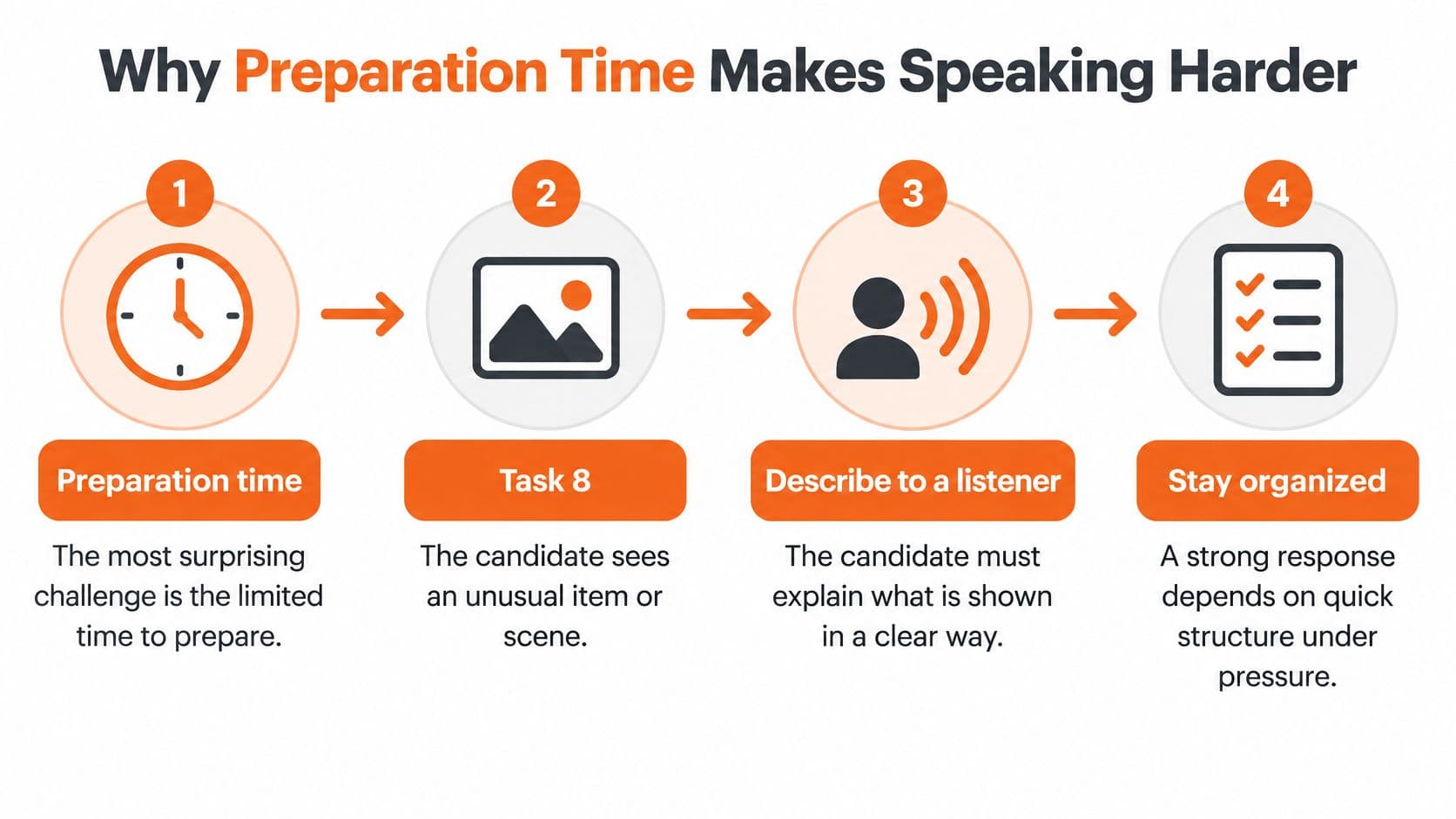
According to the CELPIP Speaking study pack, Task 8 gives you 30 seconds to prepare and 60 seconds to speak about an unusual item or situation pictured on screen. You must describe it to someone who can't see it.
The preparation sequence makes that pressure easier to understand.
Plan a route through the picture
Unlike ordinary conversation, the listener can't glance at the object or point to the part they don't understand. You must establish the main subject and explain how the details relate to it.
Use your preparation window for a compact routine:
- Name the main object. Decide how you'll introduce it in a clear opening sentence.
- Choose ordered details. Select the features that make the scene recognizable.
- Add location language. Prepare connectors such as on the left, above it, or next to the trunk.
- Be ready to begin. Have your opening ready before the countdown reaches zero, then speak when recording starts.
Don't spend the entire window hunting for an exact label. If you don't know a specialized noun, describe the object's shape, position, or purpose.
Try an unusual-scene exercise
Suppose a picture shows a bicycle hanging upside down from a tree branch. Begin by identifying the bicycle and its unusual position. Then describe the branch, how the bicycle hangs from it, and the empty ground underneath, in that order.
Finish with a short observation about what makes the scene strange. Avoid inventing a long story about who put it there unless the prompt asks for an explanation.
A useful picture description lets the listener understand the arrangement, not merely hear a list of objects.
Choose a random image, use the timed preparation-and-recording sequence, and give the audio to someone who hasn't seen it. Ask them to sketch the scene. Missing or misplaced features will show you where your description needs clearer relationships.
How to Build a Three-Part Answer Under Time Pressure
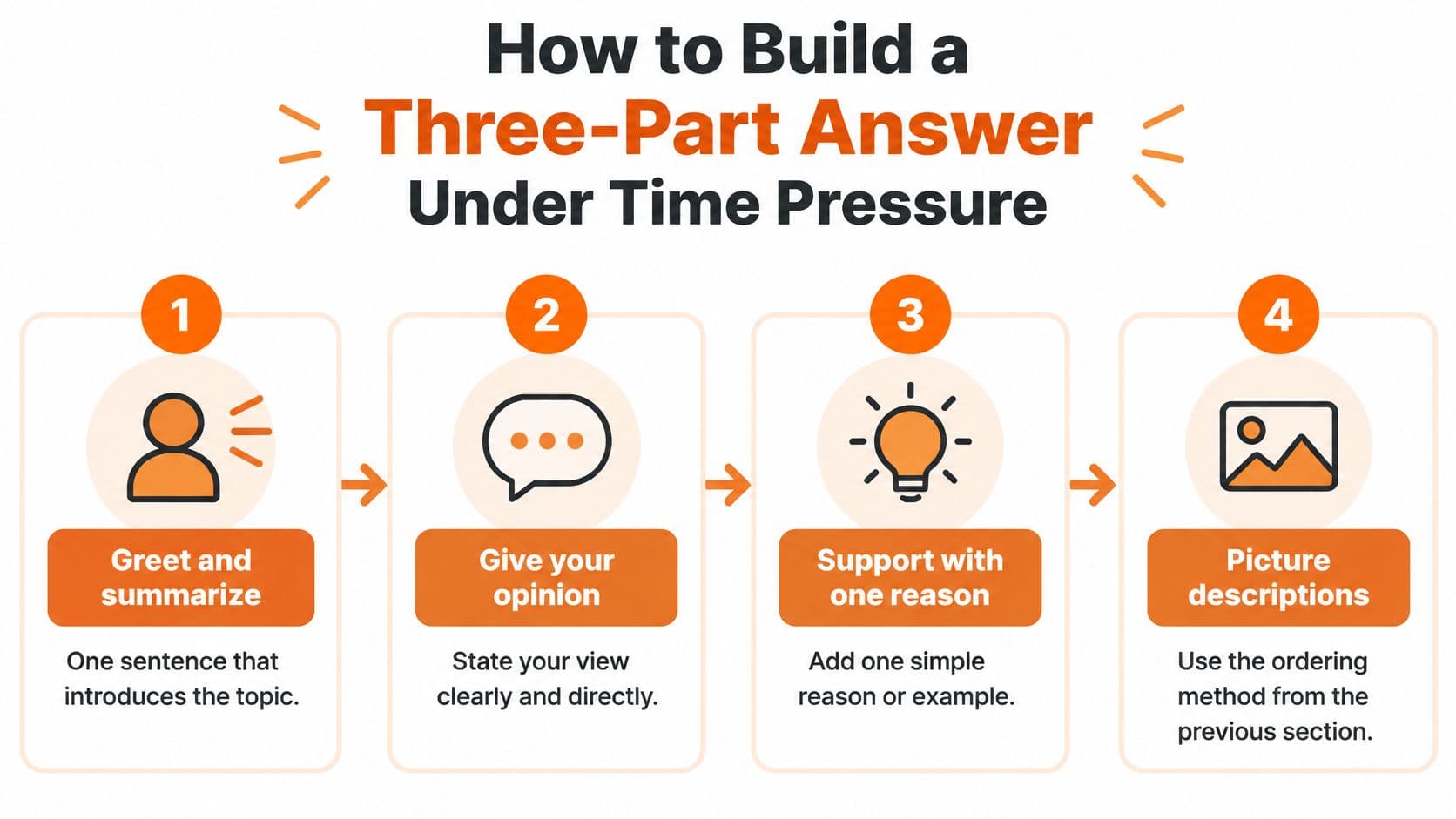
For advice and opinion prompts, use a structure that helps you develop an answer without writing a script. Our CELPIP Speaking Task 1 guide uses a three-step template: a greeting and problem summary, advice with reasons, and a concluding recommendation. Its sample answers stay within 90–110 words to fit the 60-second limit.
This visual offers a compact reminder of the building blocks.
Build the response in manageable parts
-
Greet and summarize. Briefly acknowledge the listener's situation so your advice has a clear frame. Try an opening such as Hi Maya, choosing a course while working full-time can be difficult.
-
Give suggestions with reasons. Plan two or three pieces of advice, explaining why each could help and adding a relevant example where useful. A transition such as I would suggest two things makes the organization audible.
-
Conclude with a recommendation. Choose the most useful starting point instead of introducing another topic. If I were you, I would start with… leads naturally into a practical final recommendation.
For an opinion prompt, replace the greeting and problem summary with a direct statement of your position. Support that position rather than giving unrelated suggestions. Picture descriptions need a spatial route through the scene, not an advice template.
The following video provides another resource for practising your response.
Develop ideas instead of filling space
Suppose you're advising someone who wants to study around their job. Rather than recommending an online course, explain that recorded lessons would let them study after a late shift. Then suggest checking the workload before enrolling, because a manageable schedule is more useful than an impressive course they can't attend.
That development matters. The official CELPIP scoring-level descriptors distinguish stronger performance through clear, precise detail, broad language, and wording adapted to the situation and listener.
Memorize the structure, not the answer. Connectors should clarify relationships between ideas, not decorate empty sentences. A warm tone may suit a friend, while a professional recommendation calls for more measured wording.
Before your next recording, write a short outline containing the opening, supporting ideas, and recommendation. Time your spoken answer and shorten the outline if you're rushing to include everything.
Common Speaking Mistakes, Causes and Fixes
| Symptom | Likely Cause | Fix |
|---|---|---|
| Recording runs out before the point is finished | No plan made during preparation time | Note two or three points in 30 seconds before speaking |
| Only one piece of advice given | Single idea planned | Plan at least two clear suggestions, each with a reason |
| Frequent long pauses | Improvising every sentence | Rehearse the opening line and use connectors between points |
| Answer feels generic | Few concrete details | Add one example or number to each point |
| Low score despite good English | Missing structure, not missing language | Follow the three-part method for two weeks |
| Score stalls after two weeks | Same weakness repeated across attempts | Target one dimension per week and compare recordings |
| Picture description is hard to follow | Details not put in order | Start with the main object, then describe nearby details in one direction |
Treat these as working diagnoses, not proof of what caused your score. The practice periods are suggested routines, not promises of improvement. Listen for evidence before choosing a fix.
Fix the planning gap
Giving only one piece of advice can leave an otherwise understandable response underdeveloped. During preparation, write distinct suggestions rather than several keywords about the same suggestion. Checking course availability and checking workload are separate actions; repeating that a course is useful isn't.
For generic answers, add a detail that belongs to the situation. If you use a number in a hypothetical example, make it plausible and clearly illustrative. Never invent factual claims just to make your speech sound specific.
Avoid script dependence
A memorized paragraph can become awkward when the prompt changes. You may continue talking about cost when the actual problem is scheduling, or use an informal greeting for a professional audience. Learn flexible connectors and response patterns instead.
Timing problems need different fixes depending on what you hear. If you stop early, develop the reasons; if the recording cuts you off, remove repetition and unnecessary background.
Practice constraint: Change one variable per recording and keep the rest steady enough to judge whether the change helped.
Don't simultaneously replace your vocabulary, accelerate your delivery, and add more ideas. You won't know which adjustment made the answer clearer.
Build Your Score With a Timed Practice Log
A low first score usually tells you where the structure broke down, not that your English failed. Before you chase a higher total, start a practice log: a record of what you tried, what changed, and what stayed the same. Over four weeks it separates a shaky first attempt from a genuine pattern.
Keep the log with these fields. The entries below are illustrative examples of what to record, not learner results.
| Date | Prompt Type | Weakest Dimension | One Change Tried | Score Change |
|---|---|---|---|---|
| Day 1 | Unusual picture description | Content/Coherence | Describe details in spatial order | Baseline recorded |
| Day 4 | Similar picture prompt | Content/Coherence | Keep the same spatial approach | Coherence improved; answer still ended early |
| Week 2 | Advice to a friend | Vocabulary | Replace repeated words with precise ones | Vocabulary rose; timing fell short |
| Week 4 | Prediction task | Task Completion | Plan two reasons during prep time | Response finished within the limit |
Notice the pattern across the rows: each change is small enough to hear in the next recording. That is what turns the log into a diagnostic tool rather than a diary.
A simple recording setup helps you keep conditions consistent.
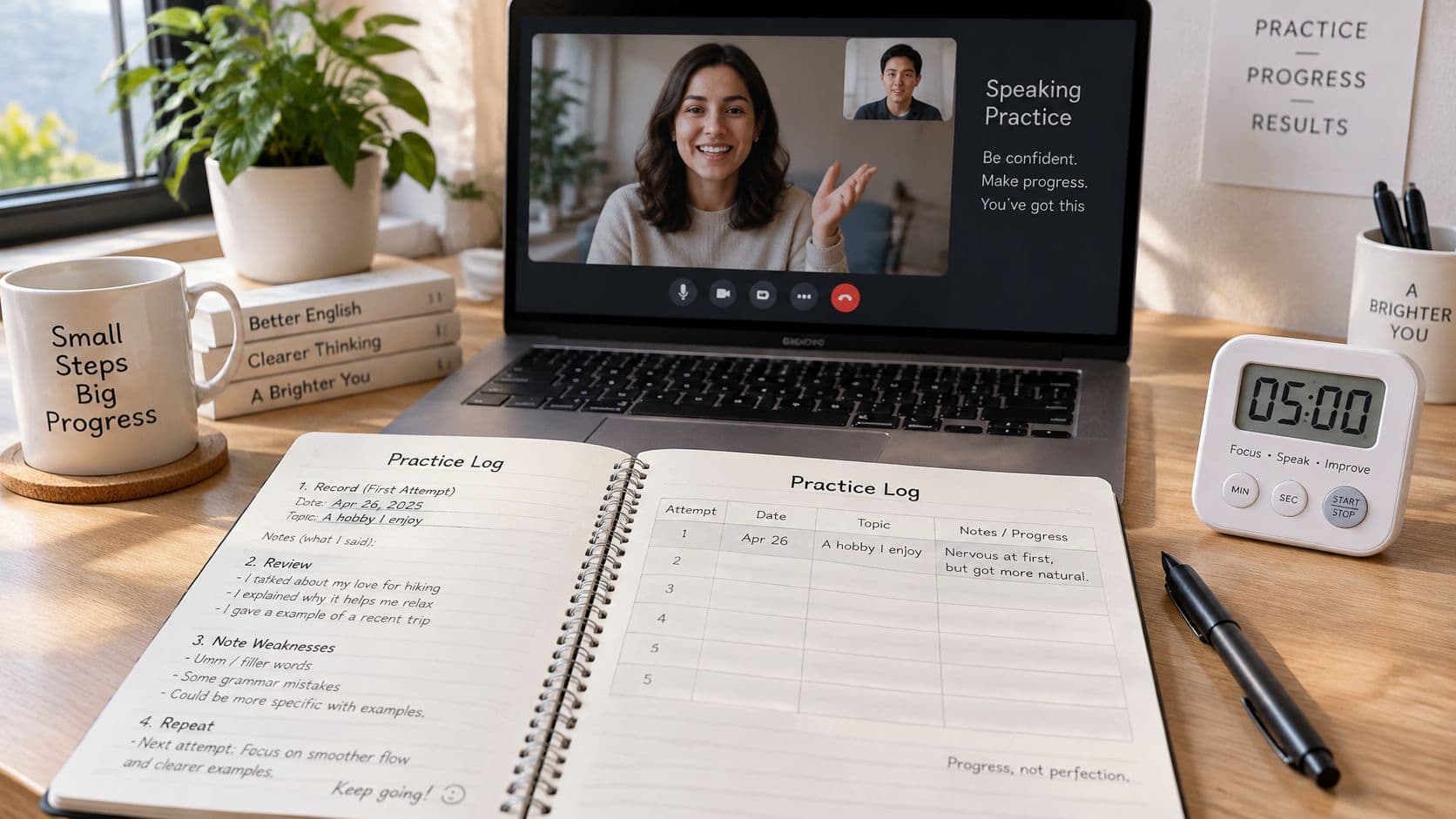
Complete a focused first session
- Record a timed picture description. Use the task's preparation and response timers without pausing them.
- Identify the weakest dimension. Write down the specific behavior behind the diagnosis, such as details listed in random order.
- Apply a single change. Choose a fix you can hear, like clearer spatial ordering.
- Schedule a comparison. Re-record a similar picture within three to four days, treating that interval as a practical study rhythm rather than a guaranteed improvement window.
Save both recordings. Compare whether a listener can follow the scene, not whether the later attempt sounds more confident. Confidence grows with practice; the audibility of your structure is what you are measuring.
Interpret automated feedback carefully
An automated score is a diagnostic estimate, not an official result. A SpeechRater study of non-native spontaneous speech found a 0.57 correlation between machine and human scores across complete six-item practice tests, compared with 0.74 between human raters. Those figures describe that system and that study, so treat any platform's score the same way: a signal to investigate, not a verdict.
Look for weaknesses that recur across different prompts, since a one-off dip often means a hard prompt rather than a weak skill. Check the transcript against your recording, because accent, background noise, microphone quality, and unusual delivery can affect speech recognition. If the transcript omits words you clearly said, treat vocabulary or grammar diagnoses built on it with caution.
Decide what to do next
Use your log alongside our guide to effective CELPIP study methods. Our Prep Academy also publishes a guide to CELPIP Speaking Task 1 questions and answers, with Band 9-10 style sample answers kept to 90-110 words so they fit the 60-second limit. Study them for organization rather than memorizing them.
On Celprep, you can record a real CELPIP speaking task and receive one weakness plus one change for your next attempt. The free plan includes one exercise per task type (Writing, Reading, Listening, and Speaking), three starter templates, one vocabulary bundle per section, and three submissions per day.
Before paying for more practice, check whether your comparison recording shows measurable movement in the weakest dimension: a stronger component score supported by clearer organization or more complete task coverage, not merely a higher total.
If it does not, keep logging on the free plan. Judge progress across several weeks of work on structure, connectors, and format rather than expecting one session to transform your performance. Improvement should become audible in the recording as well as visible in the scores.
Celprep offers timed CELPIP speaking practice with feedback on each recorded response. Visit Celprep, record your first task, and use the identified weakness and suggested change to plan your next attempt.