You may already have a test date in mind, a score target for your immigration or licensing application, and one result that's making you nervous. Maybe your Reading and Listening feel solid, but Writing keeps landing below the number you need. Good CELPIP coaching online starts with that component-level gap, not a vague promise to improve your English overall.
The computer-delivered format shapes how you prepare: you need to read, listen, type, and speak into a microphone under time limits. A useful platform helps you practise those actions, see where each skill is falling short, and treat every practice score as an estimate rather than a guarantee of your official result.
What Online CELPIP Coaching Covers
Online CELPIP coaching is structured preparation delivered through a web platform that trains the exam's four components, timing, and question types while giving feedback on your own answers. That matters because the CELPIP-General Test assesses Listening, Reading, Writing, and Speaking in one sitting of about three hours, with every component completed on a computer, as described in the CELPIP test-taker guide.
| CELPIP-General components at a glance | Official timing | Score scale | What online practice should train |
|---|---|---|---|
| Listening | 46–55 minutes | 1–12 | Conversations, announcements, and discussion scenarios at exam speed |
| Reading | 43–56 minutes | 1–12 | Correspondence, diagrams, and viewpoint passages under time pressure |
| Writing | 53 minutes | 1–12 | Email replies and survey responses with structure, tone, and grammar control |
| Speaking | 15 minutes | 1–12 | Recorded advice, experience, and prediction responses with clear fluency |
A candidate who prepares only by handwriting essays or talking through answers with a tutor misses an important part of the test experience. On exam day, you'll type your writing and record spoken responses on a computer. Online practice can reproduce those conditions more closely, giving you a chance to get comfortable with the screen, keyboard, timer, and recording process.
You also have to shift between four different kinds of work while staying within fixed section limits. That's why timed digital practice isn't an optional extra: it helps you notice whether you're spending too long on a reading question, rushing the end of an email, or taking time to organise a spoken response. Each component receives a score on a 1-to-12 scale, so a platform that practises only one or two skills can't show the full picture you need to plan effectively.
How to Evaluate a CELPIP Preparation Platform
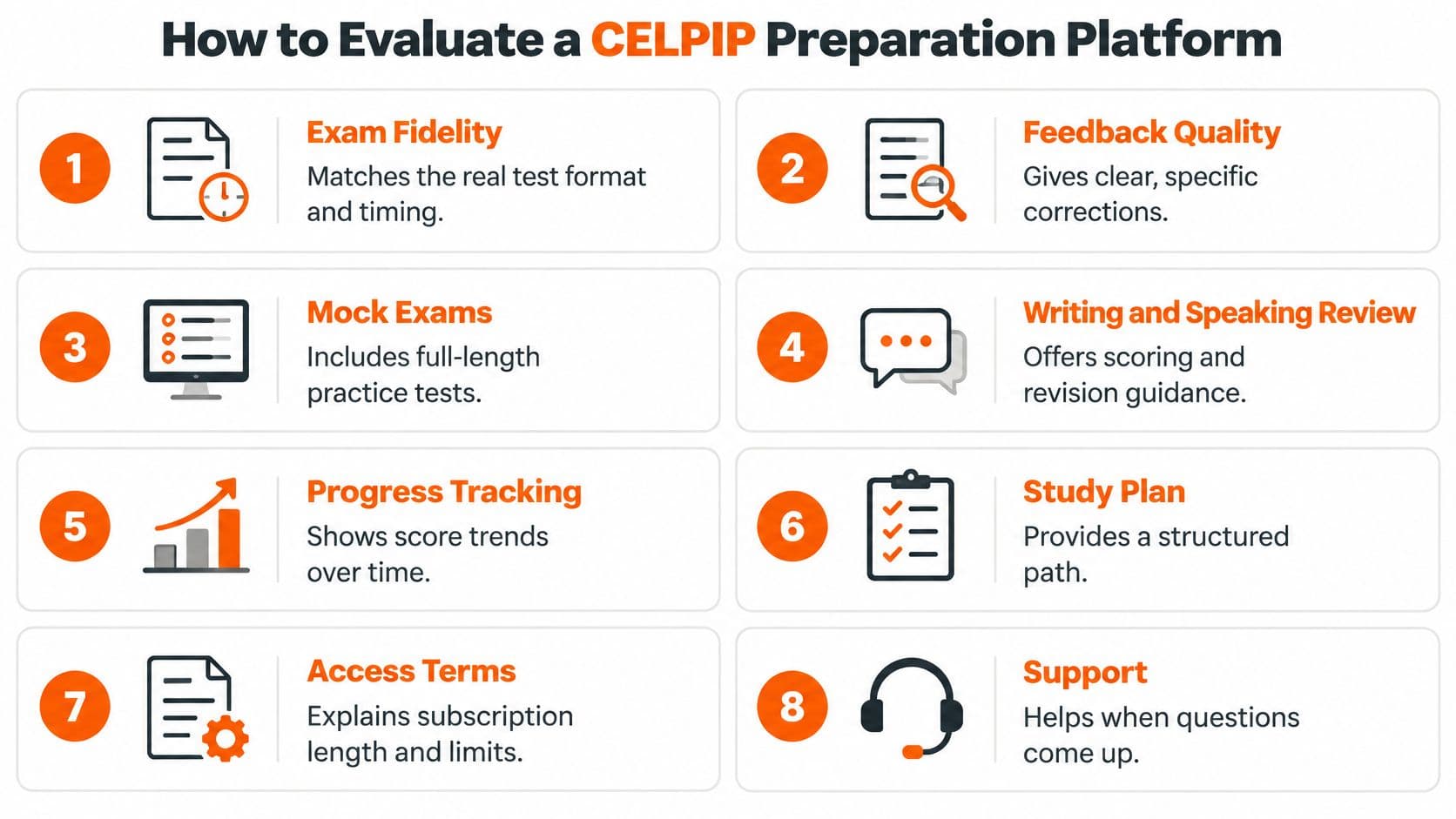
Start with this checklist, ranked by how directly each criterion affects realistic practice and actionable feedback.
| Criterion | What good looks like | Warning sign |
|---|---|---|
| Exam fidelity | Tasks, timers, and question types match the four components | Generic quizzes with no timers |
| Feedback | Comments tied to your response and CELPIP criteria | One-line grades or templated praise |
| Mock exams | Full-length, timed sittings covering all four skills | Only short practice sets |
| Writing and Speaking review | Typed writing and recorded speaking with rubric-based notes | Reading and Listening practice only |
| Progress tracking | Component-level scores and trends over time | A single overall score |
| Study plan | Time allocated by weakest component toward a stated target | One fixed course with no diagnostic |
| Access terms | Clear free tier, plan lengths, renewal, and refund policy | Hidden renewal terms or unclear refund rules |
| Independence and data | Clear affiliation statement and plain list of data collected | Vague claims about official status |
Exam fidelity comes first. Check that the platform offers tasks for all four skills, uses the right question formats, and runs real countdowns. A practice set without a timer can help you review language, but it won't teach you to pace a timed response.
For feedback quality, look for comments that quote something you wrote or said and explain what to change. A band estimate alone doesn't tell you whether the issue is task completion, coherence, vocabulary, or grammar. Likewise, mock exams should let you complete all four skills in one timed sitting, not just a handful of disconnected drills.
Writing and Speaking review matters when you need to improve an actual response. Check for typed writing tasks, recorded speech, and specific revision guidance. Then inspect progress tracking: component-level results can show whether Writing is improving while Reading stays steady, whereas a single combined result can conceal the difference.
A useful study plan should begin with a diagnostic and direct time toward the skill farthest from your target. Before paying, read the access terms carefully. Confirm the free tier, plan length, renewal rules, and refund policy; you can also review the Celprep pricing information.
Finally, check independence and data handling. Celprep describes itself as an independent practice resource, and CELPIP is a registered trademark of Paragon Testing Enterprises. Celprep collects users' name, email address, username, password, account preferences, subscription information, and practice and progress data, including test responses, scores, and study activity.
Before subscribing, try this three-question check. Does a Writing task show a countdown matching the official limit? Does the feedback quote one of your sentences and name a CELPIP criterion? Does the provider state its affiliation and show renewal and refund terms before you pay? If any answer is no, pause before entering payment details.
Target Scores and What Each Band Means for Your Application
| CELPIP-General score | CLB level | Express Entry points per ability |
|---|---|---|
| 7 | CLB 7 | 4 |
| 8 | CLB 8 | 5 |
| 9 | CLB 9 | 6 |
| 10 or higher | CLB 10 or higher | 6 |
The IRCC language-test table maps CELPIP-General scores to CLB levels and Express Entry points per ability. The table shows why a one-band difference can matter: a score of 8 corresponds to CLB 8 and 5 points per ability, while a 9 corresponds to CLB 9 and 6 points. A score of 10 or higher remains in the 6-points-per-ability category shown there, although that higher result can still matter for a program's eligibility rules or your stated target.
Targets often apply to each skill separately. If you're aiming for a particular result across all components, one low score can set the pace even when the other three are already strong. Say your Reading, Listening, and Speaking scores are 9, but Writing is 8. Most of your practice time should go to Writing, because it's the component below your target; repeating work in the stronger skills is less likely to close the gap.
Plan by component: Your overall English ability isn't the planning unit. The score you need in each skill is.
IRCC accepts CELPIP-General results for several permanent-residence and immigration streams. Australia's Department of Home Affairs has also designated CELPIP for visa-related English proficiency purposes, so candidates studying outside Canada should check the exact requirement that applies to their own application. Use the CELPIP score calculator as a planning aid, then confirm the precise requirement on the relevant official source before fixing your target. Set that target before your diagnostic mock, so you can compare each component's result against it and build a weekly plan around the largest gap.
How Practice Builds Each of the Four Skills
The most useful practice asks you to produce an answer, inspect feedback on that answer, and try again. Watching strategy videos or reading tips can help you understand a task, but it won't show whether your own response is clear, complete, and well paced.
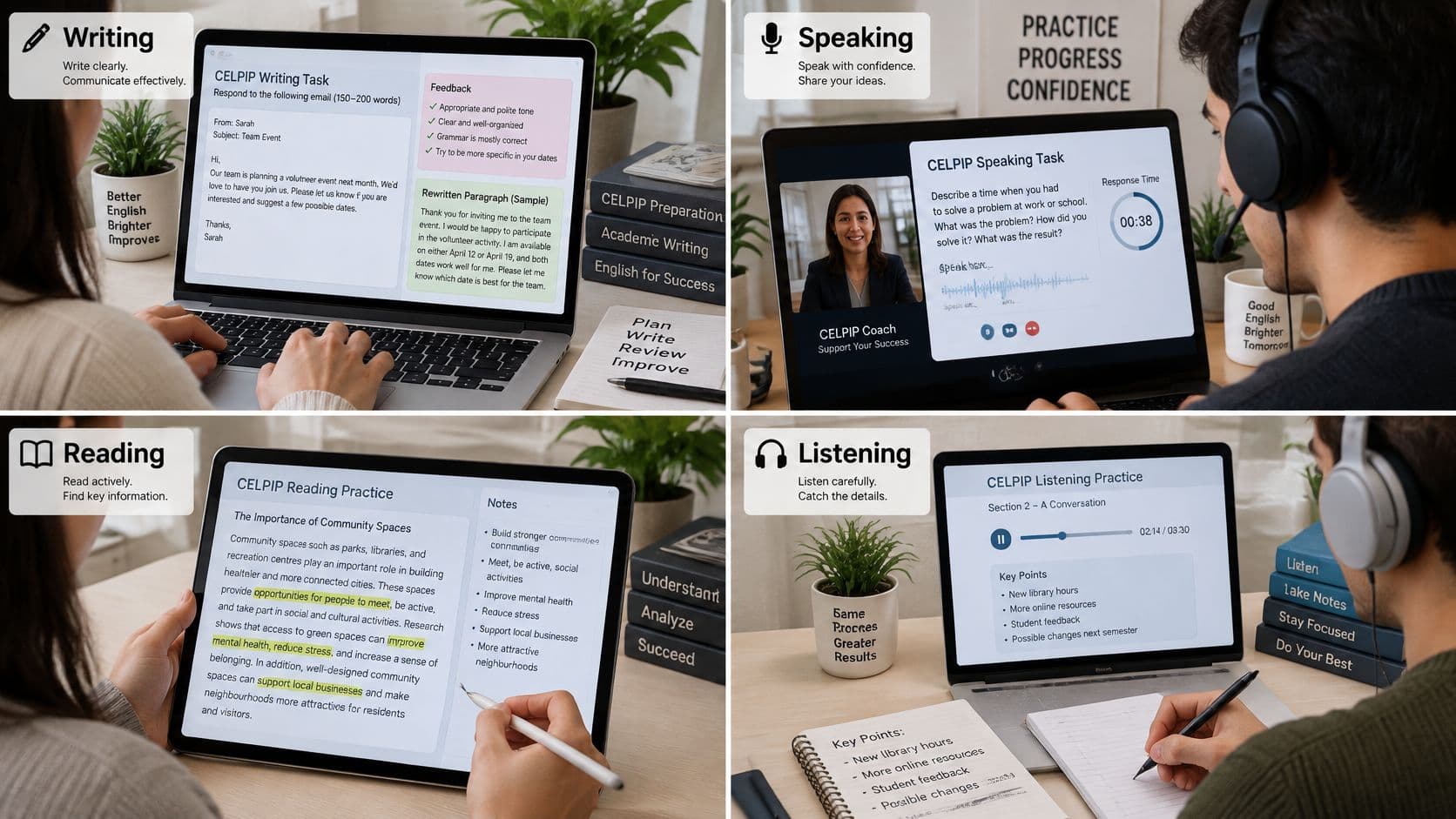
Writing
Draft a 150-to-200-word email reply under a timer. Afterward, review feedback on tone and grammar, then rewrite one paragraph to make its ideas connect more clearly. Don't just fix spelling: check whether you answered the task, used an appropriate tone, and organised information so the reader can follow it.
Speaking
Record a response to a prompt that asks for advice, a personal experience, or a prediction. Review whether you completed the task, whether your ideas were easy to follow, and whether your pronunciation and fluency made the message clear. Then answer the same prompt again after feedback. Comparing the two recordings makes changes easier to hear than relying on memory.
Reading
Work through timed passages about correspondence, diagrams, and viewpoints. When you choose an incorrect answer, don't just note the right option. Identify why your choice failed: perhaps it contradicted a detail, inferred more than the passage supports, or confused the writer's position with someone else's view.
Listening
Listen to conversations, announcements, and discussion scenarios at exam speed. Practise taking brief notes, then review the details you missed. If you lost a name, reason, or change of plan, identify whether the problem was attention, unfamiliar vocabulary, or trying to write too much while the recording continued.
A repeatable routine keeps practice focused: attempt one item, review its feedback, then redo one item. Writing and Speaking improve through repeated attempts because you can apply specific corrections to your own language. For Reading and Listening, keep a simple error log so you can spot recurring problems and choose the next drill accordingly.
A short demonstration can help you understand the sequence of practice. Watch the video, then apply the same attempt-review-redo routine to a task of your own.
What Feedback Can and Cannot Predict
A common assumption is that a practice score predicts the official result. It doesn't. Official CELPIP Writing and Speaking responses are scored by qualified raters trained to apply standardised rubrics, as the CELPIP test-results information explains. Automated practice feedback can help you identify patterns, but it isn't an official score or a guarantee of what a rater will award.
This distinction matters most when you're close to a target. A response may sound fluent and still fall short of the next band if it doesn't fully complete the task, uses an unsuitable tone, or loses coherence. Task completion, appropriateness, coherence, vocabulary, grammar, fluency, and pronunciation interact, so a single band estimate can hide what needs attention.
What useful feedback looks like
At a borderline level, look for an explanation tied to the scoring criteria, not just a number. Strong feedback should point to a specific sentence or phrase, explain why it weakens the response, and show an annotated revision. A likely score range is more honest than a promise of one exact result, and a pronunciation check should use a clear recording of your own speech so you can judge intelligibility rather than guess from a written transcript.
If your Writing or Speaking estimate is close to the target, repeat the same task after revising one or two specific habits. Changing everything at once makes it hard to tell which correction helped. For a response that sounds polished but may not have addressed every part of the prompt, make task completion your first review question.
Accessibility and next steps
IRCC notes that some applicants may be unable to complete one or more language abilities because of a physical or mental disability, even when reasonable accommodations are provided. If you need accommodations, check the available options early and practise under the setup you expect to use, including assistive technology and recording conditions. Use full mocks to rehearse realistic timing and cognitive load, and check that your recordings have clear audio.
If practice estimates stay within one band of your target across several full mocks, continue practising and watch the component-level trend. If a gap persists after three or more targeted attempts, seek a second opinion from a qualified tutor and review the official reevaluation options before paying for a retake.
Mock Exams and Timed Practice Routines
Start with a diagnostic full mock in your first week of preparation. Complete all four components in one sitting of roughly three hours, using the official timing closely: Listening takes 46–55 minutes, Reading 43–56 minutes, Writing 53 minutes, and Speaking 15 minutes. A CELPIP mock-test practice guide can help you organise the session and practise the exam sequence.
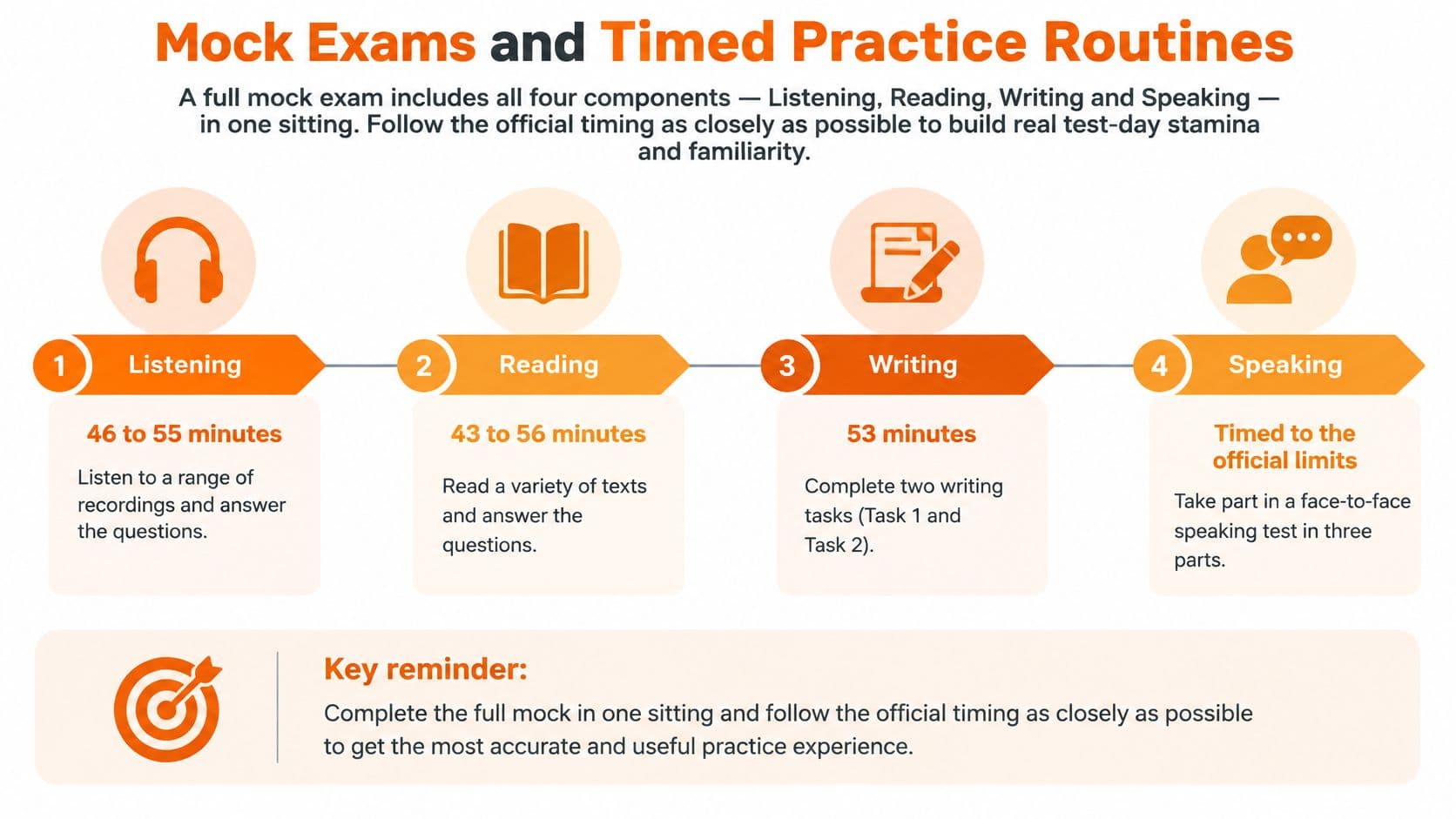
Follow one mock schedule from the baseline through test day:
- Week one: Take a diagnostic mock and record a separate starting score for each component.
- Every two weeks: Sit another full mock while using the days between attempts for focused drills on weaker skills.
- Final three weeks: Run one full mock each week to check whether your pacing and component scores are moving toward your targets.
- Five to seven days before the exam: Take your last full mock to rehearse concentration and timing without leaving it until the final stretch.
After each attempt, log three things for every component: the score or practice estimate, the task where time ran out, and the error type that repeated. For example, note that you missed a reading inference question because you chose an answer that went beyond the passage, rather than writing only “Reading needs work.” That detail gives your next practice session a clear purpose.
Keep the mock realistic: Untimed practice can build familiarity, but it can't show whether you can finish within the test limits.
Avoid three common mistakes: taking every mock untimed, reviewing only an overall result, and changing too many habits before your next attempt. Choose one or two specific corrections, practise them between mocks, then check whether they hold up in the next full sitting. Because a full exam tests concentration as well as language, give yourself time to recover between attempts instead of treating every mock as another daily drill.
Build a Four-Skill Plan and Start Practice This Week
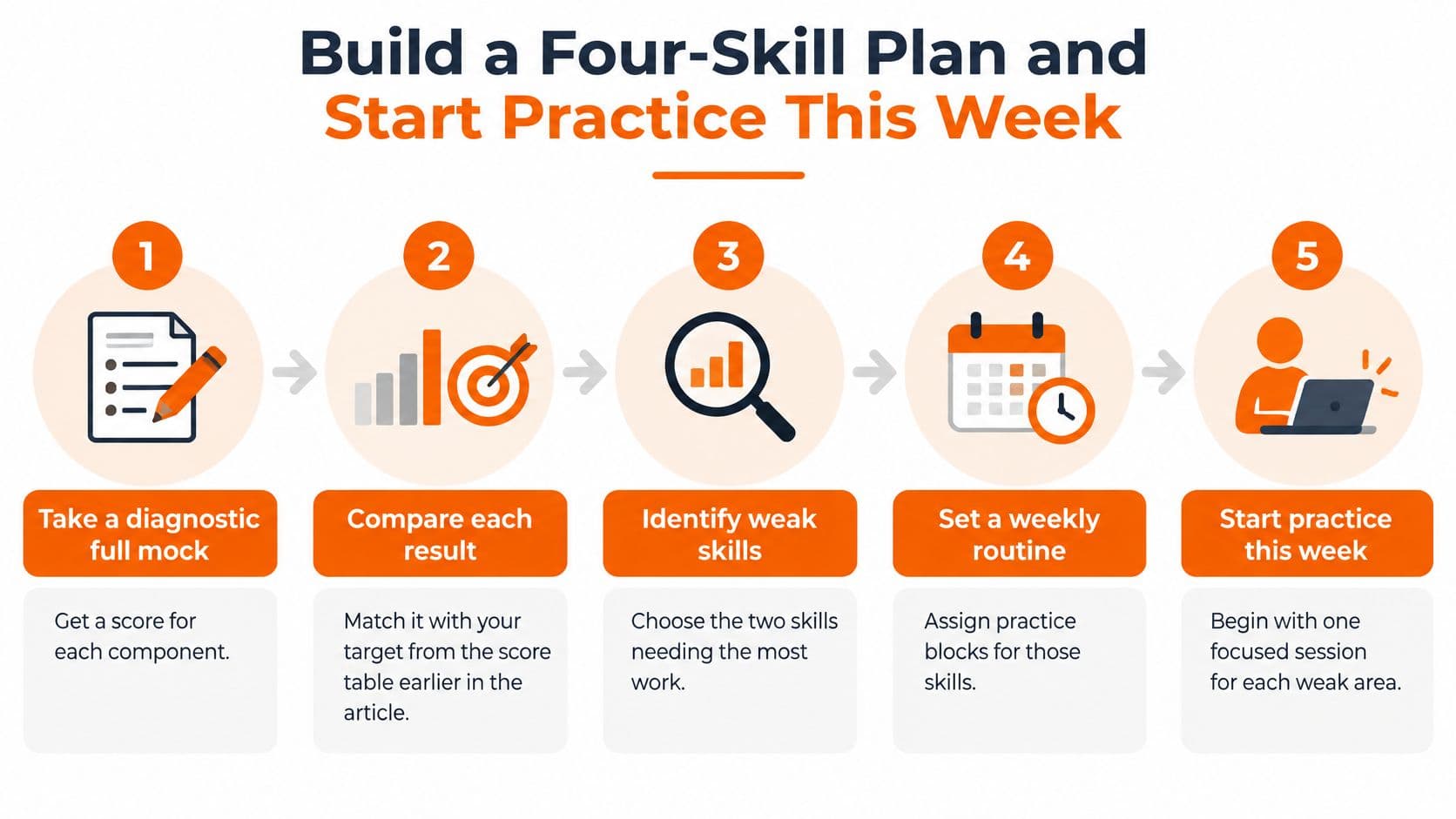
Take a diagnostic full mock first. You need a separate baseline for Listening, Reading, Writing, and Speaking before you can decide where each study session will do the most good.
- Take the diagnostic: Complete all four components under timed conditions and record each result separately.
- Compare results with your target: Match each component against the score you need for your application or professional goal.
- Allocate study time: Give your weakest skill about 40 percent of weekly practice time, and divide the remaining time roughly evenly among the other three.
- Set a weekly task for each skill: Choose one focused task per component, then review its feedback before moving on.
- Use the mock schedule: Put your full mocks on the schedule established in the mock-exam section rather than creating a competing routine.
- Review and adjust weekly: Keep the most time on the component with the largest remaining gap, and reallocate if another skill becomes the priority.
Before you pay for a platform, check its free access, plan length, renewal terms, refund rules, and data practices. Confirm the renewal and refund details in writing so you know what will happen after subscribing. Celprep offers four specialist coaches for Writing, Reading, Speaking, and Listening under one unified plan, along with full-length mock tests. Celprep reviews refund requests and responds within 24–72 hours.
Finish this week with three concrete actions:
- Diagnostic: Book or complete a timed mock and save your component-level results.
- Targets: Write down the score you need in each skill.
- Schedule: Put your first week of practice sessions and feedback reviews in your calendar.
Build your routine around the component that needs the most attention, then use timed mocks to check whether your practice is transferring to full-test conditions. Celprep brings four specialist coaches, interactive practice, and full-length mock tests together in one platform. Visit Celprep to start practising with feedback on your own responses.