You've finished work, opened a CELPIP practice question, and started writing. Your ideas seem clear until the countdown gets low. Suddenly, you're choosing between finishing your answer and checking your grammar.
That's where a time online test series can help, but only if it trains the skills your exam requires. For candidates targeting stronger CELPIP results, a timer and a question bank aren't enough. You need realistic tasks, useful feedback, and a schedule that fits both your weaknesses and your test-day arrangements.
What a Time Online Test Series Includes
A time online test series is a set of screen-based practice tests completed under a countdown. It's designed to make exam conditions familiar before your official attempt.
Think of a flight simulator. Pilots don't just study the controls, they practise using them while managing competing demands. Similarly, timed practice asks you to understand instructions, choose an approach, produce an answer, and finish before time expires.
However, online delivery doesn't automatically mean exam-specific preparation. In a UNESCO survey covering 61 countries, 25% of respondent education systems reported conducting summative assessments online, while 15% reported organizing high-stakes examinations online. Putting an assessment on a screen and reproducing a particular examination are different jobs.
General test-series features versus CELPIP-specific requirements
| Feature | General test series | CELPIP-specific practice |
|---|---|---|
| Timing | Fixed countdown per quiz | Component timing matched to CELPIP Listening, Reading, Writing and Speaking |
| Task types | Multiple choice and generic essays | Email and survey writing tasks, plus advice, experience and prediction speaking tasks |
| Scoring | Percent correct or a pass mark | CELPIP 1-12 scale reported for each component |
| Feedback | Answer key and short explanation | Criterion feedback on task fulfillment, coherence, vocabulary and grammar |
| Test version | One general mock exam | Separate plans for CELPIP-General and CELPIP-General LS |
| Progress tracking | Total score history | Component-level trends and recurring error patterns |
Read features as training decisions
Each row changes what you practise. Timing determines pacing, task types determine what you produce, and scoring determines how you interpret progress.
A generic essay may develop English, but it won't necessarily teach you to answer a practical email prompt completely. Use the provider checklist at the end to distinguish useful general practice from preparation that matches your CELPIP needs.
Matching Timing and Format to the Real CELPIP Test
Run the simulation like test day: one sitting, no pauses, no dictionary. According to the official CELPIP test-format information, CELPIP-General assesses Listening, Reading, Writing and Speaking in about three hours, with Listening at approximately 46-55 minutes, Reading at 43-56 minutes, Writing at 53 minutes, and Speaking at 15-20 minutes.
That load makes transitions part of the skill. After a difficult Listening set, practise closing it mentally and opening Reading with full attention instead of replaying the answer you missed.
CELPIP-General components, timing and what a practice series must copy
| Component | Time in the real test | Task types | What a practice series must copy |
|---|---|---|---|
| Listening | About 46-55 minutes | Conversations, announcements and discussion scenarios | Exam-style audio with matching question sets and time limits |
| Reading | About 43-56 minutes | Correspondence, diagrams and viewpoints | Timed passages with the same question types |
| Writing Task 1 | 27 minutes | Email writing | The email prompt, required points, response-length guidance and task countdown |
| Writing Task 2 | 26 minutes | Survey response choosing one option | Option selection, supporting reasons, response-length guidance and task countdown |
| Speaking | 15-20 minutes total, with separate preparation and response timers for each task | Advice, experience and prediction responses | Recorded responses with pronunciation and fluency feedback |
For Writing and Speaking, keep the two clocks separate. Preparation time is for planning the answer, while response time is for producing it, so a practice tool should never merge them into one unrestricted recording window.
Match your test version
The CELPIP test-taker guidebook distinguishes CELPIP-General from CELPIP-General LS, which assesses only Listening and Speaking. An LS candidate needs a calendar that drops Reading and Writing blocks rather than shrinking a full General plan.
Use the official free sample test to inspect the interface, instructions, timing and question types, including the Listening and Reading answer information. Then build a calendar for the version you booked.
Practical rule: Match each practice block to the component it trains, including its response format and permitted timing.
Set up a quiet workspace, use an on-screen countdown, and record Speaking responses through a headset microphone. Do not pause a simulation to check vocabulary or restart an awkward sentence. Stop the clock only where the official format or your approved accommodation permits it.
Why Timed Practice Builds Recall Under Pressure
Retrieving information is like reaching for a particular book on a shelf. Rereading is more like looking along the spines: you recognize what's there, but you haven't proved you can find and use it when needed.
Keep that distinction in mind when you study.

A meta-analysis of practice testing found a statistically significant moderate advantage over restudying, with a weighted mean effect size of g = 0.51. That supports active retrieval, but it doesn't mean that adding a countdown automatically improves learning. The task still needs to exercise the knowledge and response skills you'll use.
Start with a task you can inspect
Say you practise several complaint emails, each with a different situation. You must identify the problem, explain its effect, and request an appropriate solution without copying a complete model answer.
After a delay, try a fresh complaint prompt. If you can organize it independently, you've learned a reusable approach rather than memorized an answer.
- For Reading and Listening: Retrieve decision rules, such as checking whether an answer matches the speaker's meaning rather than merely repeating a familiar word.
- For Writing and Speaking: Produce a relevant response from a new prompt, using vocabulary and structures you can control.
- For full mocks: Combine those processes once individual tasks feel manageable.
For ways to organize active recall alongside other techniques, use these practical study methods.
You can also use video during a study break, then return to an active task rather than stopping at watching.
Choose realistic prompts over unrelated quizzes. You need practice transferring an approach to unfamiliar content, not recognizing questions you've already answered.
How Feedback Turns Practice Scores into Progress
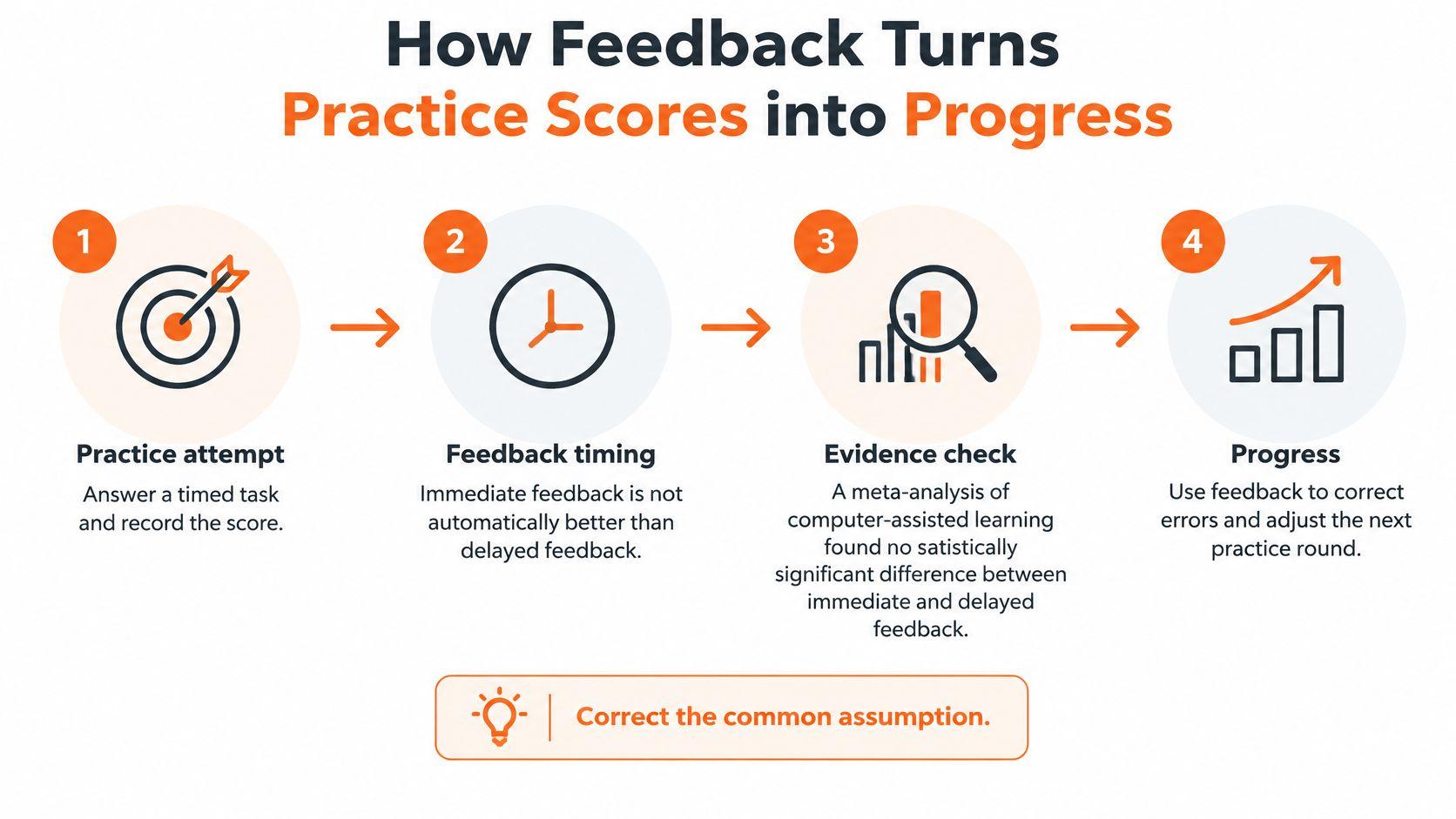
Immediate feedback isn't automatically better than delayed feedback. A meta-analysis of computer-assisted learning found no statistically significant average difference between them, with g = 0.03, 95% CI [-0.08, 0.13].
The useful question is what you can do with the feedback. A comment such as improve your grammar leaves you guessing. A diagnosis that identifies inconsistent past tense and asks you to revise the event sequence gives you a concrete next action.
Use a repeatable correction loop
- Complete a timed response. Save the original so you can distinguish what you produced independently from what you corrected afterward.
- Read the criterion-level diagnosis. Identify whether the main issue is task fulfillment, coherence, vocabulary, grammar, pronunciation, or listening-detail accuracy.
- Revise the response or replay the relevant task. Make the correction yourself rather than accepting a replacement answer without understanding it.
- Attempt a similar task targeting the same criterion. Change the content so success requires applying the correction, not remembering the previous answer.
- Check the component trend rather than the total score. Look for fewer repeated errors across independent attempts.
Suppose your Writing results look healthy while pronunciation feedback keeps deteriorating in Speaking. A combined dashboard average might appear reassuring even though your spoken responses need focused attention.
Listen to the recording and locate the actual difficulty. Are key words unclear, are endings disappearing, or are pauses splitting sentences in confusing places? Work on the identified issue instead of adding more advanced vocabulary to an already difficult response.
Feedback becomes useful when you can name the change you'll make on your next attempt.
Keep a simple log containing the component, weakest criterion, example error, and next action. For Listening, that might be missing a correction the speaker makes after stating an initial plan. For Writing, it might be omitting a required request.
Revisit the criterion after several days. Correcting an answer while the explanation is still visible shows understanding in that moment; applying the correction later provides a more demanding check of learning.
Reading Your Score and Calibrating Practice Results
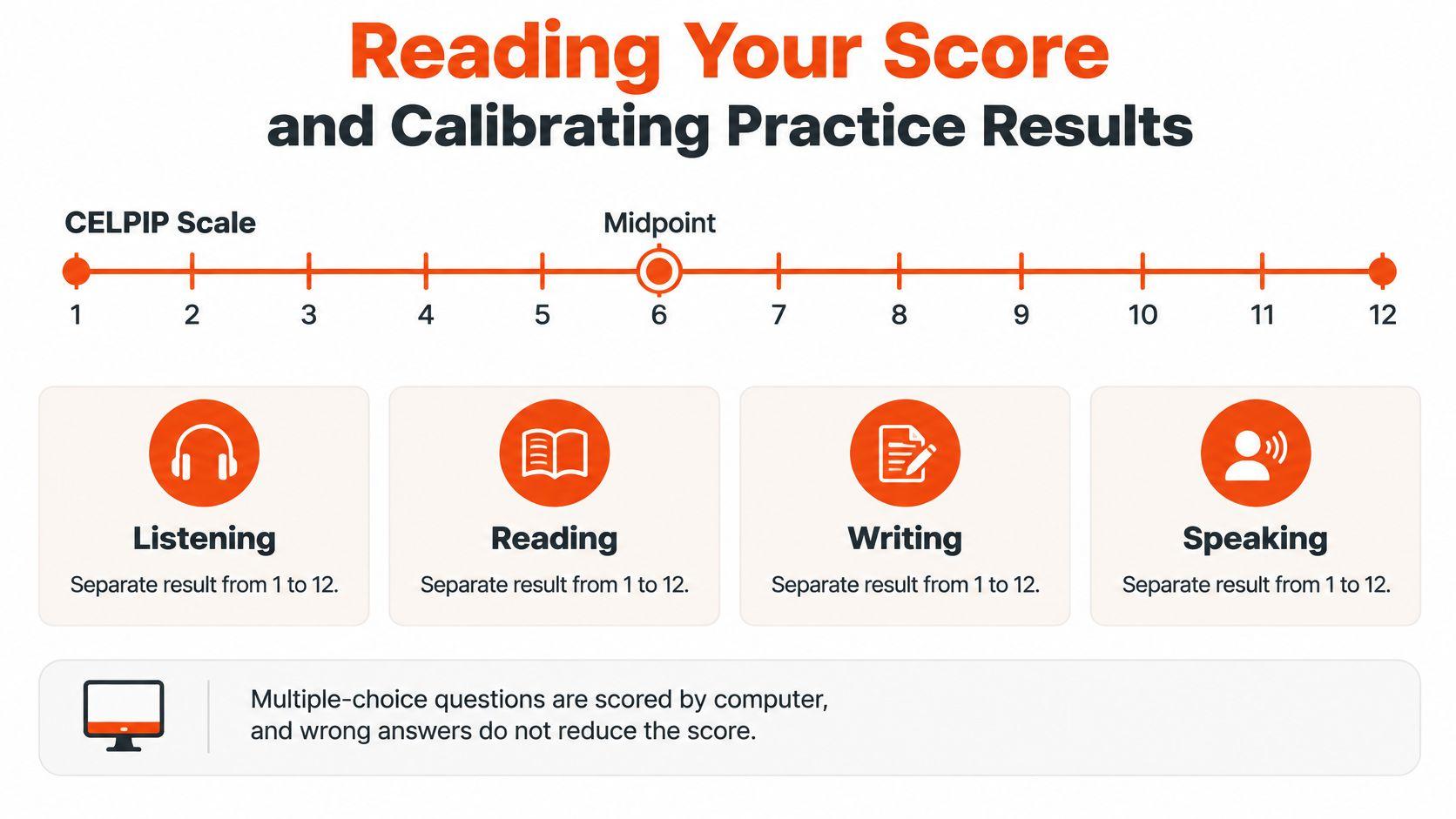
Treat a practice score like a training-room thermometer: useful for spotting trends, while the official exam remains the certified measurement. According to the CELPIP scoring and level descriptors, results run from 1 to 12, with separate component results; multiple-choice questions are computer-scored without deductions for wrong answers, while Writing and Speaking are evaluated by at least three certified raters.
The same document describes Level 9 as effective proficiency in some high-stakes social, educational or workplace contexts, and Level 10 as highly effective proficiency in those contexts.
When practice and official results disagree
Suppose your mock estimate says Level 10 and the official report says Level 8. Check the testing conditions before deciding either number is strange: a repeated prompt, an untimed second try, an edited draft, or a familiar topic can lift a practice estimate. A scorer may also miss a required email point or reward polished grammar while task completion stayed weak.
- Compare independent attempts: Separate fresh timed responses from edited submissions.
- Classify the gap: Distinguish language errors from task-completion failures, such as missing a required email point.
- Flag uncertain judgments: Ask a qualified human reviewer to inspect a large or persistent disagreement.
- Interpret ranges carefully: A spread across repeated mocks shows observed variation, not a statistically validated confidence interval.
Use a CELPIP score calculator to test how component results might combine, while keeping certified results as the reference point.
If the same weakness keeps appearing across fresh attempts, another targeted cycle usually helps more than booking again immediately. If one assessed component looks inconsistent with evidence you can point to, review the official options calmly instead of treating a higher practice estimate as proof.
Accommodations and Deadlines to Plan Around
CELPIP asks for at least two months' advance notice for special-accommodation requests and supporting medical documentation issued within the previous two years, according to its official contact and accommodation guidance. Treat that as an early planning task, not something to investigate after completing your study schedule.
Official guidance also affects re-evaluation and registration planning. Keep those rules beside your practice appointments so an administrative deadline does not undermine an otherwise sensible plan.
Official CELPIP planning deadlines
| Requirement | Rule | How to plan |
|---|---|---|
| Accommodation request | At least two months of advance notice | Set the request date in your calendar before choosing a study start date |
| Supporting documentation | Medical documentation issued within the previous two years | Check the issue date before you apply |
| Component re-evaluation | Re-evaluation may be available for assessed components | Keep a dated log of mock and official scores |
| Test session registration | Registration rules may limit how close together sessions can be booked | Confirm the session before fixing your practice schedule |
Think of the calendar as the frame around your preparation. The practice exercises are the work inside it, but the request, documentation, approval and booking dates decide which conditions that work should prepare you for.
Build an accommodation-aware calendar
A standard-condition plan follows the usual exam arrangement. An accommodation-aware plan follows the arrangement the test provider approves for you.
More timed mocks can work against you if you repeatedly rehearse conditions that do not match your approved test. Don't assume that a particular adjustment will be granted either.
- Confirm your needs early. Follow the official provider's contact process to establish whether your circumstances fall within its accommodation process.
- Gather current documentation. Check the issue date and required supporting information before submitting.
- Submit before the notice deadline. Allow room in your calendar for communication rather than treating submission as approval.
- Practise with permitted arrangements. Use adjusted timing, equipment or other conditions only as authorized for your test.
- Interpret pacing appropriately. Evaluate how well you complete the task under your approved conditions, not whether your pace matches another candidate's.
A simple planning test helps here. If a change in timing or equipment would not be present on test day, do not make it the centre of your preparation. The goal is to automaticate the skills you can carry into the approved setting: reading quickly, listening for structure, answering each task fully and speaking within the response time.
Planning reminder: Keep the request, approval and test confirmation together so your practice setup reflects the arrangement actually granted.
Check the official contact page for current requirements before booking. Keep re-evaluation and registration dates visible alongside the accommodation process, particularly if you're planning another attempt.
Choose a Series and Start Your First Week
Choose a series by what it lets you practise and improve, not by the size of its question bank alone. Open a sample exercise, inspect the feedback, and check whether you can identify a specific next action.
Use this checklist before committing:
- Correct version: Does the schedule match CELPIP-General or CELPIP-General LS?
- Realistic timing: Are component and task countdowns reproduced?
- Relevant formats: Are you answering CELPIP-style prompts rather than generic language quizzes?
- Actionable feedback: Can you identify the criterion and the correction?
- Separate progress records: Can you inspect each component instead of relying on a combined average?
- Saved history: Will your responses and progress remain available if paid access lapses?
Give your first week a clear purpose
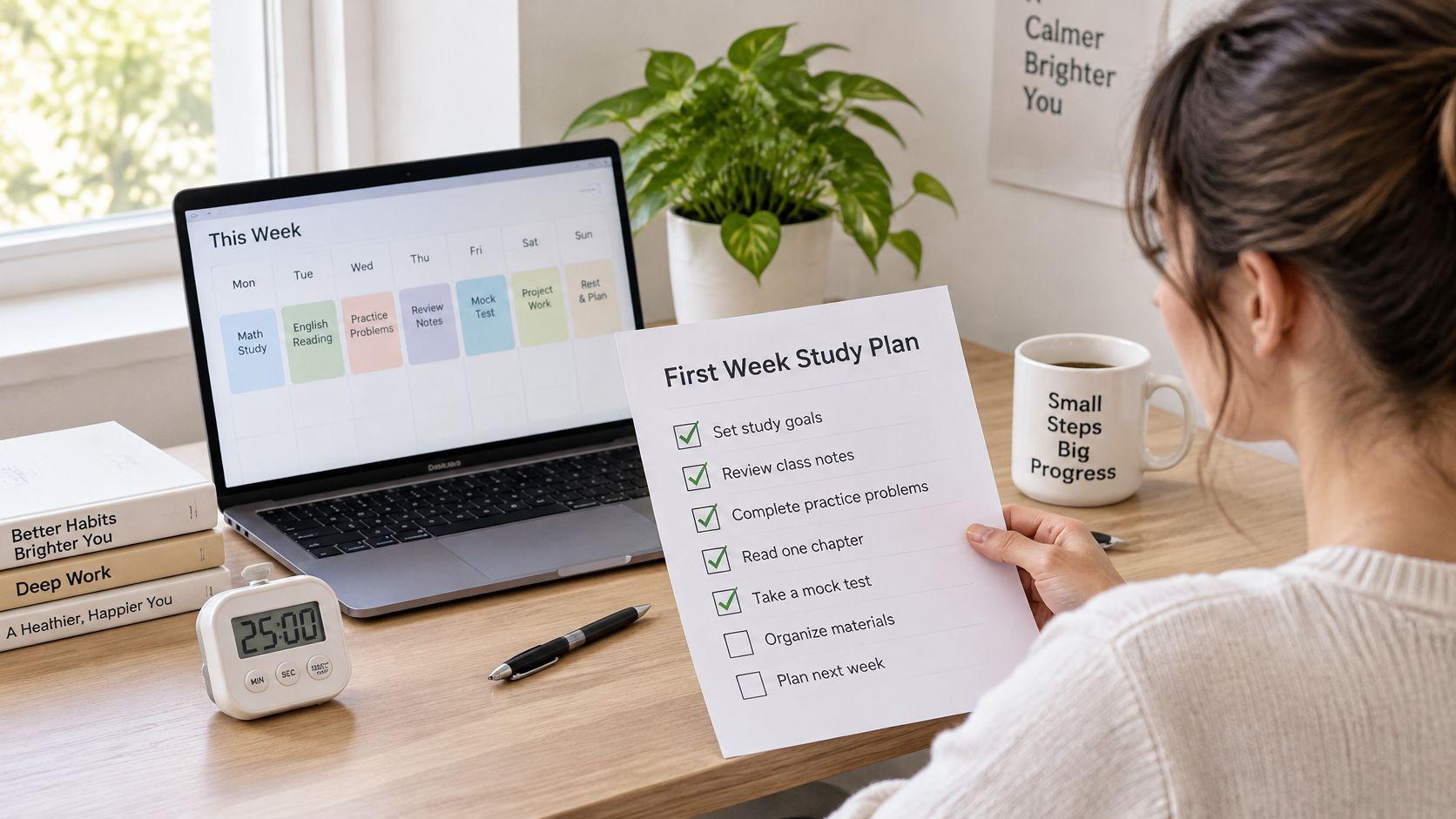
Use this seven-day starter plan as a practical schedule, adjusting the workload to your test version and approved conditions:
| Day | Practice focus |
|---|---|
| Day 1 | Complete a diagnostic task in each assessed component |
| Days 2-5 | Target the weakest component with short timed tasks and revisions |
| Day 6 | Complete a full timed mock if you're ready for sustained practice |
| Day 7 | Review component trends and select the next criterion to improve |
If you're still struggling to understand instructions, use the mock appointment for guided component practice instead. A full simulation is a checkpoint, not a substitute for learning how to complete the tasks.
Celprep is an independent preparation option to evaluate with this checklist. Our signup takes 30 seconds and gives instant exercise access; the free plan includes 1 exercise per task type across Writing, Reading, Listening and Speaking, 3 starter templates, one vocabulary bundle per section, and 3 submissions per day. All paid plans include 3,000+ real exam-style questions, full mocks under real test timing, and task-specific templates and vocabulary; practice history remains saved when paid access expires.
Confirm current plan details before signing up. If you need help deciding between self-directed practice and additional guidance, consider these online CELPIP coaching options.
The checklist works with any provider. Pick a series that meets your needs and start your diagnostic today.
Celprep offers timed CELPIP mock tests, task-specific exercises and personalized automated feedback so you can practise under a countdown and identify what to change. Visit Celprep, try a diagnostic exercise, and use the result to choose your next focused practice task.