Celprep offers a free tier and three paid plans: $14.99 for 7 days, $29.99 for 30 days, and $69.99 for 90 days; subscription prices can change. But does the lowest advertised mock-test price buy the practice you will use before your exam?
That's the question a useful price comparison should answer. Someone searching for T.I.M.E. mock test series price may be comparing a fixed bundle of CAT mocks, while a CELPIP candidate may need timed practice and feedback over a particular study window. Before comparing amounts, identify what you're buying, how long you can use it, and whether the price covers explanations or just access to questions.
Celprep Plan Prices at a Glance
Our paid plans provide unlimited practice over different access periods. The main choice is therefore how long you need access, rather than which question package to select.
The Weekly plan covers a short preparation sprint. Monthly gives you more time to diagnose weaknesses, revise responses, and practise under timed conditions. Quarterly requires more money upfront but has the lowest daily cost across the paid options.
Celprep plan prices and cost per day
| Plan | Price | Access period |
|---|---|---|
| Free | $0, no paid daily rate | Free-tier access, 3 submissions per day |
| Weekly | $14.99, about $2.14 per day | 7 days of unlimited practice |
| Monthly | $29.99, about $1.00 per day | 30 days of unlimited practice |
| Quarterly | $69.99, about $0.78 per day | 90 days of unlimited practice |
How the daily figures work
Divide the total plan price by the included days:
- Weekly: $14.99 ÷ 7 = approximately $2.14 per day.
- Monthly: $29.99 ÷ 30 = approximately $1.00 per day.
- Quarterly: $69.99 ÷ 90 = approximately $0.78 per day.
These are comparison figures, not separate daily payment options. You pay for the selected plan, and the calculation spreads that cost across its access period.
Quarterly is labeled Most popular on our pricing page. That label doesn't make it the right purchase for every learner. If your exam is close, paying for access that extends well beyond your preparation window may not help you.
Lower daily cost versus lower total spend
A working professional who can practise regularly over a longer period may benefit from the lower daily rate. A candidate who only needs a brief final rehearsal may prefer a smaller upfront payment.
Don't confuse available days with days you'll study. A subscription can provide access throughout the week, but your work schedule, family commitments, and review habits determine how much of that access you use.
The dollar symbol also needs attention. Our prices are reproduced as $, while the official practice catalog below explicitly uses CA$. Don't treat an unlabeled dollar amount as Canadian dollars or assume a USD-to-CAD conversion without confirming the billing currency in your account.
Buying rule: Choose the shortest plan that covers your preparation window, then confirm the live price and billing currency at checkout.
Subscription prices can change without notice. Check the amount shown inside your account before buying rather than relying on an old screenshot, saved comparison, or previous purchase.
Why Mock Series Prices Look Inconsistent
T.I.M.E.'s AIMCAT listings span ₹1,750–₹8,750 including GST, with 30–135 full-length mocks, according to MBAUniverse's 2026 T.I.M.E. study-material comparison. The OnlineCoaching4U comparison identifies the entry package as ₹1,750 for 30 full-length mocks and the largest as ₹8,750 for 135 full-length mocks plus 80 mocks for other management examinations.
The arithmetic explains most of that spread. Divide each price by its CAT mock count and the entry package works out to ₹58.33 per mock, while the largest package costs ₹64.81 per AIMCAT. Include the 80 additional mocks for other exams and the figure drops to ₹40.70 per test. The same series looks cheap or expensive depending on which tests you count.
Package contents widen the gap further. AcademyCheck's CAT preparation comparison describes a ₹12,250 correspondence package containing 22 AIMCATs, 100 sectional tests, 12 OMETs, books, and discussion videos. That sticker covers a full study bundle, so placing it beside a mock-only fee compares different products, much like pricing a course-and-textbook set against a stack of practice papers.
Read the contents before the headline price
- Count complete exams: Sectional exercises and full-length mocks are different units, so compare like with like.
- Separate extras: Identify books, videos, explanations, and materials for other exams before judging the price.
- Check taxes: Confirm whether GST is included in the displayed amount.
- Read validity: Find the expiry date, not just the test count.
These listings are snapshots of different products, not interchangeable offers. Confirm the provider's current package before paying, especially when a search result doesn't name the exact plan.
Official CELPIP Practice Tests Compared on Cost
A fixed practice bundle answers a different question from a subscription. A bundle tells you how many tests you are purchasing; time-based access tells you how long you can use the included practice tools. Comparing them fairly means converting each price into a common unit first.
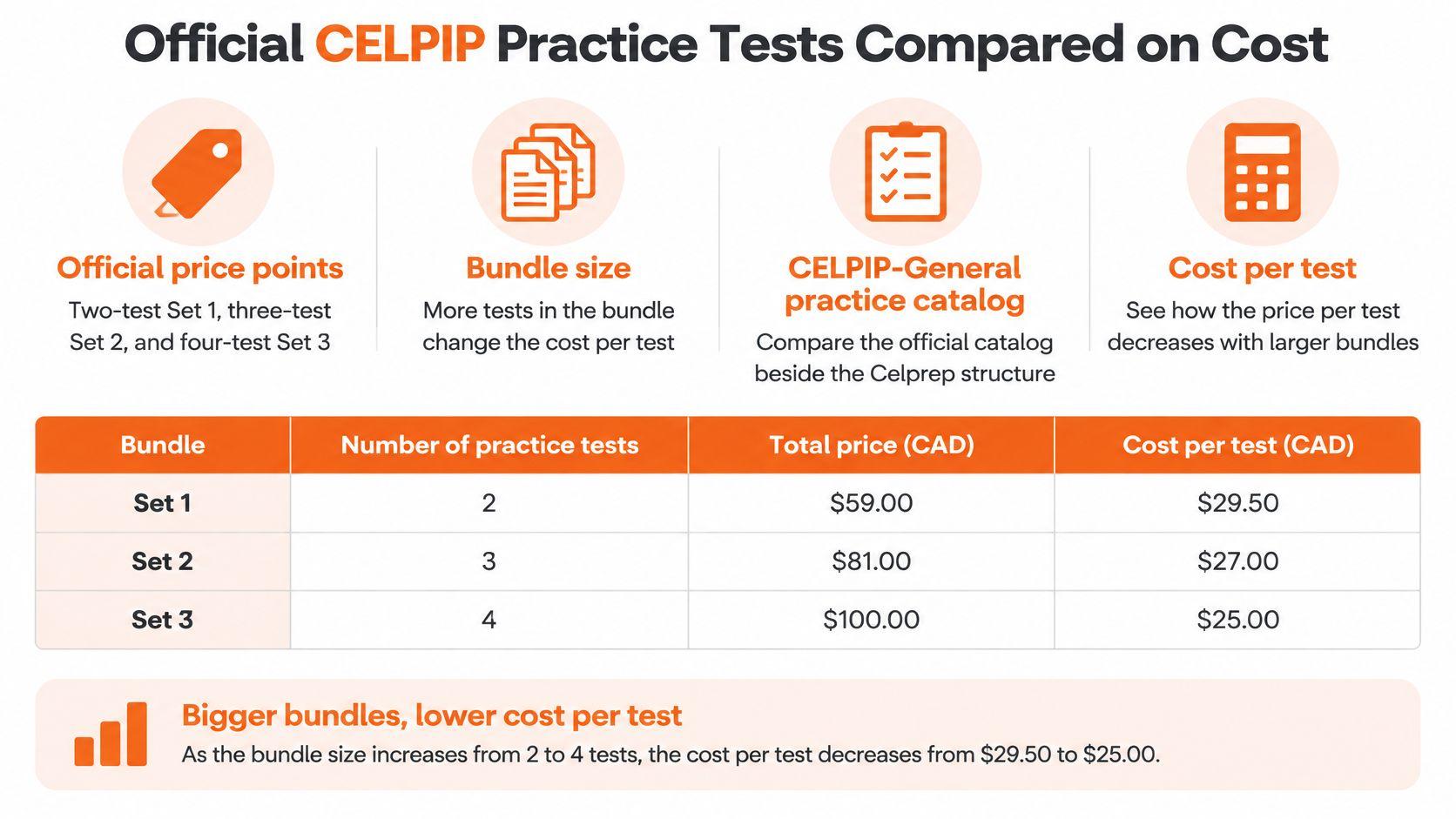
Official CELPIP practice tests are sold as fixed bundles, so their cost works out per test. Celprep sells access by the week, month, or quarter, so its cost works out per day. The visual below shows how bundle pricing commonly behaves as the test count grows.
Two access models, two units of cost
| Official practice bundle | Celprep subscription | |
|---|---|---|
| What the price buys | A fixed number of practice tests | Unlimited practice for a set number of days |
| Unit to calculate | Bundle price divided by test count | Plan price divided by days of access |
| What one unit covers | One complete practice test | Exercises, revision, or a mock exam within that day |
| Currency | Canadian dollars | US dollars |
What the arithmetic actually shows
For any bundle, divide the listed price by the number of complete tests inside. A larger bundle often lowers the per-test figure, but confirm that each entry counts as a full test rather than a set containing several. For a subscription, the same division uses days of access:
- Weekly: $14.99 over 7 days comes to about $2.14 per day.
- Monthly: $29.99 over 30 days comes to about $1.00 per day.
- Quarterly: $69.99 over 90 days comes to about $0.78 per day.
Longer plans lower the daily rate the same way larger bundles can lower the per-test rate. The key difference is what one unit contains.
Compare access, not unlike units
A purchased test is a defined practice form. A subscription day might hold exercises, response revision, or a timed mock exam, so a cheap per-test figure and a cheap per-day figure are not measuring the same thing.
Feedback varies between the two models as well. With any practice test purchase, check which sections are scored automatically and whether written and spoken responses receive detailed evaluation, so you know what the price covers before paying.
Before choosing, write down how many complete mocks you realistically intend to sit and review. Then consider whether you also need regular skill practice between them. Use the CELPIP test-booking guide to establish your exam date before committing to an access period.
Keep Canadian-dollar catalog prices separate from any USD-denominated offer. Until the billing currency is confirmed, a bare dollar symbol isn't enough to establish which option costs less.
What Each Celprep Plan Includes
The useful distinction between free and paid access is the kind of study routine each supports. Free access lets you try representative tasks; paid access supports a broader schedule of exercises, timed mocks, and revision.
Weekly, Monthly, and Quarterly provide the same core paid practice resources for different lengths of time. You don't need to choose a longer duration to obtain a different question library.
Free features
- Task samples: One exercise per task type across Writing, Reading, Listening, and Speaking.
- Starter templates: Three templates to help you understand response structure.
- Vocabulary: One vocabulary bundle per section.
- Submission allowance: Three submissions per day, with no credit card required.
Use those samples actively. Write an answer before reading a template, record a spoken response rather than rehearsing, and inspect the feedback before deciding whether the format suits you.
Paid features
- Practice library: All paid plans include 3,000+ real exam-style questions.
- Timed mock exams: Full-length practice follows real test timing.
- Task resources: Templates and vocabulary are customized for each CELPIP task.
- Exercise feedback: Paid access includes unlimited exercise feedback without daily caps.
The library and mocks serve different purposes. Individual exercises let you isolate a weakness, such as an unclear email request or difficulty interpreting a reading passage. Full mocks let you test whether you can apply those skills while managing the clock.
Templates are most useful as a planning aid, not as answers to reproduce regardless of the prompt. Check the situation, audience, and required points before choosing a structure.
Progress tools
- My Progress: Track improvement and identify what to work on next.
- Saved practice history: Your history remains saved after paid access expires.
- Renewal continuity: Renewing later lets you resume with your existing practice record.
A useful routine connects these tools: attempt a task, inspect the result, practise the specific weakness, and return to a comparable task. Completing more questions without reviewing the responses gives you less information about what to change.
Choose by workload, not curiosity alone. If your schedule requires timed full mocks and unrestricted exercise feedback, the free allowance won't cover that routine. If you only want to try a few tasks and inspect how feedback works, it may be sufficient before purchasing.
Feedback Quality Worth Comparing Beyond Price
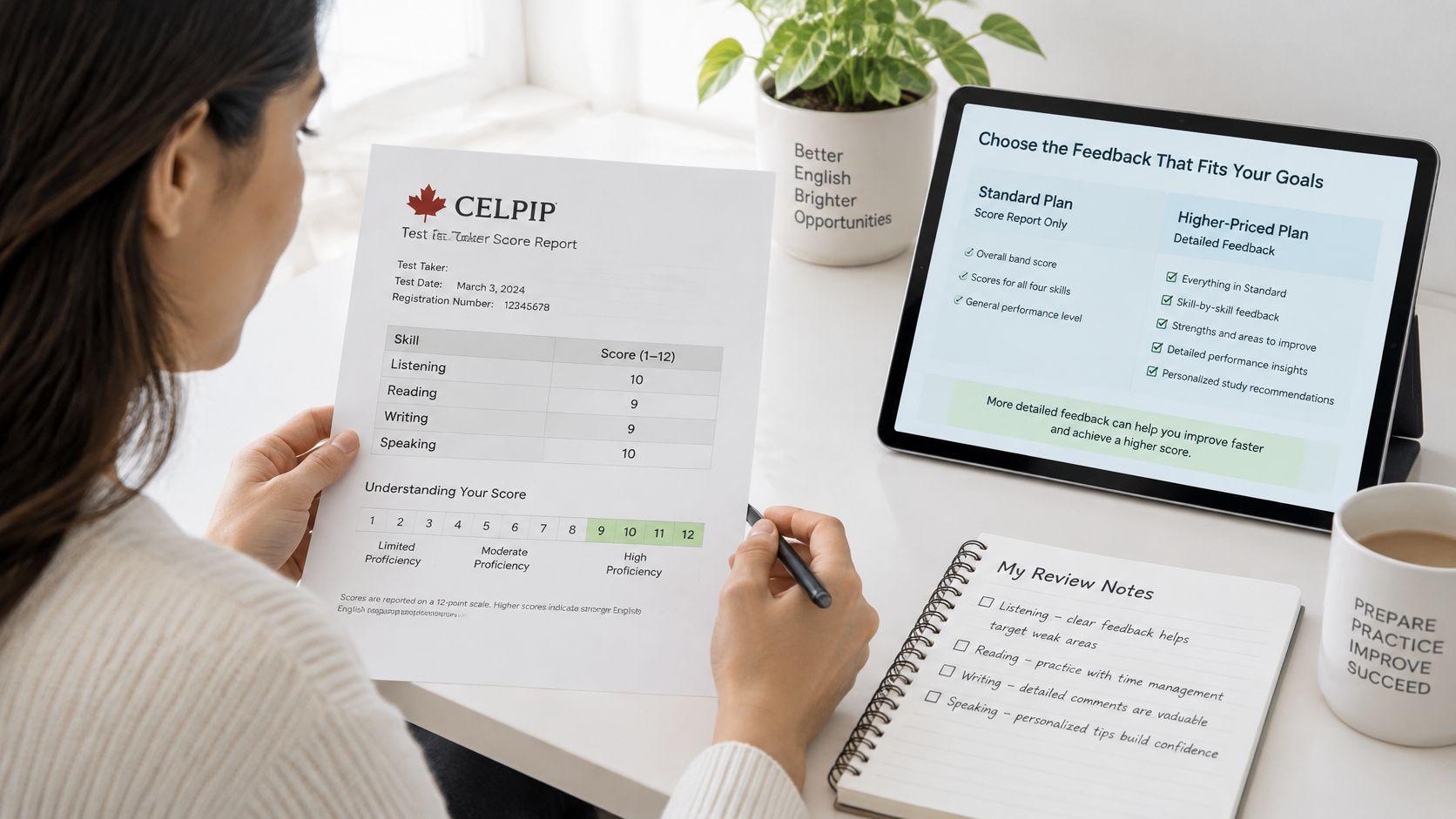
A mock-test score is useful only when you understand what it measures. The official CELPIP results guidance describes a 1–12 scale, an overall average calculation across the four skills, computer scoring for multiple-choice answers without deductions for wrong answers, and evaluation of Writing and Speaking by at least three certified raters.
Use your component results to decide what needs attention, rather than treating an overall figure as a complete study diagnosis.
Check feedback against the scoring dimensions
The official productive-skill dimensions are Content/Coherence, Vocabulary, Readability or Listenability, and Task Fulfillment. A useful practice review should help you understand your response through those dimensions, not merely attach a percentage or a generic instruction to improve your English.
Our AI feedback is trained specifically on CELPIP scoring criteria, including coherence, vocabulary range, grammar accuracy, and task completion. Each exercise response receives immediate, personalized feedback. That's preparation support, not an official score or a replacement for certified test raters.
- Content and coherence: Check whether ideas follow a clear sequence and support the response.
- Vocabulary: Look for precise, appropriate wording rather than unnecessary complexity.
- Readability or listenability: Review sentence control, clarity, pronunciation, and delivery as appropriate.
- Task fulfillment: Confirm that the response addresses every required part of the prompt.
A worked Writing example
Say an email task asks you to describe a problem with a purchased appliance and request a replacement. You explain the fault clearly and use appropriate grammar, but finish without asking the company to replace it.
The email may read smoothly while remaining incomplete. Criterion-level feedback should identify the missing request under Task Fulfillment, so your revision fixes the actual omission instead of merely replacing simple words with longer ones.
An answer key alone can't adequately diagnose that productive response. You need an explanation tied to what you wrote.
For another way to think about response review, use the accompanying video.
The Speaking coach applies response-specific review to recorded advice, experience, and prediction tasks, including pronunciation and fluency feedback. The Reading coach uses correspondence, diagrams, and viewpoint-analysis exercises to develop comprehension.
When comparing online CELPIP coaching options, ask what you'll do after receiving a result. Useful feedback gives you a revision action, such as adding the missing request, reorganizing an explanation, or making a spoken answer easier to follow.
How Plan Length Fits Your Study Timeline
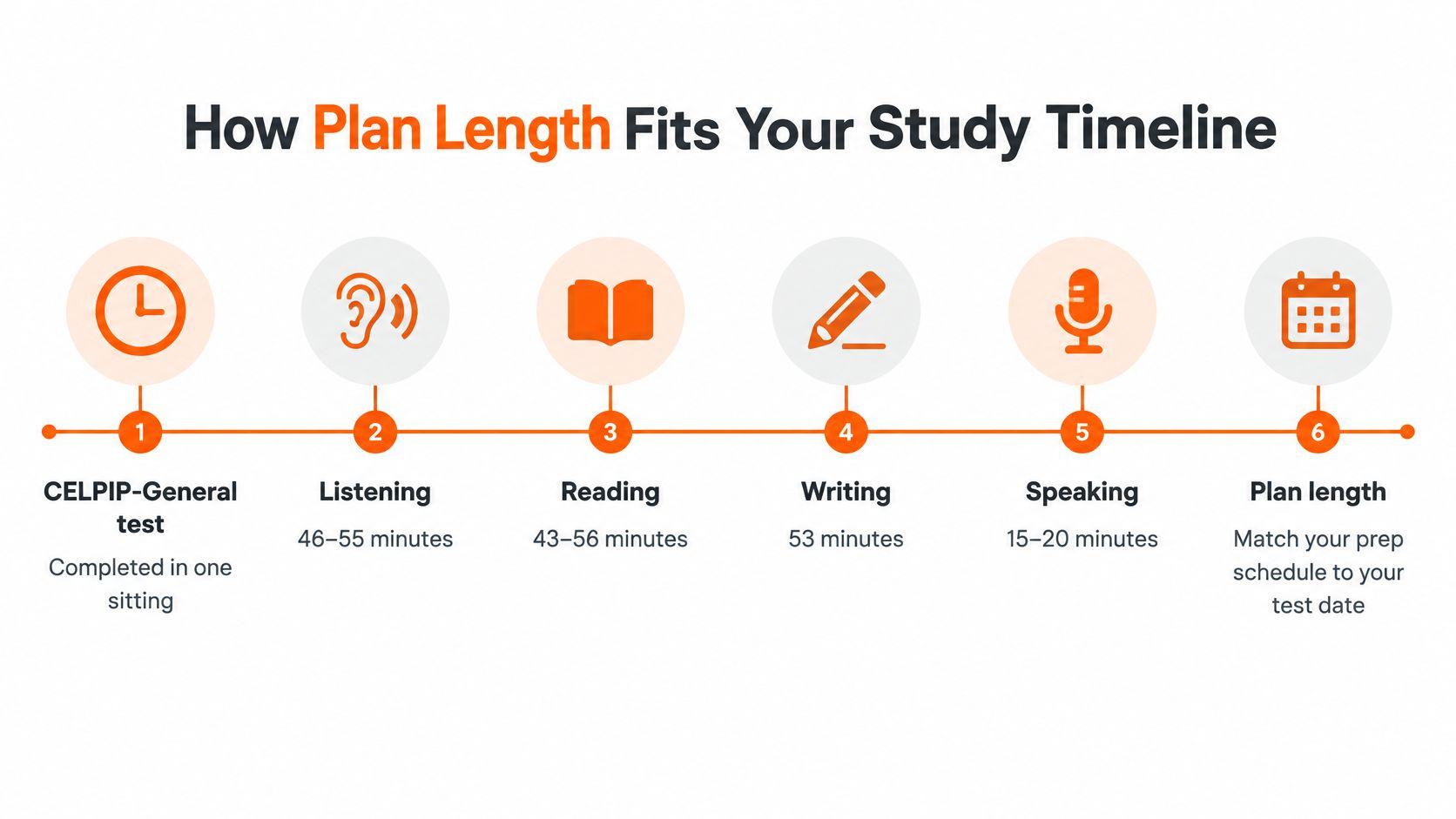
CELPIP-General requires sustained attention, not just isolated skill practice. The official test-taker guide describes a computer-delivered examination completed in one sitting, with Listening taking approximately 46–55 minutes, Reading 43–56 minutes, Writing 53 minutes, and Speaking 15 minutes, for about three hours overall.
Timed mocks are particularly useful near the test date because you need to rehearse transitions and pacing as well as answers. Leave enough room to review a mock before attempting another.
The timing overview helps you plan uninterrupted practice.
A three-week preparation window
For a hypothetical three-week schedule, one Monthly plan costs $29.99, compared with 3 × $14.99 = $44.97 for successive Weekly passes. The Monthly option therefore costs $14.98 less.
Measured across the planned 21 study-window days, that's approximately $1.43 per day for Monthly versus $2.14 per day for Weekly access. The Monthly plan's advertised access still lasts 30 days; the higher study-window figure allocates its full cost across the shorter period you intend to use.
Start with a diagnostic mix of tasks, move to timed sections, and reserve space for complete simulations and review.
A four-week preparation window
A hypothetical four-week schedule fits inside the Monthly plan's 30 days for $29.99. Across 28 planned days, the cost is approximately $1.07 per day, compared with approximately $1.00 per included access day.
Use the additional room as a buffer rather than filling every available session with a new mock. If a Writing attempt exposes weak organization, spend the next session revising structure before testing yourself again.
A three-month preparation window
For a schedule that fits within 90 days, Quarterly costs $69.99, or approximately $0.78 per included day. Check calendar dates carefully because three calendar months and a fixed access period aren't always identical.
A longer window gives you room to build skills gradually around work or family responsibilities. It doesn't require daily full-length testing.
A practical sequence is:
- Diagnose first: Use an initial week of exercises to identify recurring weaknesses.
- Add time pressure: Move from deliberate practice to timed sections.
- Rehearse the full exam: Schedule complete mocks during the final two weeks.
- Keep a buffer: Leave a few days before the exam for focused review and rest.
Don't buy preparation days you can't realistically use, but don't make your access window so tight that one disrupted weekend removes your chance to rehearse.
These examples distinguish cost per included day from cost per planned study-window day. Use the former to compare plans and the latter to judge your own likely use.
Refund and Price-Change Terms to Check First
Our 7-day money-back guarantee has usage conditions. To qualify, an account must have used 2 or fewer mock exams and completed fewer than 5 exercises.
For example, an account that has already used 3 mock exams wouldn't qualify, even if it's still within the guarantee period. Both the time window and the activity limits matter.
Test the service without overlooking the limits
Read the refund policy before starting paid practice, not only when you decide to request a refund. Each mock exam counts toward the mock limit, and completed exercises count toward a separate limit.
Starting with a small sample of exercises can help you assess the interface and feedback before using full mocks. It doesn't create an unlimited trial: exercise activity also affects eligibility.
Refund check: A money-back period isn't permission to use the whole service without restrictions.
Keep a note of when you purchased and what you've completed. Don't assume that an unused subscription day cancels out activity already recorded on the account.
Record what you're purchasing
Subscription prices can change without notice, so don't assume the amount you see today will remain the same at renewal. We may also correct pricing errors and change or cancel subscriptions when pricing information is inaccurate, including after subscription.
Before paying, save the purchase confirmation and relevant terms. That gives you a clear record of the plan you selected without relying on memory or an older comparison page.
Confirm these items:
- Current price: Check the amount and billing currency shown for your account.
- Plan length: Verify the access period against your actual preparation dates.
- Refund window: Read the deadline together with both usage conditions.
The safest purchase is one you can explain plainly: what you paid, when access ends, and what activity affects your refund eligibility.
Choose the Plan That Fits Your Test Date
Choose from your calendar outward. Mark your test date, block the sessions you can realistically attend, and identify where you'll place uninterrupted mock exams and the review that follows them.
A short final sprint and a longer rebuilding period need different amounts of access. If you're retaking the exam because of a weaker productive skill, allow room for response revision rather than budgeting only for complete tests.
Match the purchase to the work
- Brief rehearsal: Prioritize a manageable access window for final timed practice.
- Several weeks of preparation: Compare one continuous plan with the total cost of successive short purchases.
- Longer skill development: Consider whether your schedule supports regular use throughout a longer plan.
Don't choose solely because a daily rate looks attractive. The relevant question is whether you'll use the practice, inspect the feedback, and change your next response.
You can try the service before committing to a paid schedule. Upgrade when the work you intend to do requires broader access, rather than because you feel you should purchase the largest option.
A fixed official test bundle may suit a candidate who mainly needs fresh exam forms. Time-based access may suit someone who wants repeated exercises, response review, and mocks within the same preparation period. Neither comparison works unless you keep currencies, feedback coverage, and access terms separate.
Use one rule: Select the shortest continuous plan that covers your diagnostic work, timed practice, full mocks, and pre-exam buffer.
Celprep combines CELPIP-style exercises, timed mock exams, and response-specific AI feedback, so you can compare access costs against the practice you need. Visit Celprep to try the free tier, match a paid plan to your test date, and confirm the live price before subscribing.