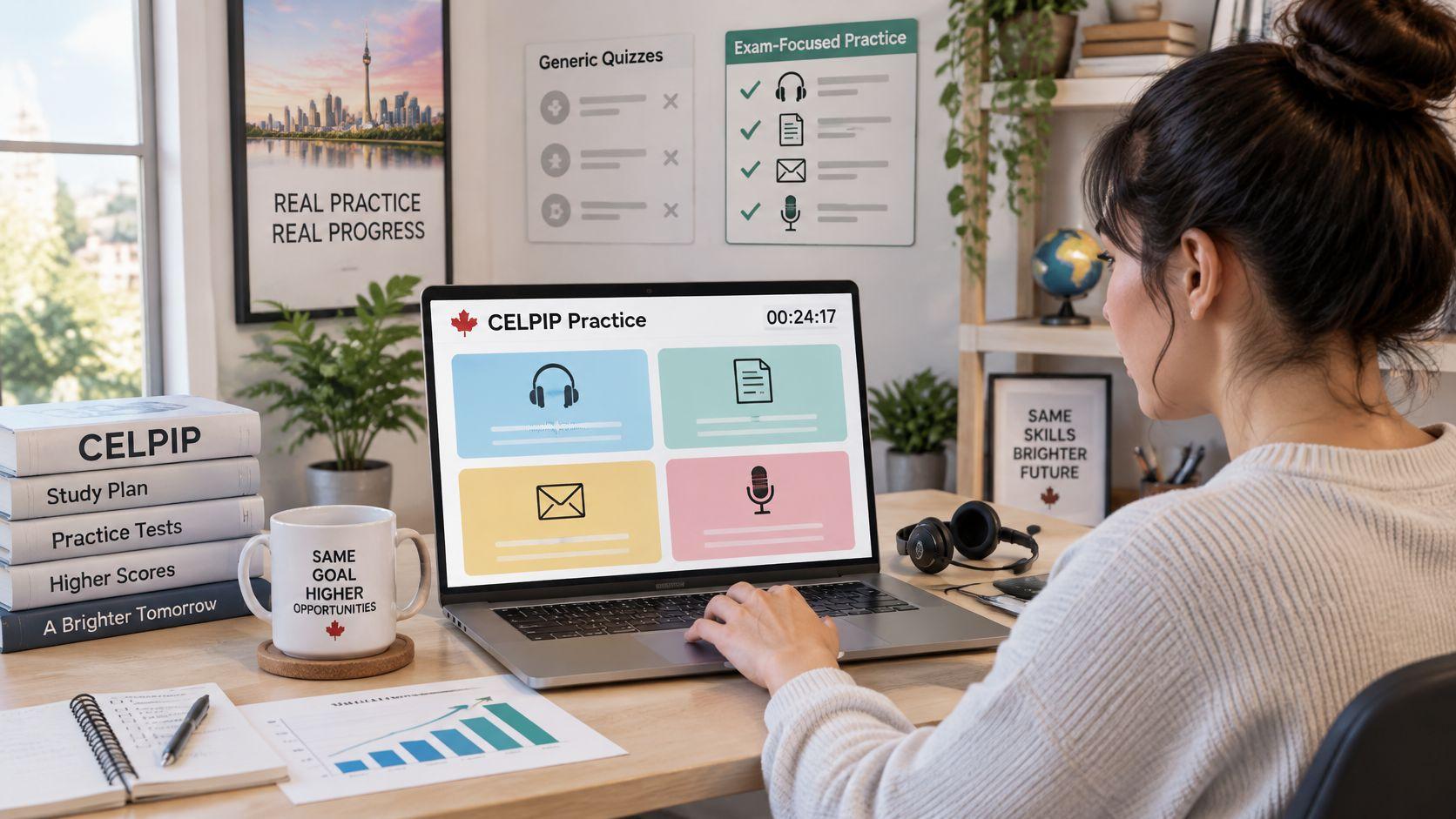
You've read the prompt three times. Thirty seconds of preparation, and the timer on the screen is already down to twelve. You wrote a full opening sentence because it felt productive. Then a second sentence, then a third, and nothing for the back half of the answer. The clock starts, you read what's on the page, and the last ten seconds vanish while you look for a place to stop.
That isn't a language problem. It's a note-taking problem. About 75% of people worldwide feared public speaking in 2025, according to Teleprompter.com's public speaking statistics, but fear isn't what costs marks in a timed test. Reading aloud from your own handwriting does.
The template below is built the other way round. It's a retrieval tool, five fields of keywords with a time budget attached to each one, so you know what fits before you write a single word.
The Reusable Speaking Outline Template
The whole thing fits on one index card, and that constraint does most of the work. Five fields, always in this order:
- Position. Your answer in one sentence of five to eight words, in keywords rather than grammar. If the listener forgets everything else, this is the line that should survive.
- Reason one. One keyword for the reason, then a concrete example nailed to it.
- Reason two. A different keyword that answers a different part of the prompt, plus its own example.
- Extra detail. Optional. A consequence if the listener does nothing, or a second example when the clock allows.
- Closing. The position again, shorter, with no new information attached.
Every field holds keywords, never sentences. "Landlord," "written rule," "friend's building" are enough to rebuild a sentence out loud. A written sentence invites you to read it, and reading is where the pace falls apart.
Take a Giving Advice prompt about a noisy neighbour. The position is ask the landlord for a quiet-hours rule. Reason one is written rule means fewer arguments, with an example from a friend's building where complaints stopped once the rule was posted in the lobby. Reason two is logged complaints with dates, because a record turns a vague annoyance into something a landlord has to answer. The extra detail is another month of the same noise if nothing gets written down. The closing is start with the written request, which is the position in five words.
Here's how the budget splits a 60-second answer.
| Field | What to write | Time in a 60-second answer |
|---|---|---|
| Position | One-sentence answer in keywords | About 5 seconds |
| Reason one | Reason keyword plus one example | About 15 to 20 seconds |
| Reason two | Reason keyword plus one example | About 15 to 20 seconds |
| Extra detail | Consequence or second example, optional | About 10 seconds |
| Closing | Position restated in a few words | About 5 seconds |
Where the five fields come from
Each field answers a question in the listener's head. The position tells them where the answer is going. The two reasons give them grounds to accept it. The closing hands them an action. That's the same sequence persuasive speaking has run for centuries: goal, opening, problem, solution, action.
The arrangement principle is much older than any exam. Public speaking became tied to democratic civic life in Ancient Greece more than 2,500 years ago, and Roman teachers later split speech preparation into the five canons of rhetoric, among them disposition, the ordering of arguments. The open textbook on public communication from Ridgewater College traces the modern outline directly to disposition, and the contemporary version of that sequence still runs introduction, central idea, main points, evidence, transitions, conclusion. An outline isn't a productivity trend. It's a method for controlling relevance and order.
The test before you trust it: you can say the position in one breath, name both reasons from memory, and still have three or four seconds left after the closing.
How to Fill the Template in Prep Time
Thirty seconds is longer than it feels and shorter than you want. The routine below fits inside it, and it also fits the 60-second prep windows of the two-stage tasks. Each step carries its reason, because a procedure you don't understand collapses the first time a prompt surprises you.
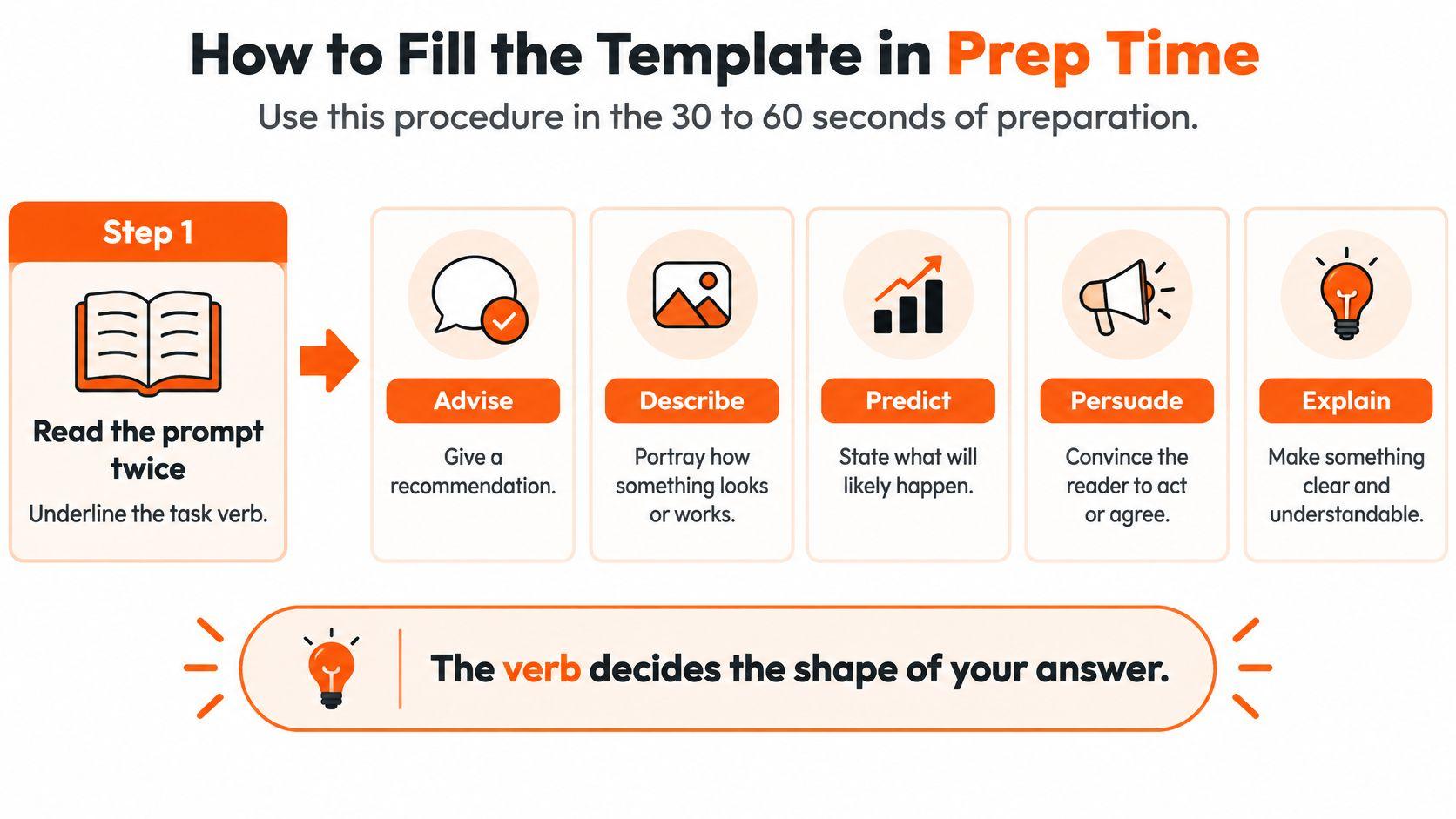
The task verb decides the shape of everything that follows, so it gets underlined first.
Writing the outline in seven steps
- Read the prompt twice and underline the task verb. Advise, describe, predict, persuade, explain. The verb sets the shape of your position, so an advice prompt needs a recommendation on the first line and a prediction prompt needs an outcome.
- Write the position as one sentence of five to eight words. A short position means your opening line is already decided when the timer starts, so you're not inventing it under pressure.
- Pick two reasons that answer different parts of the prompt, then drop the third. A third reason only holds if you can develop it, and most answers can't afford the time.
- Attach one example, number or consequence to each reason. An unsupported reason is a generalization, and generalizations are the first thing a rater hears as thin.
- Write the closing as a restatement of the position. A restatement can't smuggle in new information, which is the most common way a strong answer ends badly.
- Mark transitions as prompts, not sentences. "First" and "the main reason" are enough. A memorized transition breaks when the point before it changes.
- Check the clock before you write the extra detail. With 30 seconds of prep, write the position and two reasons and skip the extra detail entirely. With 60 seconds, add it.
A full script invites reading or memorization, and that's the pitfall worth naming out loud. Toastmasters' guide to writing and delivering a speech draws the same line: a working outline carries short keywords that trigger ideas, evidence, transitions and timing checks, while a script pushes you toward recitation. One broken first sentence then takes down the rest of the answer, because you're recalling text instead of tracking your own argument.
Practical rule: time yourself writing the outline. If it takes longer than the prep window, cut words, not reasons.
The finished card should show the next point at a glance. If you have to read across a line to find it, you wrote too much.
Adapting the Outline to Each CELPIP Speaking Task
CELPIP Speaking is eight distinct tasks inside roughly 15 minutes, as the official CELPIP test format and scoring page sets out, so a single generic speech shape can't carry all of them. The five fields stay put. What goes inside them changes.
The timing is the reason. The Revised Speaking Pro Target 9 Study Pack lists 30 seconds of preparation and 90 seconds of speaking for Giving Advice; 30 and 60 for Personal Experience, Describing a Scene and Making Predictions; 60 seconds of preparation followed by two stages for Comparing and Persuading; 60 and 60 for Dealing with a Difficult Situation; 30 and 90 for Expressing Opinions; and 30 and 60 for Describing an Unusual Situation. Those numbers decide how much outline you can afford.
| Task | Preparation | Speaking | Outline adjustment |
|---|---|---|---|
| Giving Advice | 30 seconds | 90 seconds | Two recommended actions, each with a reason and a consequence |
| Talking About a Personal Experience | 30 seconds | 60 seconds | Timeline of before, during and after |
| Describing a Scene | 30 seconds | 60 seconds | Left to right or foreground to background, then one detail |
| Making Predictions | 30 seconds | 60 seconds | Likely outcome first, then two observable signs |
| Comparing and Persuading | 60 seconds | Two stages | Preferred option, a reason, and why the rival option loses |
| Dealing with a Difficult Situation | 60 seconds | 60 seconds | Problem, action, then follow-up |
| Expressing Opinions | 30 seconds | 90 seconds | Stated view, two reasons, link back to the view |
| Describing an Unusual Situation | 30 seconds | 60 seconds | What is unusual, what it looks like, how people react |
Sorting the tasks by their windows
Two tasks give you 90 seconds of speaking, and that extra half minute is exactly where the optional field earns its place. Giving Advice and Expressing Opinions can carry a second example or a consequence, because 90 seconds absorbs it. The four tasks at 60 seconds cannot. Personal Experience, Describing a Scene, Making Predictions and Describing an Unusual Situation get the position and two developed reasons, and that's the whole card.
The two tasks with a full minute of preparation work differently again. Comparing and Persuading rewards justification, so your position needs a stated preference plus the specific reason the alternative loses on, and you have time to plant that counterpoint while you plan. Dealing with a Difficult Situation wants problem, action, follow-up in that order, which is three fields doing the work of four.
What changes inside each field is the content type, not the count. Advice turns reasons into actions the listener can take. Personal Experience turns them into a sequence of what happened before, during and after. Scene description runs left to right or foreground to background, then closes on a single detail that proves you looked. Predictions front-load the likely outcome and back it with two things a listener could observe. If a task ever feels shapeless, working through CELPIP speaking test questions by type makes the required shape obvious fast.
For anyone targeting Level 9 or 10, which correspond to CLB 9 and CLB 10 on the CELPIP test overview, the outline has to carry extended, organized responses, not just correct sentences. Check the prep window before writing anything. It tells you how much outline you can afford.
Rehearsing From Keywords Against the Clock
An outline you've never spoken from is a guess. Rehearse one task at a time, aloud, with the actual preparation and speaking times running. The recording is where the outline proves itself or falls apart.
- Choose one task and set its exact windows. Use the preparation and speaking times from the table above, not a rough approximation.
- Fill the card with keywords only. No written version, not even a scratch one. The moment a full sentence exists, you'll read it.
- Speak the answer from the keywords and record it on your phone. Recording catches the pauses you don't notice while speaking.
- Play it back and mark every stop, repeat and overrun. Timestamp them. "I lost it around the second reason" is not useful; "I stopped at 0:34" is.
- Cut the repeated claims, the long background and the weak example, then run the same prompt again. Revision without a second take is just planning.
A 2025 study of 60 university students reported mean gains of 10 points in fluency, grammar and vocabulary and 15 points in phonetic accuracy from personalized, immediate feedback, according to research on AI-assisted second-language speaking. Feedback works, but it works unevenly, which is why the recording matters more than the feeling you had while speaking.
Our speaking coach follows the same loop: you record responses to advice, experience and prediction tasks and get pronunciation and fluency feedback on the recording itself, which is the version of the answer a listener hears. A bank of timed attempts built from the CELPIP speaking practice book prompts gives that loop enough variety to expose the tasks where your card still collapses.
Recovery when an idea slips
Ideas slip. The cost isn't the slip, it's the silence after it. Plan a stock phrase before you need one, something like "the second reason is," and move straight to the next keyword. A two-second transition costs almost nothing. Eight seconds of hunting for a lost sentence costs the closing.
This is also why the card stays at five fields. A more detailed outline tends to push you toward word-for-word recall, and word-for-word recall breaks the moment one sentence goes wrong. The useful template isn't the most complete one. It's the one that keeps you flexible while making task completion visible.
The next take starts here.
After each run, check three things you can observe rather than feel: the answer finished inside the limit, every element of the prompt got covered, and the transitions between points were clear with less hesitation than the previous take. Then record a fresh take of the same prompt. Progress should show up in the recordings, not in your memory of how it went.
Diagnosing Problems and Setting This Week's Fix
Most speaking problems look identical from the inside and completely different from a recording. Match the symptom to its cause before you change anything, because the wrong fix makes the answer worse. Adding a third reason to a thin answer, for instance, usually turns one problem into two.
| Problem | Likely cause | Fix |
|---|---|---|
| Sentences stall mid-answer | Full sentences written in the outline | Cut to keywords and rehearse the keyword version aloud |
| Runs out of time before the closing | Two reasons developed at length, no time budget | Set 5 seconds for the closing and cut the second example first |
| Blank after the first sentence | No recovery phrase planned | Keep a stock phrase such as "the main reason is" and return to the next keyword |
| Points repeat each other | Reasons not checked for overlap | Pick two reasons that answer different parts of the task |
| Closing adds new information | Closing written before the body | Restate the position sentence in the closing |
| Accent drives all corrections | Focus on sounding native-like | Fix only features that block understanding |
The order to fix things in
Check the outline before you blame your delivery. If the card was complete and you still ran out of time, cut the second example. If the card was thin and you filled the silence with repetition, add a second example rather than a third reason.
Then apply a fixed order to every take. First, does the answer complete the task, with a position and both reasons intact? Second, is it organized enough that a listener can follow without backtracking? Third, is it intelligible, with clear word stress and audible sentence endings? Fourth, pace and pauses. Only after those four, look at accent features that don't block understanding.
That last point needs saying plainly. A 2025 systematic review covering 23 studies found that generative-AI speaking feedback most consistently supported fluency, pronunciation and speaking performance, while noting that automated feedback needs careful interpretation, as the review of AI feedback in language learning reports. Other work in the same area found segmental pronunciation improving while stress patterns barely moved, and learners often can't hear the difference a tool is flagging. Automated scores aren't definitive. Test any feedback against what a listener understood.
What the raters reward is broader than sounding smooth. Official CELPIP information states that Speaking and Writing are scored by qualified raters trained to apply consistent criteria, and the score comparison chart describes high-level performance in terms of control over a broad range of complex structures and the ability to produce extended responses. Your card should prompt all of that at once: a clear answer to the task, connected ideas, varied but accurate language, and enough development to fill the time.
The honest limit of any outline: it fixes structure, timing and task coverage. It won't fix a grammar pattern you haven't learned or a sound a listener can't catch.
That's why the weekly routine below is narrow. One variable per week, measured against the same prompt. If organization is your weak point, spend the week on how to improve English speaking with structure as the target and leave pronunciation alone.
- Record one response for each task type you struggle with. Two or three recordings per week is enough, as long as they're the hard ones.
- Transcribe one of them word for word. Then check four things against the transcript: task response, logical connection between points, varied and accurate language, and development that fills the time.
- Change one thing on the card, not five. Shorter keywords, a different second reason, a planned recovery phrase.
- Repeat the same prompt next week and compare the two recordings side by side. The comparison is the progress report, and it's more reliable than how the answer felt.
Celprep gives you personalized feedback on every attempt, and the My Progress tool tracks improvement over time so you can see which component needs the next week of work. If your Speaking card keeps collapsing under the timer, start with the free plan, which includes one exercise per task type, three starter templates, a vocabulary bundle for each section, and three submissions a day. Record a response, read the feedback against your own recording, and let the second take tell you what changed. Visit Celprep to begin.