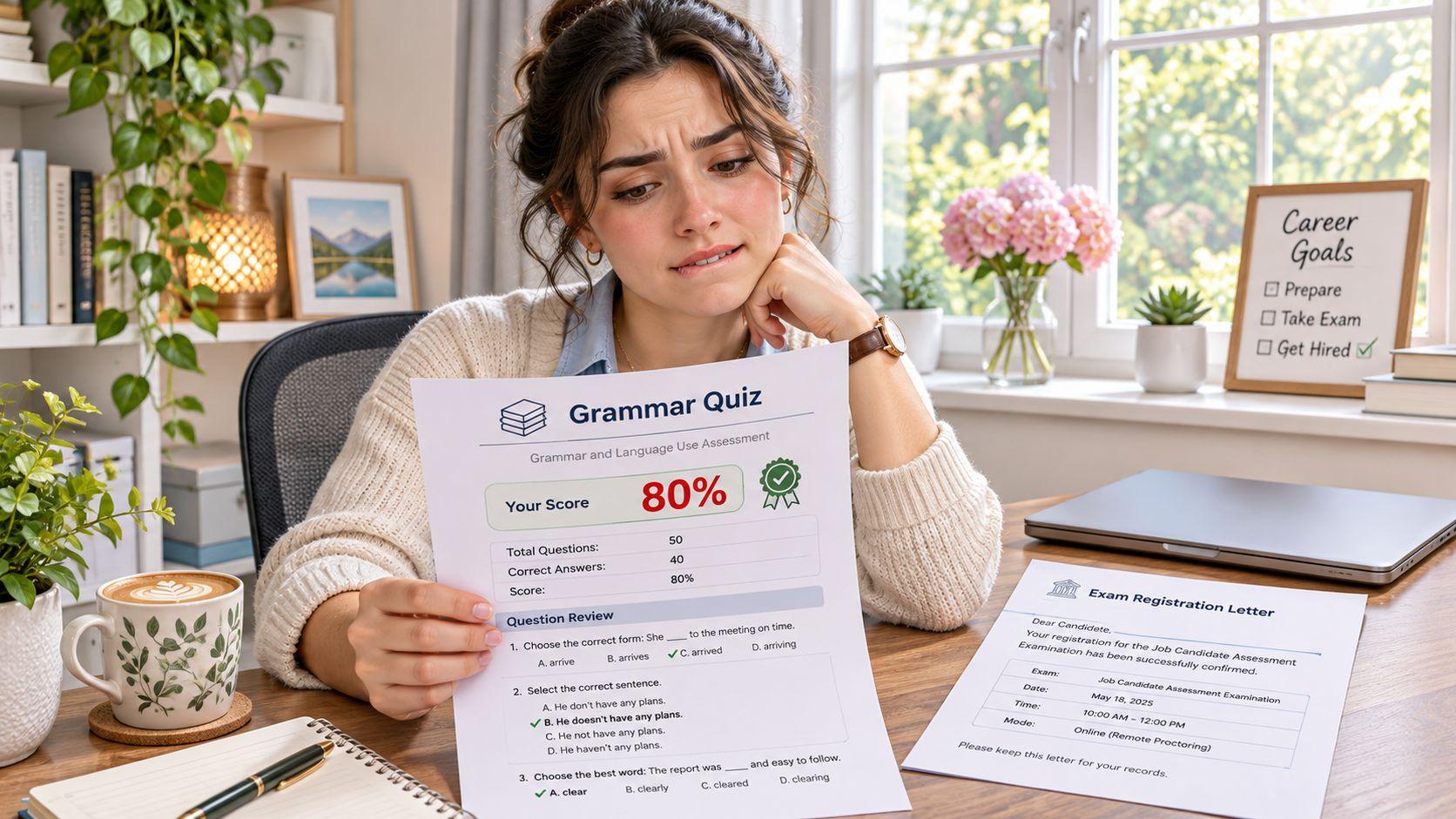
You finished a grammar quiz with 80 percent, closed the laptop, and felt ready. Then you sat a full practice test, typed the email in a hurry, recorded eight speaking answers, and got back a single number with nothing attached to it. Nothing in that result told you whether the problem was the missing closing request, the grammar slips, or the borrowed keyboard you were typing on at eleven at night.
Most CELPIP preparation goes wrong in that gap between an easy quiz and a real assessment. A proficiency sample test is a diagnostic instrument, and reading it properly means answering three questions: which scoring dimension held your score down, whether the conditions of the run skewed the result, and what single change you'll make on the next attempt. Answer those and your next run has a direction. Skip them and you'll keep buying more questions when the question count was never the issue.
What a Proficiency Sample Test Measures
Grammar quizzes measure grammar. Grammar is one of the things a scored speaking or writing task rewards, and it's rarely the thing that costs a high-target candidate a band.
The term itself comes from laboratory quality assurance, not from language classrooms. ISO 13528:2022 sets out statistical methods for proficiency-testing providers to design interlaboratory comparison schemes and analyze participant results, as the ISO standard documentation explains. Providers hand participants a common test item or sample, collect their measurements, compare those results with an assigned or consensus value, and judge performance against predetermined statistical criteria. The participant doesn't know the sample's correct value in advance, which is the entire point.
A quiz is practice scales at the piano. A sample test is the dress rehearsal with a stopwatch and an examiner scoring every note. Scales build the fingerwork, and the rehearsal tells you that your timing collapses in the third movement and that you rush the ending when someone is watching. Both are useful. Only one of them predicts the performance.
Three features separate a real sample from a workbook page:
- Real conditions. Same timing, same interface, same sequence of tasks inside a single sitting, not three questions taken during a lunch break.
- Observable performance. You produce something scoreable, such as a written email or a recorded answer, rather than ticking a box.
- Explicit criteria. Your output is compared against stated standards, not against a vague feeling that it went fine.
On the CELPIP General Test, that means four separate skills: Listening, Reading, Writing, and Speaking, each with its own tasks and its own score. Practice platforms build exercises around those skills, and the boundary is worth keeping clear. Celprep describes itself as an independent practice resource, and CELPIP is a registered trademark of Paragon Testing Enterprises, so no third-party material is the official test itself.
Before you trust any sample test, ask three questions. Does it use the real timing? Does it score each skill separately? Does it show which errors produced the score?
If a sample fails any one of those, treat its number as a rough signal and go find a better instrument.
Sample Test Layout and Timing by Section
Keep this layout beside you while you practise. The CELPIP General Test has four components; the final row shows how they combine into a full sample run. Read the table as a map of what you must do, rather than as a score prediction.
| Component | Items or tasks | Response type |
|---|---|---|
| Listening | Questions based on audio | selected answers |
| Reading | Questions based on written material | selected answers |
| Writing | Email and survey response | typed written responses |
| Speaking | Tasks with on-screen prompts | spoken responses |
| Full sample test | All four components in sequence | mixed |
The official CELPIP test overview lists 38 Listening questions, 38 Reading questions, two Writing tasks and eight Speaking tasks, with the full testing experience taking approximately 2 hours and 50 minutes.
Each component has its own clock. Listening requires you to follow the audio and answer within the allotted time. Reading requires you to divide your time between understanding passages and selecting answers. Writing requires time for both the email and survey response, including checking what you typed. Speaking requires you to prepare and deliver responses within the time shown for each prompt.
Use the sample's component and task timers. Extra time changes what the result measures: a polished response completed after the clock expires does not show whether you can produce it within the test's limits.
Selected answers versus produced answers
Listening and Reading ask you to select answers. Writing and Speaking require you to create them, so reviewing a model alone leaves part of the skill untested.
For produced responses, examine task fulfillment, coherence, vocabulary, grammar, and readability or listenability. These dimensions work like separate gauges on a dashboard. An answer can address the prompt yet be difficult to follow, or use varied vocabulary while leaving part of the task unanswered. Record the limiting dimension alongside the component result.
Where the stamina sits
Stamina can affect performance without being a separate scoring category. If errors cluster late in a component, attention or time pressure may have contributed; the total score alone cannot distinguish those effects from a language weakness.
During a full sample, note where concentration drops and whether later answers become rushed or incomplete.
A practice week can combine separate component sessions with a full timed run. Short sessions let you examine specific errors closely. The full run shows whether those same difficulties persist when the components follow one another, helping you interpret the result rather than just collect a number.
Set Up a Realistic Sample Run
Two candidates with the same English can post different scores on the same sample because of the setup. Fatigue from a long sitting, an unfamiliar keyboard, headset audio that muddles consonants, low confidence with the microphone, slow typing, small screen text, and any approved accommodation you're entitled to use all move the result.

Accessibility isn't a footnote in this field. Research on English language proficiency assessment treats accessibility for English learners and test takers with disabilities as a distinct design concern rather than an add-on. In practice that means the conditions of your practice run deserve the same attention as the content of your answers.
Run the setup as a repeatable procedure:
- Pick a quiet room you can use again. Same desk, same chair, same background noise. You're training for a specific room on test day.
- Use the headset and keyboard you'll have. A different keyboard changes your typing speed and your error rate, and a different headset changes what you can hear.
- Run the full timed sequence in one sitting. No pauses beyond the breaks the format allows, because pausing converts an endurance test into a series of sprints.
- Write the log entry within 24 hours. Record the component scores, the device, the audio, your energy level, and anything that felt off while the memory is fresh.
Keep two readings for every run. One is the conventional score estimate. The other is a condition note: timing, device, audio, fatigue, accommodations. A low Writing score on a night you worked until nine and typed on a tablet is a different fact from a low Writing score on a rested Saturday at your usual desk.
Practical rule: a result recorded with its conditions tells you whether to fix your English or fix your setup. That distinction decides what you study next.
Do the diagnosis once per run, not once per question. One clear weakness and one change for the next attempt beats a page of vague observations.
How to Run a Writing and Speaking Sample Round
A practice round is a unit of work with a beginning, a middle, and a debrief. Run it in this order and you'll finish with evidence instead of a feeling.
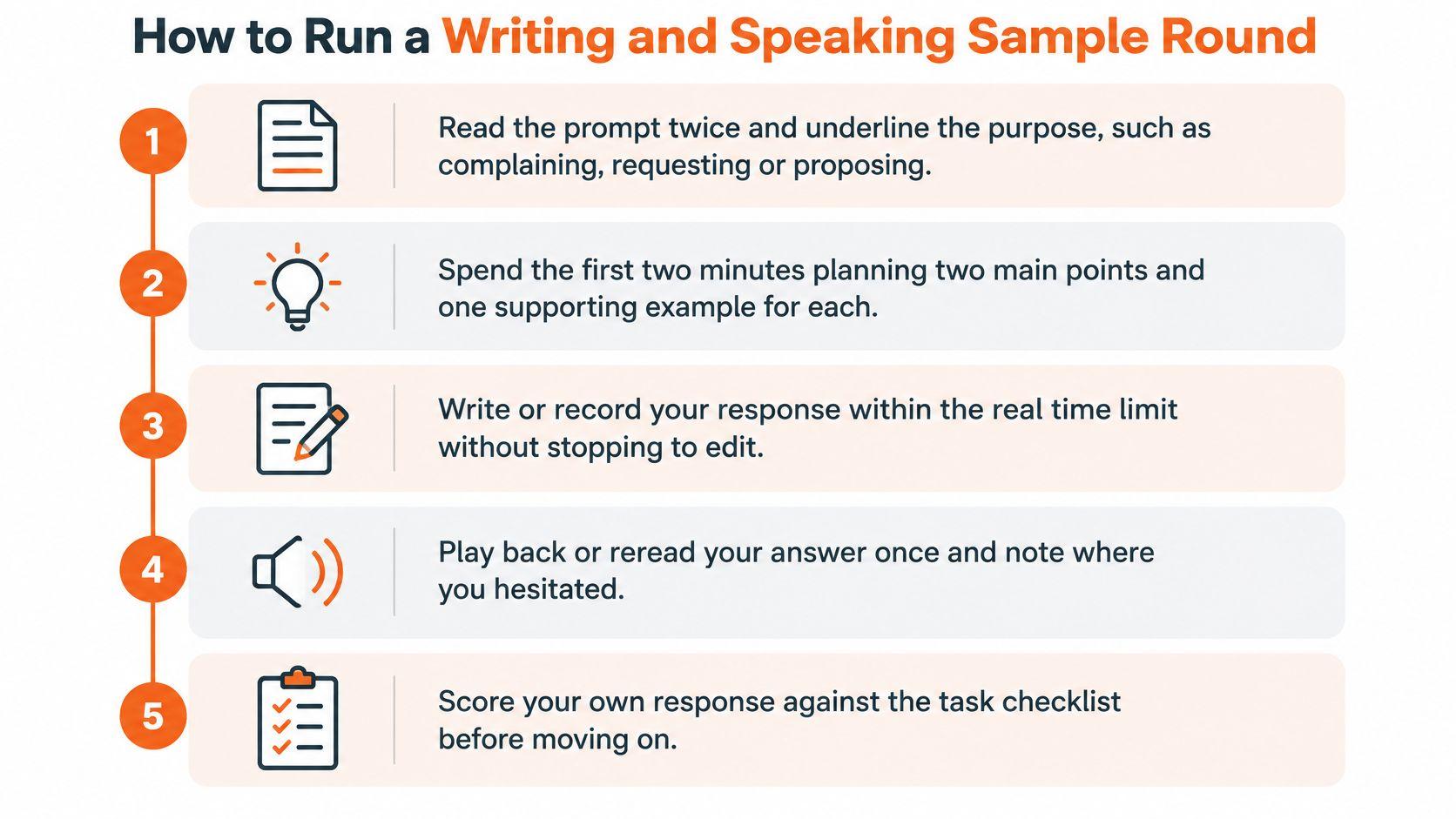
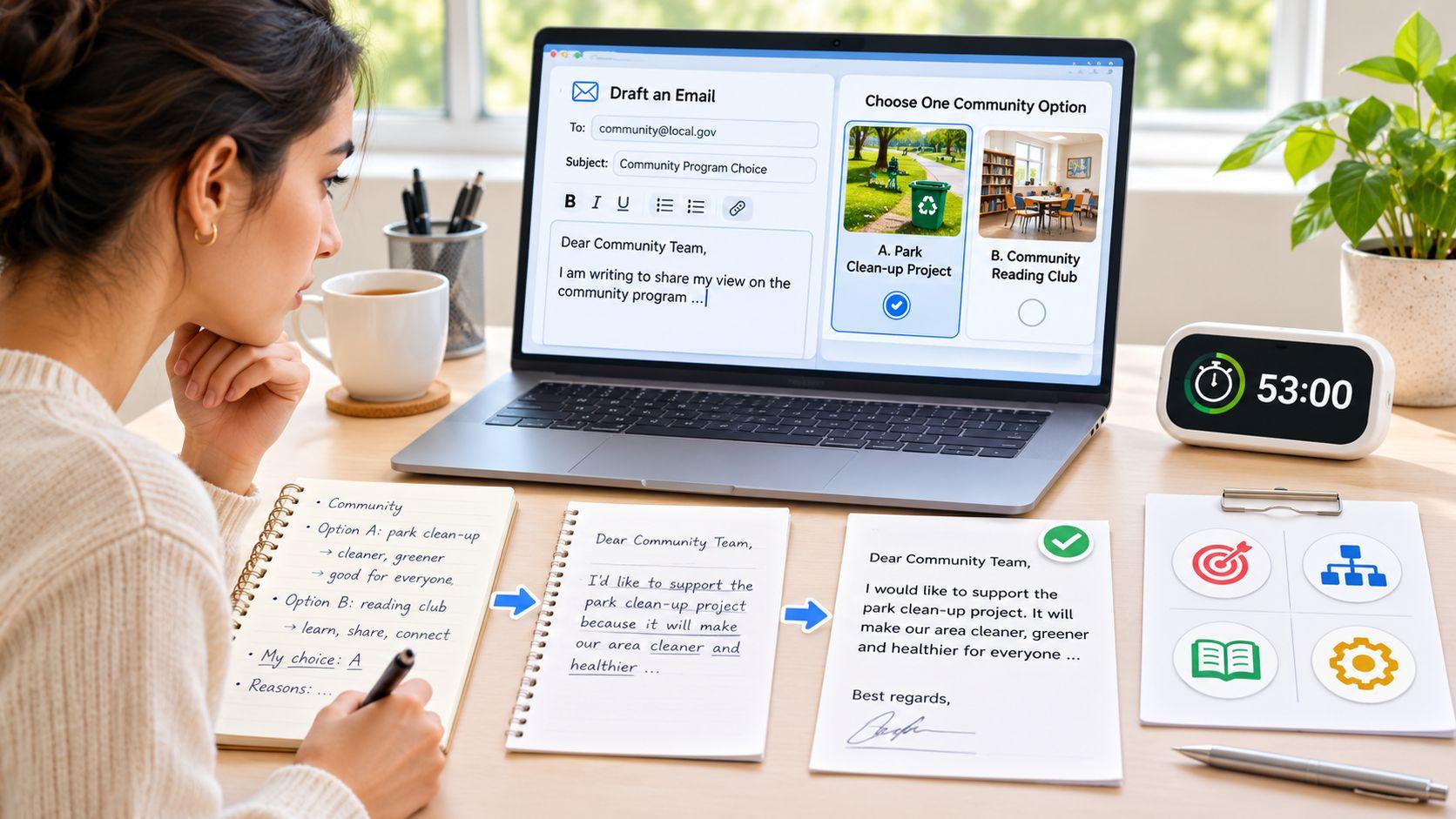
- Read the prompt twice and underline the purpose. Is this a complaint, a request, a proposal, or an invitation? This prevents the most common opening mistake: a first paragraph that rewrites the prompt back at the reader instead of doing something with it.
- Spend the first two minutes planning two or three points. A short list on scrap paper keeps the middle of your response organized. This step prevents the response that gives only one suggestion when the task clearly expects several.
- Write in your planned order and stay inside 150 to 200 words. Drafting as you think is how people run out of minutes with two points still unwritten.
- Reserve the last three minutes for checking. Read for grammar, check the tone, and confirm that every part of the prompt got an answer. This prevents the forgotten closing request, which costs task fulfillment marks and is entirely fixable.
- For Speaking, use the preparation time, then talk to the prompt. Plan the shape of the answer, then speak it without reading notes aloud. A scripted answer read from a screen sounds flat and usually loses marks for natural delivery.
- Record the response and replay it once. Listen for pace, pronunciation, and whether the answer was complete. Most candidates assume an answer sounded fine; the recording disagrees often enough to be worth the two minutes.
A pacing benchmark you can check
Sample speaking answers in prep guides are usually built around 90 to 110 words to fit a 60-second response, which gives you a rough way to benchmark your own pace. If your recorded answer runs 200 words in a minute, you're either rushing or you've planned too much.
Our Speaking Task 1 guide includes Band 9-10 style sample answers that stay inside that range, and it lists common mistakes with fixes, including giving only one piece of advice, which it says to avoid by planning at least two clear suggestions during prep time. If you record a real CELPIP speaking task on Celprep, you get one weakness plus one change to make on the next attempt, which is the debrief this round needs.
A finished practice round leaves you with three artifacts: a complete draft, a timed recording, and two written notes on what to fix. If you can't name those two things, the round was rehearsal without feedback.
Reading and Listening Under Timed Conditions
Listening and Reading look like the easy half of the test. They punish slow decisions far more than unfamiliar vocabulary, and that's why high-target candidates lose a band.
What the questions actually ask
The formats repeat. Detail questions follow a conversation or an announcement and ask for a specific fact, such as a changed appointment time or a room number. Gist questions ask what the main purpose was, whether the call was a complaint or a follow-up. Inference questions ask what a speaker implies without saying, like whether a refund is likely or whether a deadline will slip.
For Reading, expect correspondence such as emails and notices, diagram-based items where you match labels to a figure, and short passages presenting viewpoints you must compare. Read the question stem before the passage. Knowing you need a date and a condition changes what you scan for.
Pacing rule: work out your per-question pace before test day, dividing the section's time by its item count, then check your position at the halfway question. Falling behind costs more than one wrong answer, because panic spends minutes you needed for the final passage.
How to listen once
The audio plays once, so note-taking replaces re-listening. Write keywords, names, numbers, and dates rather than full sentences. Trying to transcribe a conversation is how the next question gets missed.
For Reading, don't re-read a passage you didn't understand the first time. Answer from what you retained, flag the item, and move. If the audio itself is your weak point, work through our English listening test guide before the next full run rather than adding more practice sets.
After the run, log every missed question with its cause: misheard detail, slow stem reading, wrong inference, or ran out of time. Group the misses by cause and you'll see which fix belongs at the top of next week.
Turning Component Scores Into CLB Levels
Official reporting is separate for each component, and those scores are aligned with the Canadian Language Benchmarks from CLB 3 through CLB 12, according to the CELPIP test and score overview. Averaging the four scores into one number is like averaging the readings on four separate gauges on a dashboard. The average can look healthy while one gauge sits in the red, and that one gauge is the one a visa officer or admissions office reads first.
Different programs and immigration pathways set their own minimum component levels, and several publish different floors for each skill rather than a single overall cutoff. Before you set your target, look up the exact requirement for the program you are applying to and write down all four minimums, not just the headline figure.
Consider a candidate who posts Listening 11, Reading 10, and Speaking 9, but Writing 8. The average looks comfortable. If the program requires a higher Writing floor than the other components, the result falls short on Writing alone, and no amount of extra Listening practice fixes it. The strong scores cannot compensate. This is why your weakest component, not your best one, should shape your study plan.
Why the weakest component controls the outcome
Requirements are read component by component, so the lowest score is the one that holds the decision. Balance your effort accordingly. That also explains why CELPIP Level 10, linked to CLB 10 and described as highly effective proficiency in some high-stakes social, educational, or workplace contexts, isn't just a nicer-sounding version of Level 9. It represents a different category of evidence, and the requirements written around it tend to be specific.
Verified levels replaced self-report for a reason. The Interagency Language Roundtable history records that language competence wasn't formally examined in the U.S. for the country's first 175 years, and that in 1956 only 25% of entering Foreign Service officers tested at a useful proficiency level in any foreign language. The response was a testing mandate, and eventually a six-level scale running from no functional ability to educated-native performance. Standardized scales exist because self-assessment proved unreliable at scale, which is worth remembering when you are tempted to estimate your own level by feel.
Record each component separately in your practice log, and set a target for each one rather than a single overall goal. Run your numbers through the CELPIP score calculator to see how each component maps to a CLB level, then compare that against the requirement you need to meet.
One caution about reading sample results. Practice estimates are approximations, and one run is a snapshot. Track three or four runs and read the trend instead. A component that moved from 8 to 9 across two weeks is a signal. A single drop after a bad night's sleep is not.
Diagnose Weak Skills From Your Results
An overall estimate answers a question nobody asked. The official CELPIP scoring guidance separates the dimensions that decide your band: content and coherence, vocabulary, readability and listenability, task fulfillment, and language control. It also distinguishes computer-scored multiple-choice items from constructed-response assessment, which is precisely why one number can't tell you where the loss happened.
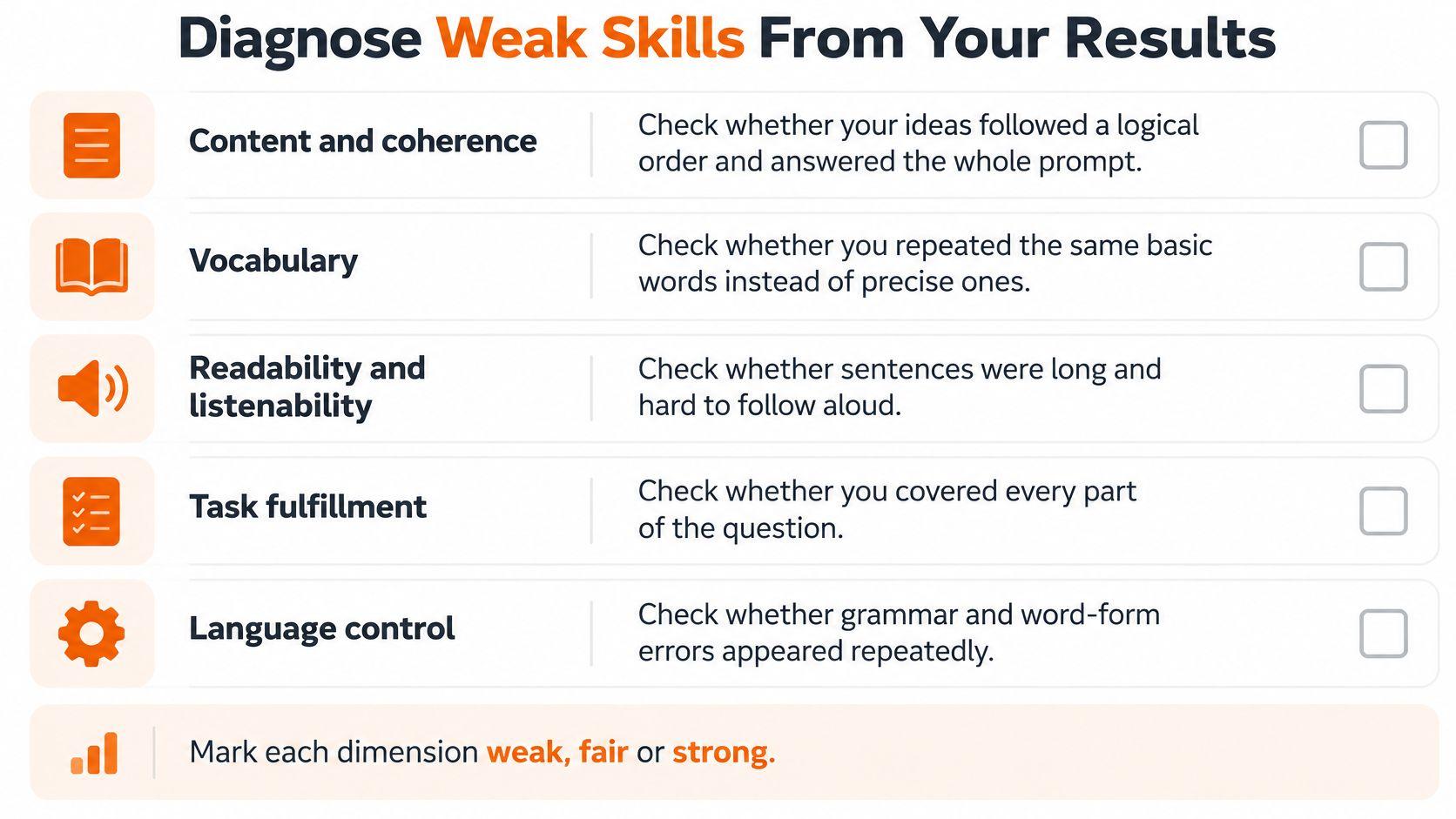
Read each dimension against a concrete question. Content and coherence: did the ideas follow a logical order and answer the whole prompt? Vocabulary: did you reach for the same basic verbs all the way through? Readability and listenability: were sentences so long that a listener lost the thread? Task fulfillment: did you cover every part of the question? Language control: did grammar and word-form errors repeat, or appear once as a slip?
| Observed pattern | Likely dimension | Next step |
|---|---|---|
| Strong ideas, weak flow | Content and coherence | Outline two or three points before writing |
| Clear meaning, frequent grammar slips | Language control | Rewrite one response, editing only grammar |
| Accurate but repetitive word choice | Vocabulary range | Replace repeated verbs with a set of alternatives |
| Missed details in listening | Listenability | Replay with transcript, then retest the same audio |
| Off-topic speaking answers | Task fulfillment | Restate the prompt in the first sentence |
The pairings above aren't arbitrary. Ideas that arrive out of order point to planning, not language, so the fix happens before you write. Meaning that lands but grammar repeats points to control, and the efficient drill is a single response edited for grammar alone, not a new topic. Repetitive word choice with accurate content is a range problem, best fixed by building a small set of substitutes and reusing them under time pressure. Missed details point toward processing speed and attention, so replaying with the transcript shows whether you couldn't hear it or couldn't hold it. Off-topic speaking is usually a planning failure rather than a language failure, and restating the prompt in your first sentence keeps the answer anchored.
Contrarian but practical: more questions often add less value than better error attribution. A short diagnostic with reliable skill-level explanations beats a long mock that only hands back an overall estimate.
This matters most at the top of the scale. For a candidate aiming at band 10, the difference from band 9 is a difference in described proficiency category, not a wobble in measurement. Treat a one-band gap as work to be done, not as test-day luck.
Build a Two-Week Study Plan From Your Log
Your log already contains the plan. Extract it in this order.
- Compare each component with its reference minimum. Mark each one as above, at, or below.
- Choose the weakest component. It controls the outcome, so it gets the first block of effort.
- Name the dimension behind its weakest pattern. Use the diagnosis table, not intuition.
- Spend the first week on that dimension only. Short drills built on the matching fix beat a mixed review: outline before writing, replay audio with the transcript, restate the prompt before speaking.
- Retest the same task type at the end of the week and record the new result beside the old one, so the comparison is visible.
- Move to the next dimension only when the retest shows a change. If nothing moved, the diagnosis was wrong, and the drill should change rather than intensify.
Keep one full timed run in each week, using the same room, headset, and sequence described earlier. Weekly full runs show whether the trend holds across several runs, which matters more than any single result. If you want a wider set of drills for the weak dimension, our guide to effective study methods covers the options.
Schedule the next full sample test this week. Fill in the component log, name one dimension, and start there.
Celprep is built for exactly this loop: you write, speak, read, and listen under real task structures and timing, and every attempt comes back with personalized feedback on coherence, vocabulary range, grammar accuracy, and task completion, plus a My Progress record that shows what to work on next. The free plan gives you one exercise per task type, starter templates, a vocabulary bundle per section, and three submissions a day, so you can test the diagnosis approach before committing to a paid plan. Start with a free sample test at Celprep and bring your log with you.