You're sitting in front of a monitor with a countdown clock ticking down from 30 seconds. The screen asks you to advise a close friend who can't decide between taking an evening course or quitting their job for a full-time program, and you'll have roughly a minute to answer. Most test takers freeze right here because they try to recall memorized phrases instead of leaning on a repeatable plan.
That single scenario mirrors the actual pressure of the CELPIP-General Speaking section. According to the official CELPIP-General test format, candidates complete eight distinct speaking tasks in approximately 15 minutes by recording verbal answers to on-screen prompts rather than talking to a live interviewer. Every second of hesitation stays on the recording, so you don't have time to invent a structure from scratch while the clock runs.
For Canadian applicants, speaking performance matters. As documented in the Canadian English Language Proficiency Index Program overview, Immigration, Refugees and Citizenship Canada approves CELPIP-General for immigration and citizenship, and Express Entry awards up to 24 points for first-official-language results across all four skills, plus 4 points for a second official language when minimum thresholds are met. A weak speaking score can pull down an otherwise strong profile.
The ten questions for speaking test practice below cover all eight CELPIP communicative functions, plus two extra variants of the advice and opinion formats that transfer across the exam. Every prompt includes a clear response shape, realistic timing, and a concrete way to rehearse without memorizing scripts.
1. Task 1 Giving Advice (Friend Choosing a Course)
Prompt: Your friend is deciding whether to take an evening course or a full-time program while working. Give your friend advice about which option to choose and explain your reasons.
You get about 30 seconds to prepare and roughly 60 to 90 seconds to speak. The trade-off here is depth versus speed: if you try to list four advantages, you'll rush your grammar and run out of time before closing. Under the official CELPIP Performance Standards, raters score four dimensions equally: Content/Coherence, Vocabulary, Listenability, and Task Fulfillment (which includes relevance, completeness, tone, and length).
Before you start speaking, map out the trade-offs visually so your recommendation sounds grounded in your friend's actual life.
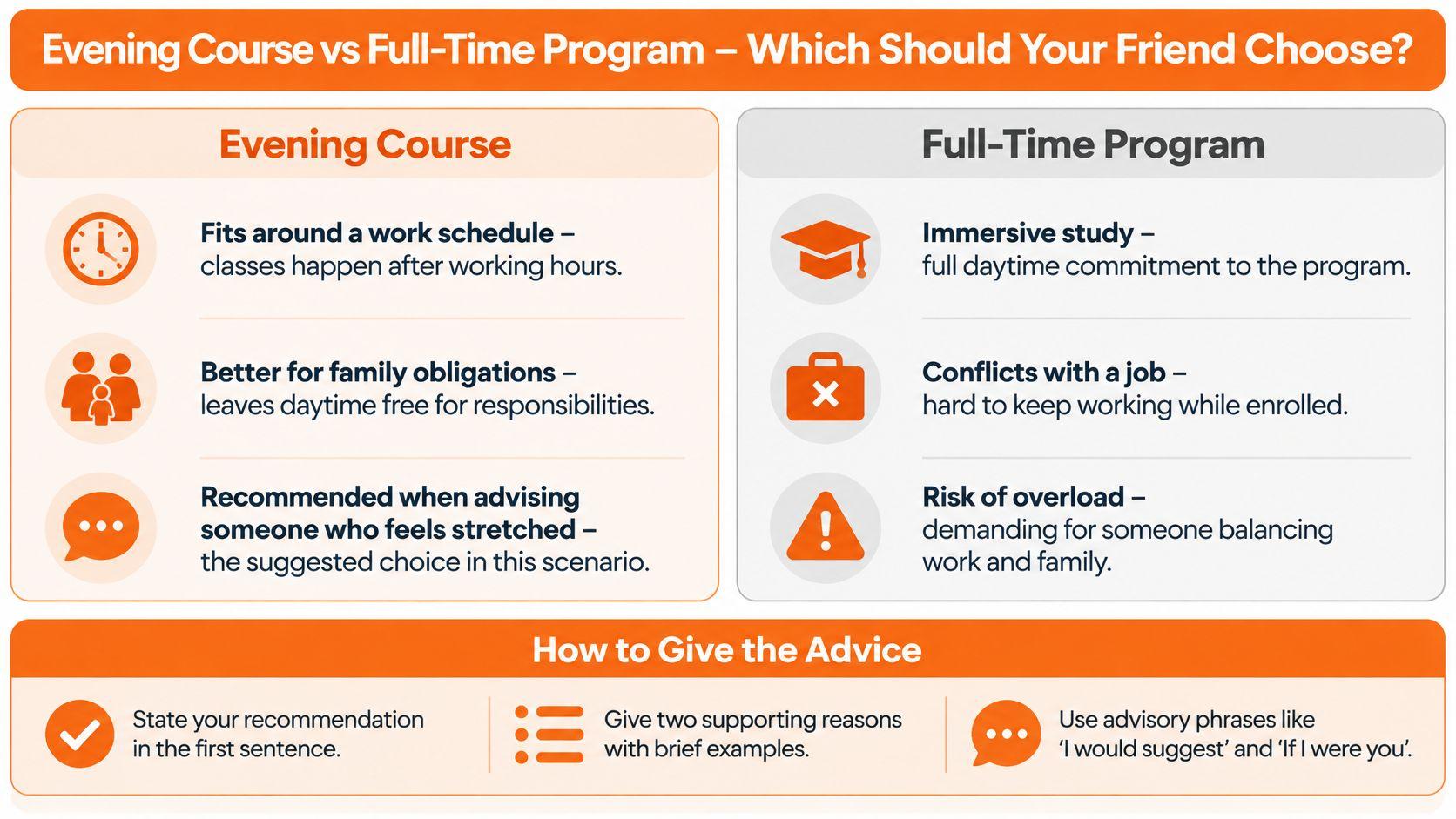
The Three-Part Advice Structure
A 60-second advice response fits comfortably between 90 and 110 words, which gives you room to speak clearly without rushing. Planning at least two distinct suggestions during prep time prevents the common trap of repeating one thin reason twice.
- Open with empathy and a clear recommendation (10 seconds): Greet your friend by name, acknowledge the dilemma, and state your pick using warm phrasing like It might be worth considering the evening course first.
- Support with two specific reasons (40 to 65 seconds): Pair each reason with a concrete detail, such as protecting a steady paycheck for someone with family obligations or applying new skills at work immediately, linked by The main benefit would be.
- Close with encouragement (10 seconds): Offer a supportive final line, like checking in after they review the course syllabus.
This same skeleton works when advising a colleague on whether to accept a job offer in another city. For Band 9 to 10 model scripts and common pitfalls to avoid, review our CELPIP Speaking Task 1 practice guide before recording your next timed attempt.
2. Task 2 Talking About a Personal Experience (A Memorable Trip)
Prompt: Describe a memorable trip you have taken. Where did you go, who did you travel with, and why was it memorable?
Candidates often lose marks on storytelling prompts because they spend 45 seconds setting up the airport drive and get cut off before explaining why the trip mattered. After brief preparation, you have 60 to 90 seconds to narrate events in a clean sequence while maintaining consistent past tenses. High-reliability oral exams reward this kind of functional storytelling: a Cornell University archived reliability study of 5,881 ACTFL Oral Proficiency Interviews shows that certified raters achieve strong scoring consistency when prompts elicit real-life communicative functions rather than isolated grammar recall.
A simple visual memory gives your answer natural emotion and specific vocabulary without forcing you to invent details on the fly.

Pick a real memory with one clear turning point rather than inventing a complicated story that forces you to pause and think.
Four Beats for Timed Storytelling
During preparation, jot down four tiny anchors: where, when, what happened, and why it mattered. Move through them with clean time markers like First, After that, and Eventually so the listener never loses the timeline.
Say you recount a weekend mountain hike with your sister that changed how you handle stress, or a family visit abroad that shifted how you view another culture. Spend 15 seconds on context, 35 seconds on the central event, and 20 seconds reflecting on what stuck with you. Rehearse with a countdown timer and study more narrative breakdowns in our CELPIP Speaking Task 2 walkthrough so you know exactly how much detail fits your speaking pace.
3. Task 3 Describing a Scene (A Busy Public Park)
Scan the image from left to right, or from foreground to background, before you say a single word. Without a spatial order, most test takers jump randomly between details and end up repeating there is five times in a minute.
Prompt: Look at a picture of a busy public park featuring families on picnic blankets, cyclists along a paved path, and a crowded food stand, then describe what is happening in the scene.
Visual tasks test present continuous tense, precise spatial prepositions, and descriptive range. The official CELPIP scoring descriptors link upper-level scores in Levels 9 to 10 with clear, precise descriptions, specific details, diverse grammatical structures, and fluent rhythm. Listing objects won't reach that bar, because raters also want you to interpret actions and atmosphere.
Watch this short breakdown of scene-description techniques to see how spatial grouping keeps pacing steady under time pressure.
Turning a List Into a Cohesive Picture
Start with a one-sentence overview of the setting and mood (for example, a sunny Saturday afternoon at a lively neighborhood park), then move through three distinct zones of the image.
- Upgrade your action verbs: Swap flat descriptions for phrases like is browsing the menu, appears to be waving, and seems to enjoy to show both lexical precision and polite speculation.
- Anchor locations clearly: Use in the foreground, just to the left of the path, and in the far background so someone who can't see the picture could sketch it from your voice alone.
- Practice beyond parks: Apply the exact same spatial scan to a crowded train station during rush hour or a local farmers market packed with vendors and shoppers, then listen back to catch rushed clusters or flat intonation.
4. Task 4 Making Predictions (A Coming Change in the Neighborhood)
Picture a residential street where crews have just broken ground on a six-story office building. You're asked to describe what changes this development will bring to the neighborhood over the next five years.
The biggest mistake on prediction tasks is relying on will for every single sentence. That pattern flattens your grammatical range and makes uncertain outcomes sound like guaranteed facts. Examiners look for logical speculation, varied modal verbs, and clear cause-and-effect links backed by sensible reasons.
Balancing Positive and Negative Forecasts
A strong prediction answer doesn't cheerlead or complain for the full response window. Split your time evenly between upside and downside to prove balanced, nuanced thinking.
- Frame the shift (10 seconds): Summarize what's changing right now and state that the development will likely reshape the area in mixed ways.
- Predict one positive outcome (25 seconds): Use modals like is likely to or could, paired with a conditional like If hundreds of office workers arrive each morning, then local cafes and bakeries will probably see stronger weekday sales.
- Predict one negative outcome (25 seconds): Pivot with On the other hand and forecast a realistic friction point, such as tighter street parking or heavier morning congestion along residential blocks.
- Offer a brief wrap-up (10 seconds): Mention a condition that could soften the downside, like better bus frequency.
Try running this same four-step forecast on how a new public transit line might shift local housing prices, or how lasting remote work trends may alter downtown office demand. Varying may, might, could, and will probably across those examples quickly builds automatic grammatical range.
5. Task 5 Comparing and Persuading (Two Options for a Company Retreat)
A weak comparison answer praises both choices equally and then asks the listener to decide. A stronger answer makes a clear recommendation, respects the other option, and shows why your choice fits the stated need. That is the core skill in comparing and persuading prompts.
Prompt: Your workplace is choosing between hosting an annual team retreat at a downtown city hotel or at a quiet rural lodge. Compare both options and persuade your colleagues to pick your preferred choice.
You can rehearse this kind of task fulfillment with the Paragon Testing free online sample test. Memorized idioms will not rescue an answer that forgets to compare, persuade, or address the listener's priorities. Examiners reward a response that stays on purpose and develops relevant reasons.
Practical rule: Name two or three decision criteria in your first ten seconds, such as cost, travel time, and team focus, so your comparison stays anchored.
Structuring a Convincing Comparison
Start with your choice and your criteria. If you prefer the rural lodge, say plainly that it suits the team better because it supports focus, relaxation, and stronger interaction. Then give each reason a short explanation. For example, the rural lodge removes downtown distractions, so departments have more space to talk, plan, and work together.
Concede one real advantage of the other option. A city hotel may offer easier transit access and more nearby services. That matters for colleagues who rely on public transportation. State that point, then return to your recommendation. The trade-off is simple: the hotel may be easier to reach, while the lodge better protects the purpose of a retreat.
A clean timing plan keeps the answer balanced. Use about 10 seconds for your choice and criteria, 20 seconds for your strongest reason, 20 seconds for the concession and counterpoint, and 10 seconds for the close. This shape prevents a long list of scattered points and keeps the persuasion visible.
Finish with a direct call to action: For these reasons, I recommend booking the rural lodge before spring rates rise. Reuse the same structure when convincing a manager to choose remote training over in-person workshops, or when arguing for one neighborhood over another when buying a family home.
6. Task 6 Dealing With a Difficult Situation (A Late Delivery)
Sounding too aggressive costs you points for tone, while sounding overly timid leaves the problem unsolved. Difficult-situation prompts test pragmatic competence, meaning your ability to stay polite, firm, and goal-focused under real Canadian workplace or service pressure.
Prompt: An important package you ordered arrived two weeks late, and the delay disrupted your plans. Call the delivery company's manager to explain the problem and request a fair resolution.
Visualizing a real counter interaction helps you keep your voice calm, measured, and natural rather than robotic.

The Courteous and Assertive Four-Step Script
When nerves hit, speakers either ramble through irrelevant backstory or blurt out demands. Keep your response disciplined with four short moves.
- Open with a courteous greeting (5 to 10 seconds): Identify yourself and state clearly why you're calling, setting a respectful register from the first word.
- State the problem in one clean sentence (15 seconds): Give the core fact (the package arrived two weeks past the promised date) and one concrete impact without blaming the employee personally.
- Bridge politely before pushing back (20 seconds): Use diplomatic phrasing like I understand the situation, however, I paid extra for expedited shipping specifically to meet this deadline.
- Make one specific, reasonable request (15 to 20 seconds): Ask for a shipping-fee refund, a partial credit, or a confirmed follow-up email by Friday afternoon, then thank the listener for their help.
Rehearse this identical register shift on two common real-life dilemmas: calling a landlord about a broken heater in the middle of winter, and speaking to a supervisor about an unexpected scheduling conflict at work.
7. Task 7 Expressing Opinions (Working From Home)
Don't spend your opening 15 seconds saying this is a very interesting topic with many sides. State your position in sentence one so the rater knows where your argument is going immediately.
Prompt: Do you think working from home should be the norm for office employees? Explain your opinion with reasons and examples.
Structured argumentation pays off across major speaking exams. For context, IELTS's test statistics page reports an inter-rater reliability coefficient of 0.90 for Speaking, which means raters tend to score the same performance consistently. Since different raters reach similar judgments, the practical lesson is simple: an answer organized around a clear position and extended reasons is easier to score well than one padded with memorized filler.
Ground your opinion in a vivid, everyday setting like a quiet home desk rather than talking in vague generalizations about the modern economy. One concrete detail does more work than three abstract claims.

Handling the Counterpoint Without Losing Your Stance
After stating a direct position (for example, supporting flexible remote or hybrid work as the default for office staff), back it up with two distinct reasons tied to real work, study, or community life. You might highlight how cutting a 90-minute daily commute protects focus and reduces burnout, then add how digital tools let distributed teams collaborate smoothly without crowded meeting rooms.
The trade-off here is real: committing fully to one side risks sounding one-dimensional, while straddling both sides waters down your opinion. Resolve this in your final 20 seconds by acknowledging an objection and answering it: Some people worry that remote work weakens team connection; however, scheduled in-person project days preserve trust while keeping daily flexibility.
This move does two jobs at once. It shows grammatical control through concession structures, and it proves you can extend an argument rather than repeat your opening sentence. You can apply the same format to arguing why public libraries should expand digital services, and test your timed delivery against additional online English speaking test prompts.
8. Task 8 Describing an Unusual Situation (A Power Outage in an Apartment Building)
You can't predict the exact curveball you'll face on Task 8, whether it's an odd object in a photo or a sudden disruption in your building. What you can control is a reliable narrative skeleton that keeps your tenses steady when the topic surprises you.
Prompt: A sudden power outage hit your apartment building during a heavy snowstorm last night. Describe what happened, how residents responded, and how you felt about the building's response.
Because unusual situations force you to combine description, narration, and brief commentary, candidates often stumble when switching between past and present tenses. Preparing a small emergency-and-disruption vocabulary kit ahead of time (words like blackout, backup generator, flashlights, hallway, and coordination) removes those mid-sentence stalls.
Linking Cause, Reaction, and Outcome
Organize your 60-to-90-second response around three clear transitions so your story flows smoothly from surprise to resolution.
- Explain what triggered the disruption (15 to 20 seconds): Set the scene with past continuous and simple past together (for example, I was cooking dinner when the lights suddenly flickered out across the entire block).
- Describe how people reacted (30 seconds): Use cohesive connectors like meanwhile and as a result to show human behavior, such as neighbors checking on older residents in the hallway and sharing battery chargers in the lobby.
- Deliver the outcome and a quick reaction (15 to 20 seconds): Close with eventually to explain when power returned, and add one sentence evaluating how calmly building management handled the crisis.
Run the same three-step drill on a sudden road closure caused by spring flooding where drivers had to coordinate detours, or a weekend neighborhood water supply interruption.
9. Variant of Task 1 Giving Advice (Choosing a Healthy Routine Before an Exam)
If you're squeezing speaking practice around a full-time job, this advice variant hits close to home. Unlike choosing between two fixed options, this prompt asks you to build a practical action plan for someone who feels overwhelmed.
Prompt: Your cousin has three weeks before an important exam and feels stressed and disorganized. Advise them on how to balance study, sleep, and exercise over the next three weeks.
Time management matters on test day just as much as it does during prep. According to the official CELPIP test overview, the entire CELPIP-General examination runs in one sitting in under two hours and 50 minutes, which means your brain has to handle timed speaking transitions when fatigue is already setting in. Practicing realistic planning advice trains both your sequencing language and your own study pacing.
Give two or three actionable steps with clear time anchors instead of five vague tips your listener could never follow.
Sequencing Practical Advice Clearly
Limit your recommendation to three concrete steps and signpost every move with First, Then, and Finally so your cousin could write them down.
Start with a warm, reassuring opening, then suggest breaking study time into focused 45-minute daily blocks targeting the weakest skill first. Next, advise locking in a consistent bedtime so memory consolidation doesn't suffer from late-night cramming. Finally, recommend a 20-minute evening walk or short workout to reset focus between sessions, and close by offering to check in at the end of week one.
10. Variant of Task 7 Expressing Opinions (Public Transit Funding)
Personal lifestyle topics like remote work come easily to most speakers, but civic and policy prompts require a cooler, more analytical tone. In Canadian academic and workplace discussions, strong speakers back up policy views with concrete trade-offs instead of sweeping slogans.
Prompt: Some people believe local governments should spend more public money on public transit rather than on new road construction. Do you agree or disagree? Give reasons and examples to support your view.
The common trap here is sounding extreme, like claiming cities should stop maintaining roads altogether. Hedging language (generally, in rapidly growing cities, over the long term) signals high-level control while keeping your main position unmistakable.
Framing Civic Trade-Offs Clearly
Acknowledge the competing pressure first, then anchor your argument in everyday realities any resident recognizes.
- Concede the opposing need briefly (10 seconds): Note that basic road maintenance remains necessary for emergency vehicles, freight delivery, and outer neighborhoods without rail access.
- State a clear policy stance (10 seconds): Pivot cleanly to argue that new capital budgets in congested cities should prioritize public transit expansion, such as dedicated bus rapid transit lanes.
- Back your stance with concrete impacts (35 to 45 seconds): Tie your two reasons to measurable daily outcomes like shorter peak-hour commute times, lower carbon emissions, and reduced household fuel and parking costs compared to adding another highway lane that quickly fills up again.
- Close with a balanced summary (10 seconds): Restate that reliable transit benefits drivers too by pulling single-occupancy cars off busy corridors.
Before test day, practice speaking aloud for one minute using a compact civic vocabulary set (congestion, infrastructure, emissions, taxpayer funding, commuters) so those terms flow without hesitation.
How Each CELPIP-Style Speaking Prompt Differs in Function and Language Focus
| Item | Speaking Function | Core Language Focus | Key Tip |
|---|---|---|---|
| Task 1: Giving Advice – Choosing a Course | Recommend an option and explain why | Advisory phrases, clear reasons, examples | State your recommendation first, then give two reasons |
| Task 2: Talking About a Personal Experience – A Memorable Trip | Narrate a meaningful personal experience | Past tenses, chronological sequencing, feelings | Outline where, when, what happened, and why it mattered |
| Task 3: Describing a Scene – A Busy Public Park | Describe a visual scene and its activities | Present continuous, prepositions of place, descriptive verbs | Organize details from foreground to background |
| Task 4: Making Predictions – A Neighborhood Change | Forecast likely effects of a development | Future forms, modals, conditional sentences | Include balanced outcomes and link causes to effects |
| Task 5: Comparing and Persuading – Company Retreat Options | Compare choices and persuade others | Comparatives, persuasive language, counterarguments | Compare options using clear criteria, then make a recommendation |
| Task 6: Dealing With a Difficult Situation – A Late Delivery | Explain a problem and request a solution | Polite, assertive phrasing and appropriate tone | State the issue clearly and make a specific request |
| Task 7: Expressing Opinions – Working From Home | Present and support a position | Opinion phrases, reasons, examples, counterarguments | State your position early and support it with concrete examples |
| Task 8: Describing an Unusual Situation – Apartment Power Outage | Narrate an unusual event and explain reactions | Varied tenses, sequencing, cause and effect | Explain what happened, how people reacted, and the outcome |
| Variant of Task 1: Giving Advice – Healthy Routine Before an Exam | Give practical guidance for study and wellbeing | Imperatives, modals, sequencing language | Limit advice to two or three concrete steps |
| Variant of Task 7: Expressing Opinions – Public Transit Funding | Take a position on a civic policy issue | Agreement language, hedging, benefits and costs | Acknowledge the opposing view and support your position with specific examples |
Turning These Speaking Prompts Into a Daily Practice Routine
Reading through questions for speaking test preparation only builds familiarity; recording timed answers builds score-ready fluency. If you have limited study time around work or family, don't try to drill all ten prompts in one exhausted evening. Spread them across a realistic seven-day cycle so every session stays under 20 minutes.
Start your week with the advice prompts (Items 1 and 9) and opinion prompts (Items 7 and 10). Their core architecture (direct claim, two supported reasons with concrete examples, and a crisp closing) transfers directly to persuasion, predictions, and difficult situations. Once those four patterns feel automatic, rotate two remaining tasks per weekday, strictly timing 30 seconds of prep and 60 to 90 seconds of speaking, then run all eight core task types back to back once on the weekend to simulate full-section transitions.
How to Audit Your Recordings Without Chasing the Wrong Fix
Reviewing your own voice feels uncomfortable at first, yet listening back to one recording per session is where real score jumps happen. Don't try to fix five issues at once. Pick one clear weakness (such as dropping into present tense during a past story, or running out of time before your closing line) and write down one specific change to apply on the very next attempt.
Be thoughtful about how you interpret automated scores when you practice on your own. A 2025 evaluation of an AI speaking-assessment tool archived by the University of Southampton found that automated grading performed well on controlled tasks but was less reliable when evaluating spontaneous speech. Because CELPIP speaking prompts demand spontaneous answers across eight communicative purposes, always compare automated notes against the official rubric, watch for recurring patterns across three or four recordings, and focus on intelligibility, clear rhythm, and complete task fulfillment rather than trying to erase your natural accent.
If you want a structured way to test this loop right away, you can record a real CELPIP-style speaking task on Celprep, which returns one specific weakness and one achievable change for your next attempt trained on CELPIP scoring criteria. The free tier gives you one exercise per task type, three starter templates, one vocabulary bundle per section, and three daily submissions without a credit card, making it easy to validate your timing and structure before committing to a paid plan.
Build your timed speaking habit on Celprep, where you can practice real exam-style CELPIP speaking prompts, access task-specific templates and vocabulary bundles, and get instant pronunciation, fluency, and structure feedback suited to each recorded response. Start with three daily free submissions to pinpoint your biggest weakness and fix it before test day.