You've done the vocabulary lists. You can read a news article in English without much trouble. Then the recording starts, two speakers talk over each other for forty seconds, and by the time you write your answer the audio has already moved two questions ahead.
That gap between understanding English and passing an English listening test is where most candidates lose their target score. It isn't a knowledge gap so much as a processing gap. The test moves at its own pace and gives you one hearing, which means your preparation has to train speed, attention and prediction, not just word recognition.
This guide explains how the main formats are built, what each one measures, and how to trace a missed answer back to a specific cause so the next practice session fixes something real.
English Listening Test Formats Compared
Almost every high-stakes English listening test follows the same rule. The recording plays once, at its own speed, and you write answers while the audio keeps moving. What changes between tests is the shape of the thing: how many parts, how many scored items, and how long you have to hold concentration.
| Test | Parts | Scored questions | Typical duration |
|---|---|---|---|
| IELTS Listening (Academic and General Training) | Four parts: two everyday, two educational | 40 | About 30 minutes |
| CELPIP Listening | Six parts: problem solving, daily life, information, news, discussion, viewpoints | 38 | 46–55 minutes |
IELTS Listening packs 40 questions into about 30 minutes, split into four parts of ten. The IELTS listening format guide lays out the progression: Part 1 is a conversation between two speakers in an everyday setting, Part 2 is a single speaker on a social topic, Part 3 is a discussion in an educational or training context, and Part 4 is one person speaking about an academic subject. The same four-part paper serves IELTS Academic and IELTS General Training, so a nurse applying to migrate and a master's applicant sit identical listening material.
CELPIP Listening works differently. It runs 46 to 55 minutes and scores 38 questions across six parts, moving from problem solving and daily-life conversation through information, news, discussion and viewpoints. Fewer items over more time means each question carries more weight, and the audio types change more often, so you're constantly switching listening stance.
Before you buy a single practice book: check which test your college, employer, licensing body or immigration program accepts, and the minimum score it names. That one detail decides whether you're training for a four-part paper or a six-part one.
Getting the format wrong wastes months of work. Getting it right tells you how long your practice sessions should run, how many questions you should answer per sitting, and which audio types you need to seek out deliberately.
What Listening Tests Actually Measure
A listening test doesn't measure whether you know English. It measures whether you can convert sound into meaning, and meaning into a written answer, before the audio moves on. Think of it as a relay with three baton passes, and a dropped baton at any stage costs you the point even if the other two stages were perfect.
Here's the chain as a single picture.
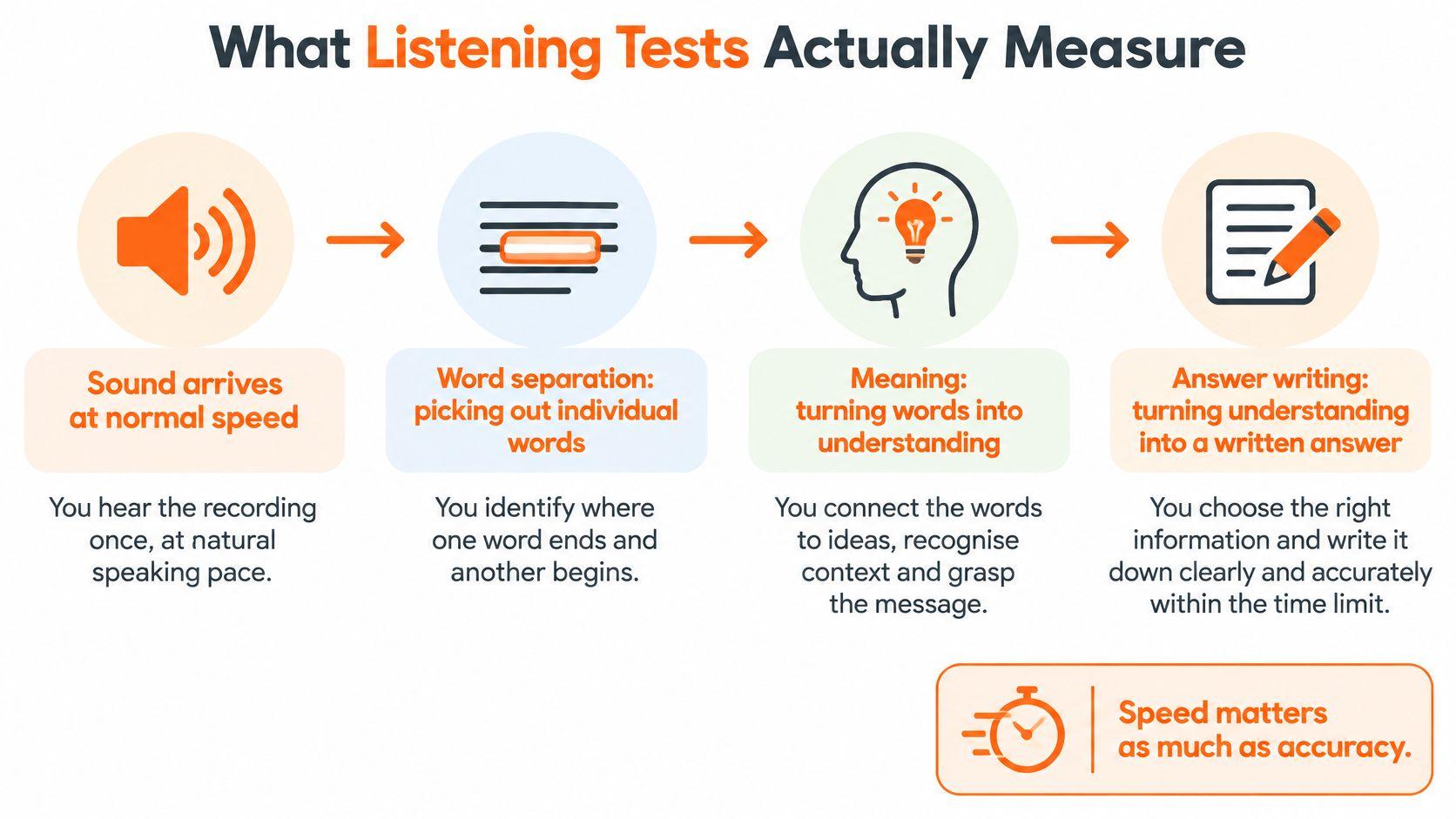
Most candidates practise only the middle stage, meaning, because that's the stage that feels like "studying English". The first stage, separating words out of connected speech, and the third, writing a correctly formed answer fast enough, are where marks disappear.
The four abilities the questions target
Every item you meet is testing one of four things, whether or not the instructions say so.
- Main idea: what the whole clip is about, or why the speaker is talking.
- Specific facts: names, numbers, dates, prices, room numbers, conditions attached to an offer.
- Speaker stance: what someone thinks, whether they're recommending or warning, how confident they sound.
- Argument structure: how a point is built, qualified, or reversed halfway through.
The British Council's guide to the listening test shows how varied the answer formats are: multiple choice, matching, plan or diagram labelling, form, note, table and flow-chart completion, sentence completion and short-answer questions. It also notes that recordings use British, Australian, New Zealand and North American accents, which rules out building your comprehension on one familiar voice.
No replays means prediction, not reaction. Skim the questions during any pause, decide what kind of answer fits each gap (a price, a surname, a day of the week), then listen for the confirmation rather than trying to catch everything.
Here's a self-check worth running after every practice clip. Before you look at the answer key, name which of the four abilities the question tested. If you can't name it, you practised listening in general, not listening for that question type, and the score won't tell you much.
CELPIP-Style Audio Scenarios Explained
Six recordings, six different jobs. CELPIP Listening changes the type of audio between parts, and the official CELPIP test format and scoring page sets the shape: approximately 46 to 55 minutes and six scored parts, running from Listening to Problem Solving and Listening to a Daily Life Conversation through Listening for Information, Listening to a News Item, Listening to a Discussion and Listening to Viewpoints. Each part gives you spoken passages followed by questions, so you never apply the same listening stance twice in a row.
Most candidates take this test at a laptop with headphones, which makes the variety easy to underestimate.

A worked problem-solving clip
Say a problem-solving recording puts a customer and a company agent on the line about a delivery that arrived three days late. The customer opens by asking for a refund. The agent offers a replacement instead. They go back and forth, the customer pushes for compensation on top, and the call ends with the agent agreeing to reship the order and waive the second shipping fee, with no refund.
The trap is the first suggestion. If you lock onto "refund" as soon as you hear it, you'll choose the option that describes what the customer wanted, not what both people settled on. The answer lives at the end of the exchange, after the negotiation, so your job is to track the final agreement and ignore the opening positions.
| CELPIP part | Audio scenario | What to listen for |
|---|---|---|
| Listening to Problem Solving | Two people working out a practical problem | The solution each person accepts |
| Listening to a Daily Life Conversation | Everyday talk between friends or colleagues | The speaker's plan, feeling or next step |
| Listening for Information | Announcement or set of instructions | Times, places, numbers and conditions |
| Listening to a News Item | Short radio-style report | What happened, who is affected and what comes next |
| Listening to a Discussion | Two or more speakers debating | Each speaker's position and where they disagree |
| Listening to Viewpoints | One speaker giving an opinion | The stance taken and the reasons given |
The walkthrough below shows the same tracking habit applied to a full set of parts.
Where most of the marks hide
In a daily-life conversation, the question usually asks what the speaker intends to do next or how they feel about a plan, not what they said first. In information clips, announcements and instructions, the answer targets are almost always concrete: a time, a place, a price, a condition such as "bring photo identification" or "registration closes on the Friday". Write those as you hear them, because the clip won't repeat them.
News items reward a simple three-part frame: what happened, who is affected, what comes next. Discussions are harder because two or more speakers hold positions, and the answer often depends on where they diverge rather than what they agree on. Viewpoint clips, the last part, ask for the speaker's stance plus the reasons behind it, and the reasons are what separate a correct option from a plausible-sounding one.
After each part, before checking the key, say the main purpose of the clip in one sentence. "Two colleagues rearranging a shift" or "a resident complaining about noise bylaws." If you can't produce that sentence, the detail questions were always going to be a coin flip.
How Listening Scores Are Calculated
A blank answer and a wrong answer can have different consequences, even when both feel uncertain. Knowing how marks work helps you decide what to do when time is short.
Each correct answer earns one mark, and a wrong answer costs you nothing. The CELPIP test results guidance explains that correct responses contribute to the final score, multiple-choice answers are scored by computer, and there is no penalty for a wrong answer. IELTS also converts the raw total out of 40 to a nine-band scale, reported in whole or half bands. Its IELTS scoring guidance notes that conversion thresholds can shift slightly between test versions.
| Test | Mark per correct answer | Wrong or blank answers | Reported scale |
|---|---|---|---|
| IELTS Listening | 1 mark | No negative marking; spelling errors or answers over the word limit count wrong | Nine-band scale in whole or half bands |
| CELPIP Listening | 1 point | No deduction; blank answers count as incorrect | 1–12 scale |
The key difference is what happens to an empty response. CELPIP guidance says blank responses count as incorrect, and questions generally have four options with one correct answer. Leaving a question empty guarantees no point; selecting an answer gives you a chance.
If time is nearly up, eliminate options you know are wrong, then choose from what remains. For IELTS, the raw score is converted to a band, and the threshold may vary slightly between test versions. The CELPIP listening score chart shows how raw points correspond to CELPIP levels from 1 to 12.
Why You Miss Answers and How to Fix Each Cause
"I understood every word and still got six wrong." Candidates say some version of that after almost every practice set, and it's the most useful sentence in listening preparation because it identifies the problem as processing rather than comprehension.
The instinctive response is to increase playback speed or memorise another vocabulary list. A 2025 study of English learners found that the recurring problems were unfamiliar accents, rapid speech, long audio passages, limited vocabulary and noise from other test participants, and a second study that year linked foreign accents, limited exposure to authentic English, concentration, anxiety and unfamiliar test formats to weaker performance, as summarised in this review of listening difficulties. Neither list is solved by drilling word lists, which is why so much preparation plateaus.
Six causes behind one wrong answer
A missed item almost always traces back to one of six mechanisms: vocabulary, connected speech, accent recognition, inference, memory or distraction. Sorting your errors into those buckets is what turns a score into a diagnosis.
| Missed-answer pattern | Likely cause | Fix |
|---|---|---|
| Heard the word but chose the wrong option | Inference error or distractor | Check whether the answer was stated or implied, then replay only that segment |
| Could not pin down a term | Limited vocabulary | Build a short list of topic words from each missed clip and hear them in context |
| Could not parse fast speech | Connected speech and delivery speed | Shadow short native-speed clips, then play them through without pausing |
| Unfamiliar accent caused the miss | Limited accent exposure | Listen to British, Australian, New Zealand and North American speakers each week |
| Forgot an earlier detail by the answer | Working memory overload | Jot one short cue per detail as it is heard, then check the cue against the question |
| Lost track after a speaker change | Attention loss at transitions and distraction | Practise clips with speaker switches and background noise, then complete full timed sets |
| Right idea, wrong answer form | Plural, number or spelling error | Write the expected form before playback and check plurals, numbers and spelling |
Notice how different the remedies are. A vocabulary miss needs more exposure to the same topic area. A connected-speech miss needs ear training on how "did you" collapses into "didja" in fast speech. A memory miss needs a note-taking habit, not more listening hours. Treating all of them with "listen more" is like treating every ailment with the same tablet.
The pattern in your error log matters more than the total. Five misses from distractors point to a completely different training plan than five misses from accents.
Write the cause before you read the key
The method is deliberately boring. Finish one timed section, then before you open the answer key, write next to each doubtful question why you think you missed it: didn't know the word, couldn't separate the sounds, lost the thread when the second speaker started, ran out of time to write.
Then check the key and compare your diagnosis to reality. Candidates are often wrong about their own weaknesses, and the log corrects them faster than any tutor can. Repeat the visible patterns in short drills and your practice data starts showing trends instead of a random score moving up and down.
Build a Staged Practice Routine for Timed Listening
The most common preparation mistake is also the most comforting one: slowing everything down and keeping the subtitles on. Research summarised in this study of speech pace and listening comprehension found that adjusting instructional speech pace can improve comprehension, while identifying fast speech, unfamiliar vocabulary, accents, grammatical structures and pronunciation as the barriers learners face. The catch is obvious once stated. An actual test doesn't slow down and doesn't offer text, so a routine that depends on either builds a skill you can't use on test day.
Rapid-fire trivia helps you memorise facts, not understand speech. Short, repeated drills with delayed replay strengthen real-time inference while keeping test-like conditions, and unrestricted pausing may improve recognition while hiding the attention and working-memory demands of a real session, as noted in this research summary on second-language listening processes.
Five stages, in order
- Start at normal speed with questions previewed. Read the prompts first and predict what type of answer each gap needs. Prediction trains the inference you'll need when there's no pause button.
- Add speed and reduced forms. Work with clips where speakers contract, elide and run words together. This builds the word-separation stage that connected speech attacks.
- Introduce competing voices and interruptions. Two speakers who cut across each other, a phone ringing, background announcements. Attention at transitions is a trainable skill, not a personality trait.
- Move to long passages, one timed pass, no pausing. Full sections under test conditions show you whether stamina holds in the last five questions.
- Review with subtitles afterwards, never during. Read the transcript only to answer two questions about each miss: why did the wrong option sound plausible, and was the correct information stated or inferred?
The order matters because each stage adds one demand while the earlier skills stay in play. Skipping to stage four feels productive and tells you nothing, because you can't yet separate a speed problem from an accent problem from a memory problem.
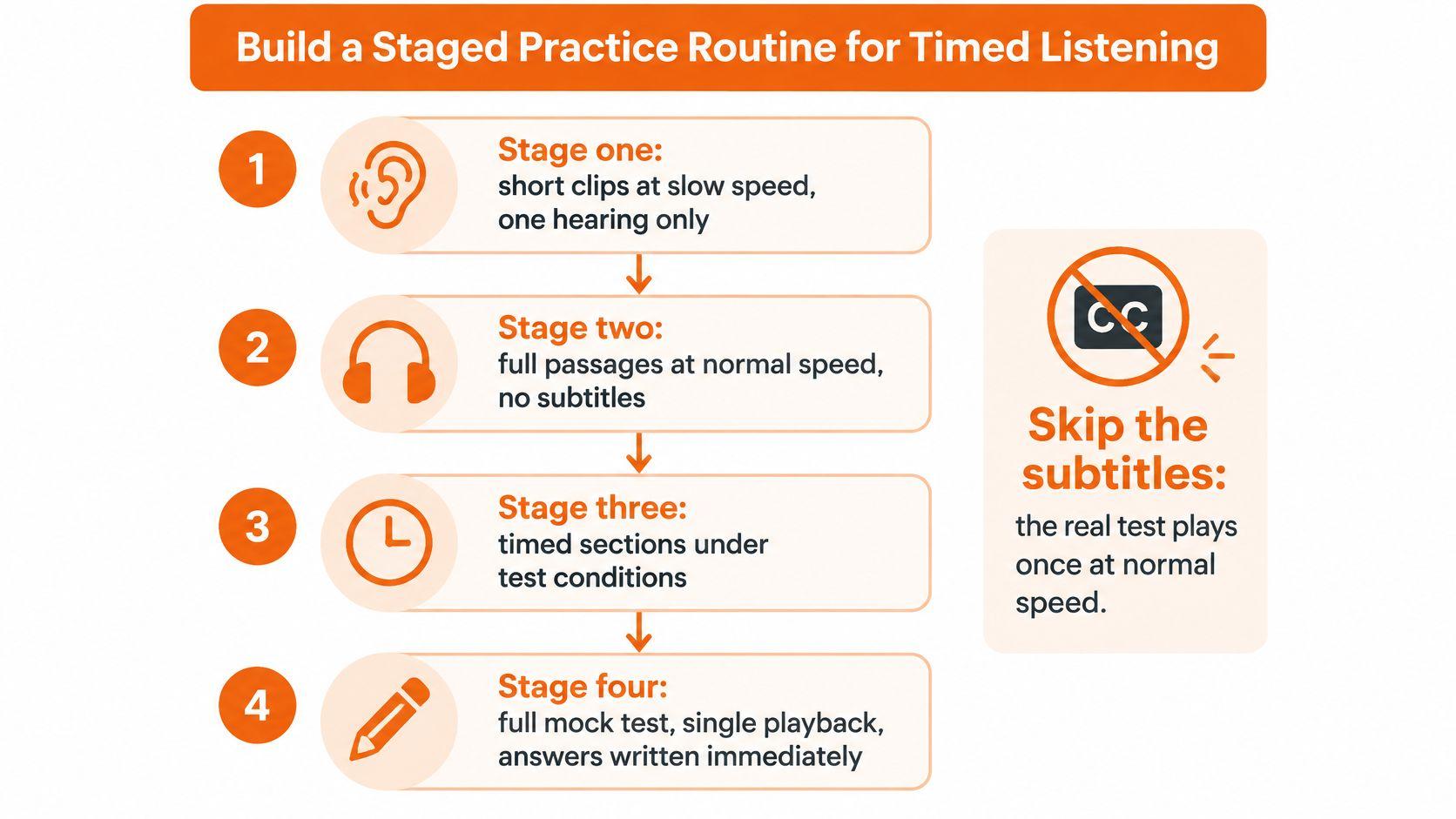
A score becomes trustworthy only when full-length timed sets hold steady across several attempts. Feeling comfortable on short, slowed, subtitle-supported clips predicts nothing, and the official frameworks reward stable performance rather than isolated wins. If you want a wider set of routines to pair with this, these study methods that hold up under timed conditions are worth reading alongside your listening log.
Confirm Your Test and Book a Timed Practice Set
Decide the format before you decide anything else. Which test does your college, licensing body or immigration program accept, and what minimum score does it state? That answer sends you either to a four-part IELTS paper or to a six-part CELPIP one, and training for the wrong one wastes weeks you won't get back.
Next, sort your recent misses using the diagnosis table from earlier. Note whether each miss came from vocabulary, connected speech, accent, inference, memory, distraction or answer form. You're looking for the cause that repeats, because that's the one worth attacking first.
Then book one full timed set this week. Follow the staged routine, log every miss with its cause before checking the key, and compare your total to your target. Spend several days on short drills for your weakest cause before sitting another full set, then compare the two full-set results rather than the drill scores.
Celprep's listening coach uses authentic conversations, announcements and discussion scenarios that mirror the CELPIP exam, so you can rehearse the six parts in the order they appear. The CELPIP practice test page shows how a timed mock runs, and Celprep is an independent practice resource, with CELPIP a registered trademark of Paragon Testing Enterprises.
Name one skill, one fix and one date. "Accent recognition, weekly Australian and New Zealand news clips, Thursday at seven." That sentence is worth more than another month of unfocused listening.
Celprep builds CELPIP-style listening practice around the six-part structure described here, with conversations, announcements and discussion scenarios that mirror the actual exam, plus full-length timed mocks under real test conditions. If Level 9 or 10 is your target, one timed listening set will tell you which cause deserves your next two weeks. Visit Celprep to try the free tier and see how the feedback reads on your own answers.