The 2025 EF English Proficiency Index drew on English-test results from 2.2 million adults in 123 countries and regions, according to Education First. That reach shows how widely English ability is measured, but a global comparison can't answer the question that matters to an applicant: will this particular result meet the receiving organization's requirements?
An English proficiency test is a timed sample of communication tasks assessed under standardized conditions. It isn't a school grade or a verdict on whether you're fluent. For someone preparing for Canadian permanent residency, a strong conversation at work may matter less than meeting the required level in every component and keeping the result valid until submission.
Major English Proficiency Tests Side by Side
Say you're comfortable answering customers' questions in English, but you're applying to a Canadian immigration program and considering university study later. Choosing the most familiar test name isn't enough. You need to find out which results each organization accepts before comparing formats.
The main options differ in what they assess, how they report performance, and who uses the results. Even versions within the same test family can serve different purposes.
Major English proficiency tests compared
| Test | Skills assessed | Score scale | Typical length | Common users |
|---|---|---|---|---|
| IELTS (Academic or General Training) | Listening, Reading, Writing, Speaking | 0–9 bands, overall reported in half bands | Check the booked version's published schedule | Universities, professional bodies, migration programs |
| TOEFL iBT | Reading, Listening, Speaking, Writing | 0–120 total, 0–30 per section | About 2 hours | Universities and licensing agencies |
| CELPIP-General | Listening, Reading, Writing, Speaking | Separate component levels aligned to CLB 3–12 | Under 3 hours | Canadian immigration, workplace and professional use |
| CELPIP-General LS | Listening and Speaking only | Separate component levels aligned to CLB 3–12 | Check the LS booking schedule | Canadian programs that accept the Listening and Speaking version |
CLB means Canadian Language Benchmarks, a framework used to describe language ability. A component is an assessed skill, such as Reading; a band or level is a reported category on a particular test's scale.
Those labels aren't interchangeable. A higher-looking number doesn't necessarily represent stronger English when you compare different tests, just as a temperature number means little until you know whether it's Celsius or Fahrenheit.
Start with acceptance: A test that suits your strengths is useful only if the organization receiving your results accepts that exact version.
Once you've identified the accepted options, compare the experience of taking them. Consider whether you're comfortable recording spoken answers, typing extended responses, and reading on a screen. Choose between eligible formats, rather than choosing a favorite format and hoping it will qualify.
The Four Skills and How Long Each Section Takes
Knowing a route well enough to drive it every day is different from passing a road test. On the road test, you must demonstrate particular actions while an examiner watches. Language testing creates a similar distinction between everyday competence and performance under specified conditions.
At work, you can ask someone to repeat a question or explain your point another way. During CELPIP-style assessment, you must understand the prompt, select relevant information, and finish within the task's limits.
CELPIP-General component windows and task formats
The CELPIP-General test description describes a computer-delivered sitting lasting under three hours, with the approximate component windows shown below.
| Component | Published time window | Task format | Usual pressure point |
|---|---|---|---|
| Listening | About 47–55 minutes | Conversations, announcements and discussions | Keeping track of details across audio |
| Reading | About 55–60 minutes | Correspondence, diagrams and viewpoints | Finishing every question in time |
| Writing | About 53–60 minutes | An email and a survey response | Organizing ideas quickly within the word count |
| Speaking | About 15–20 minutes | Advice, experience and prediction responses | Structuring a spoken answer on the spot |
These are published approximate windows, not a custom timetable you should create by adding every maximum together. Use the provider's booking information for the overall appointment schedule.
What time pressure changes
A confident speaker might give an interesting answer that never addresses the actual request. A capable writer might spend too long polishing the opening and leave a required point undeveloped. Neither problem means the person lacks English altogether.
Listening and Reading create a different challenge. You may understand the general meaning but miss who agreed to do something, which condition applies, or how the writer's opinion differs from another person's.
Separate the likely causes before choosing practice:
- Language gap: You can't understand or express the idea accurately, even without a timer.
- Format gap: You understand the language but aren't sure what the task expects.
- Timing gap: You can complete the task well, but not within the available window.
Try a representative task under timed conditions, then examine the same task without pressure. The difference helps you identify whether you need stronger English, better exam familiarity, or both. Start with the skill that feels least like ordinary communication and most like a race.
How Component Scores Become Levels and Bands
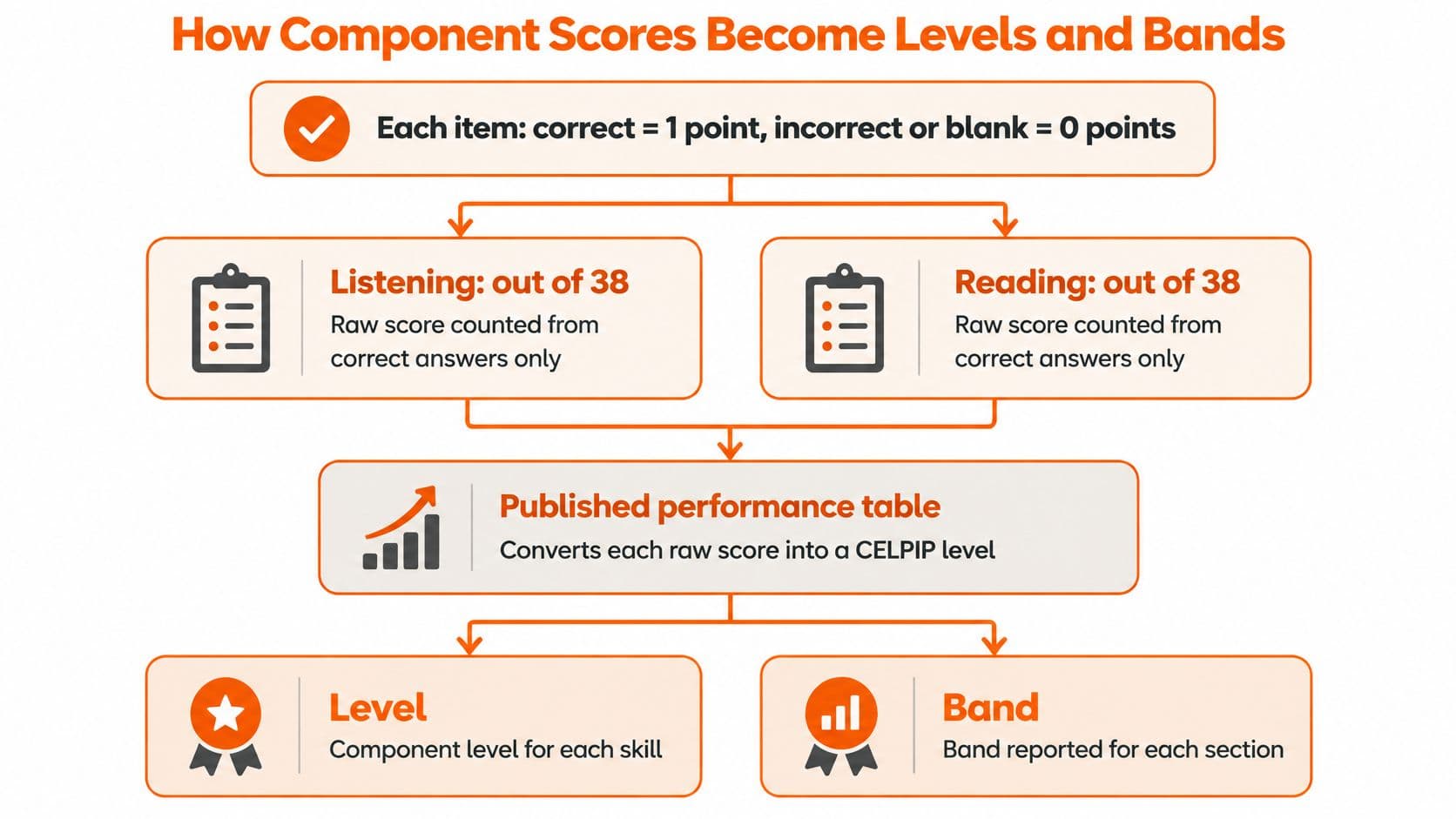
Guessing costs nothing on the CELPIP Listening and Reading sections. A wrong answer and a blank answer receive the same treatment: neither earns credit. The CELPIP teacher guidebook describes this correct-or-incorrect scoring and reports both components on a 38-point scale, which produces the published performance ranges below.
CELPIP Listening and Reading correct answers by level
| Level | Listening (correct out of 38) | Reading (correct out of 38) |
|---|---|---|
| Level 7 | 27–31 | 24–28 |
| Level 8 | 30–33 | 28–31 |
| Level 9 | 33–35 | 31–33 |
| Levels 10–12 | 35–38 | 33–38 |
Read each row horizontally. The correct-answer range attached to a level differs between the two components: 29 correct answers falls inside the Level 7 range for Listening but the Level 8 range for Reading.
Neighboring ranges also overlap, and Levels 10 to 12 share one broad band of 35 to 38 in Listening. Treat the table as a guide to where your practice totals sit, not a promise that a particular raw score always produces a particular level.
The diagram illustrates the basic counting and reporting sequence.
What the ranges mean for preparation
A candidate near a boundary has little room for avoidable errors. Leaving questions unanswered, overlooking a negative word, or confusing the speaker's suggestion with the final decision can pull a raw total below the range you targeted.
A CELPIP score calculator can show where a practice total falls within the published ranges. Treat any estimate as a planning aid rather than an official scoring decision.
Record the reason behind each missed answer. Useful categories include misunderstood vocabulary, missed detail, incorrect inference, and unfinished question. A raw total tells you how the attempt went; an error log tells you what to practice next.
Don't aim only to touch the edge of a published range. Build enough consistency that an unfamiliar topic or difficult passage doesn't undo your preparation.
Writing and Speaking need a different approach
Writing and Speaking work differently because there is no answer key to count. Assessors judge how effectively you complete the task, develop and organize ideas, choose vocabulary, and control grammar. Clear communication carries more weight than impressive words.
For an email, ask whether you explained the situation, addressed every requested point, and used an appropriate tone. For a spoken response, ask whether a listener can follow your main point, supporting reasons, and conclusion.
CELPIP reports component levels; IELTS uses bands. CELPIP produces four separate component results and no additional overall score, so each level stands on its own when an organization checks your profile.
That separation is what makes component scores matter. An acceptable Reading result doesn't explain a shortfall in Writing, and a polished Speaking answer can't compensate for unanswered Reading questions. Read your results as four separate gates rather than one average, because a single weak component can block a goal even when the other three look strong.
How the Major Tests Build and Report Scores
A score report works like a transcript: each skill receives its own result, and the summary does not erase differences between those components. IELTS and TOEFL scores therefore can't be swapped one-for-one. Their scales divide performance differently, and the receiving organization decides which result satisfies its requirements.
According to the IELTS scoring guidance, the overall band is the average of the four section bands, rounded to the nearest half band. For Writing, assessment dimensions include task achievement or response, coherence and cohesion, lexical resource, and grammatical range and accuracy.
Those dimensions ask whether you answered the task, arranged your ideas clearly, selected suitable words, and used grammar effectively. A strong total can still conceal one weak component.
How each test assembles the result
The ETS explanation of TOEFL and CEFR mapping gives TOEFL iBT section scores of 0–30, a total score of 0–120, and approximate CEFR total reference points of 42 for B1, 72 for B2, 95 for C1, and 114 for C2.
| Test | Score scale | How the overall score is built | Reference points |
|---|---|---|---|
| IELTS | Section bands and an overall band | Average of section bands, with rounding to the nearest half band | Requirements are set by the receiving organization |
| TOEFL iBT | Section scores of 0–30 and a total of 0–120 | Sum of section scores | Approximate CEFR totals: B1 42, B2 72, C1 95, C2 114 |
| CELPIP-General | Separate component levels aligned to CLB | Each component reported on its own | CELPIP level corresponds to the CLB level |
CEFR, the Common European Framework of Reference for Languages, describes broad proficiency categories. A reference point helps interpret a total score, but it does not show whether every skill reached the same level.
Why an overall result can hide a weak skill
An overall score works like a course average. A high Reading or Listening result can raise the summary while Writing or Speaking remains below a required minimum.
Before using a conversion chart, identify the decision you need to make. A rough comparison can help you interpret an unfamiliar scale, but it can't replace an admissions or immigration rule.
Read the complete requirement: accepted test, required total where applicable, and section minimums. A conversion estimate can't grant an exemption from any of those conditions.
Why Universities and Immigration Programs Ask for Them
Organizations ask for language results because they need comparable evidence from applicants educated in different places. According to the ETS TOEFL score-data summary, by 2021 TOEFL scores were accepted by more than 11,500 colleges, universities, and licensing agencies across over 160 countries.
That broad acceptance doesn't create a universal admission standard. Each receiving organization decides what evidence it needs for its own purpose.
Match the result to the decision
| Purpose | What to identify in the requirement |
|---|---|
| University admission | Accepted version, overall requirement, section minimums, and any department-specific rule |
| Immigration | Eligible test, component benchmarks, and rules for keeping results valid |
| Professional licensing | Required skill profile and whether language evidence must be submitted before registration |
| Employment or certification | Accepted evidence, required level, and submission process |
Immigration requirements can differ between pathways. A test accepted for one application isn't automatically suitable for another, and a language result sufficient for eligibility may not achieve the points outcome you want.
Professional licensing creates a separate question. A result used for an immigration application doesn't automatically satisfy the regulator responsible for your occupation.
Read the rule before judging the result
Look for words such as overall, each component, minimum, and accepted version. These tell you whether the organization checks a combined result, individual skills, or both.
A weaker section blocks the goal when the applicable rule requires that section to meet a minimum. Don't assume every uneven profile is unacceptable, but don't assume a strong total cancels a shortfall either.
If the wording is unclear, ask the receiving organization a precise question: does this exact test version and component profile satisfy this application? Keep its response with your application records so you're planning against a clear requirement rather than a general internet comparison.
How to Choose the Right Test Version and Target
Choose in this order: destination first, test second, preparation third. Reversing that order can leave you practicing tasks that won't produce the evidence your application needs.
This selection guide captures the starting decisions.

A practical selection sequence
-
Name the receiving organization and deadline. Identify the exact program, institution, or regulator. Save the requirement page and distinguish the registration deadline from the result-submission deadline.
-
Confirm the accepted test version. The CELPIP guide for score users distinguishes CELPIP-General, which assesses all four skills, from CELPIP-General LS, which assesses Listening and Speaking only, and maps CELPIP 9 to CLB 9 and CELPIP 12 to CLB 12. A similar name doesn't make a different version acceptable.
-
Write down each component target. Use the requirement's own labels and list Listening, Reading, Writing, and Speaking separately where applicable. Don't reduce a component-based requirement to a vague goal of better English.
-
Check validity against your application timeline. Include likely administrative delays and time to obtain another result if necessary. A qualifying result must still be usable when the organization requires it.
-
Compare the eligible formats with your strengths. Consider recorded speaking, typing, screen reading, question types, and sustained concentration. Our CELPIP versus IELTS comparison can help you examine format differences after acceptance is confirmed.
-
Choose preparation resources for the actual gap. Use language-building work if comprehension or expression is weak, and task-specific timed practice if the format is the obstacle. Prioritize components below target rather than dividing study time equally by habit.
Make the target usable
Keep a one-line booking note: accepted test version, required component profile, submission deadline, and validity checkpoint. That note should be specific enough that another person could check your booking against it.
Our free plan includes one exercise per task type across Writing, Reading, Listening, and Speaking, three starter templates, one vocabulary bundle per section, and three submissions per day without a credit card. We give personalized feedback on every attempt, aligned with CELPIP scoring criteria, and our My Progress tool tracks improvement and shows what to work on next; paid plans add the full practice library and unlimited feedback. The purpose of criteria-aligned feedback is to explain how you developed ideas, chose vocabulary, communicated clearly, and completed the task, using examples from your response rather than only a number.
Re-check the receiving organization's requirement before booking. It decides which test version and score profile count, regardless of what a preparation resource recommends.
How Long a Result Stays Valid and Why Timing Matters
Taking the test as early as possible isn't always the safest choice. An early attempt gives you more opportunity to improve, but it also starts the validity clock sooner.
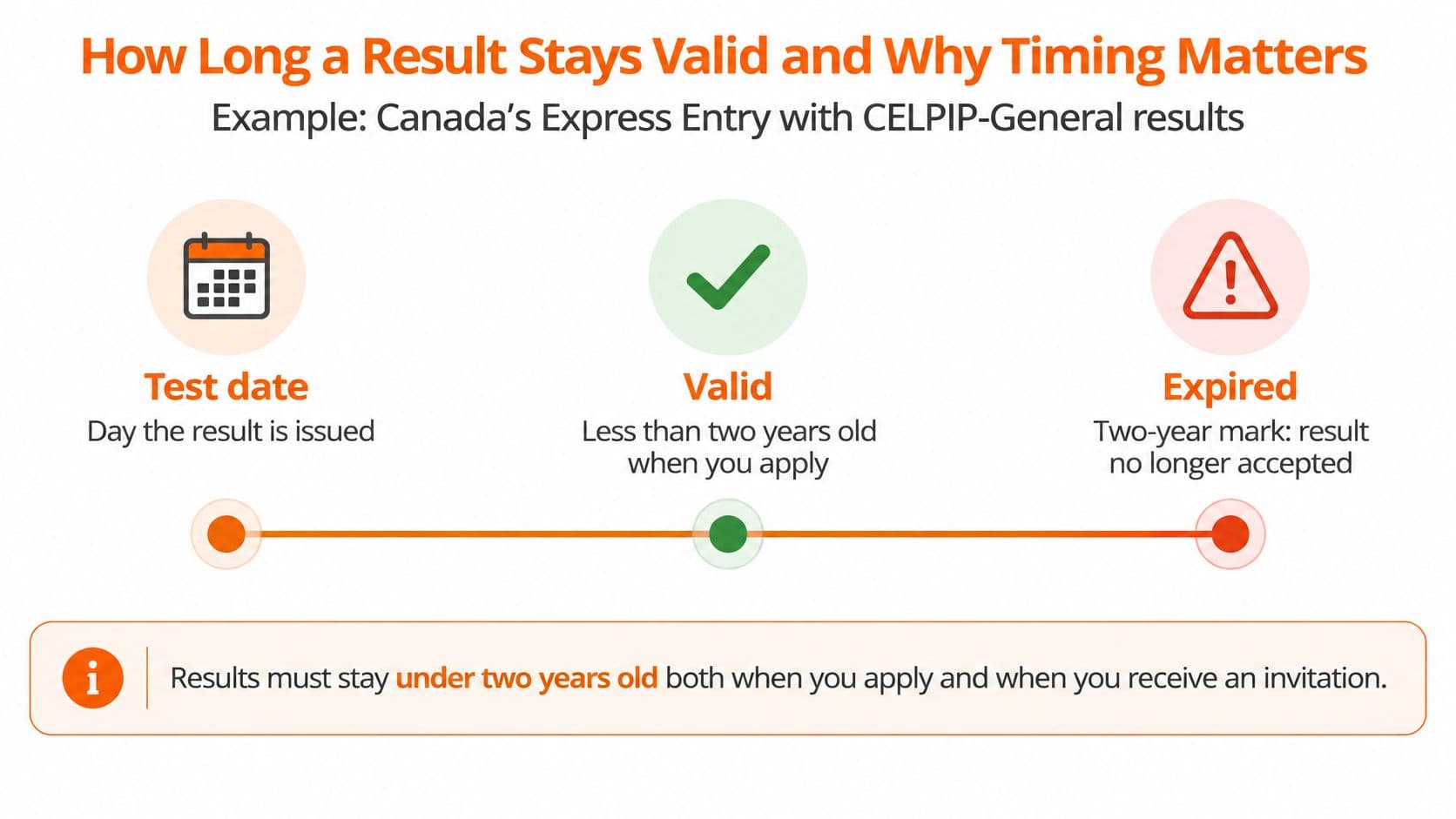
For Express Entry, Immigration, Refugees and Citizenship Canada's language-test guidance accepts CELPIP-General and requires results to be less than two years old both when you submit your profile and when you submit your permanent residence application. An expired result can affect language points or eligibility even if you previously met the required benchmark.
The timeline highlights the expiry risk. For planning, distinguish the invitation from the later permanent residence application: receiving an invitation doesn't remove the need to submit valid results with that application.
Plan backward from submission
Don't plan only around the day you hope to receive an invitation. Include the application work that follows it, and allow room for an unexpected delay.
Build a timeline containing:
- Test date: Record the date used for validity and retain the official result.
- Profile submission: Check that the result qualifies when you enter the pool.
- Expected invitation: Treat this as uncertain, not a guaranteed appointment.
- Permanent residence application: Check that the result will remain acceptable at submission.
- Possible retake: Leave room to book, prepare, sit the test, and receive another result.
Work backward from the anticipated application submission to identify the latest practical testing point that still leaves a retake buffer. Then compare that plan with the earliest attempt that would help you diagnose your current ability.
An early result is useful evidence of readiness. It isn't a guarantee that the same result will remain usable throughout a delayed application.
Protect the application, not just the score
Avoid changing your plans solely because a particular benchmark is described as valuable online. Points systems and program selection rules aren't interchangeable; check the calculation that applies to your pathway.
Validity also matters outside immigration. Receiving organizations may treat older results differently because language ability can change through continued use or reduced exposure.
Add reminders before the result approaches expiry, and keep studying the component most likely to fall below target on a renewal attempt. Maintaining eligibility requires both a suitable skill profile and usable evidence of it.
Preparing Around Your Weakest Skill
A proficiency test gives you four separate results, and the lowest one sets your ceiling. A strong Reading score cannot compensate for a Speaking result that falls below the requirement, so a useful preparation plan starts with the component blocking your goal, not with the exercise you enjoy most. Put your latest component profile beside the receiving organization's requirements and mark the shortfalls.
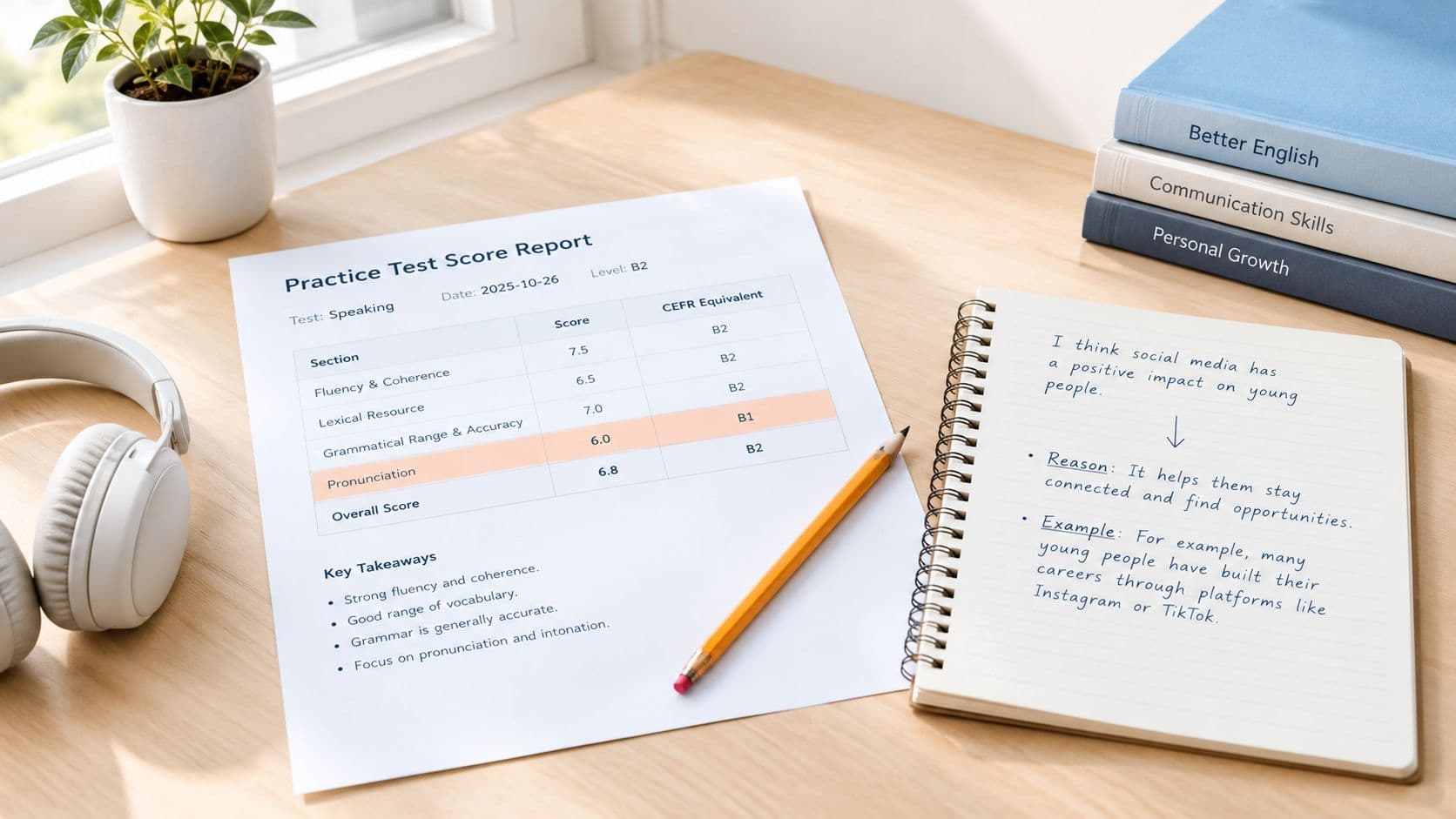
Treat a practice report as a diagnostic record rather than a verdict on your overall English.
Match the symptom to the practice
| Weak component | Typical sign | First practice focus |
|---|---|---|
| Speaking | You stop after the opening idea or rush the ending | Record timed responses; plan a main point and at least two supporting reasons before speaking |
| Writing | Relevant ideas appear in a confusing order, or the response misses task requirements | Draft timed emails and survey responses using a repeatable structure |
| Reading | You understand passages but leave later questions unanswered | Drill question types under time and explain every incorrect answer |
| Listening | You understand the topic but miss decisions, conditions, or speaker details | Use varied audio and compare your notes with the details actually stated |
For Speaking, listen to the recording before reading feedback. Can you identify your recommendation immediately, and does each supporting point explain why it helps? A common Task 1 mistake is offering only one piece of advice. During prep time, plan at least two clear suggestions, then build the answer as a greeting and problem summary, the advice with reasons, and a closing recommendation.
For Writing, underline every part of the prompt and match it to a sentence or paragraph in your response. If a requested point has no matching passage, fancier vocabulary won't solve the main problem.
Watch the video alongside active practice, then apply its guidance to a fresh response.
Build a repeatable diagnostic routine
Success means reaching the result you need, not clearing a universal pass mark. Preparation routines differ, but candidates usually benefit from a consistent timed practice schedule and extra attention to the component that falls furthest below target.
If you want to test a routine before paying for preparation tools, Celprep's free plan includes one exercise per task type, three starter templates, a vocabulary bundle per section, and three submissions per day, with no credit card required. That is enough for a first diagnostic week.
Use a CELPIP practice test to establish a timed baseline. Choose the below-target components, review each response against the scoring criteria (coherence, vocabulary range, grammar accuracy, and task completion), and make one specific change before repeating the task.
For Reading, explain why the correct option fits and why your choice doesn't. For Listening, identify whether you missed the language itself or failed to retain the detail. That distinction keeps you from repeating exercises without changing the skill behind the mistake.
Practice scores are estimates, not official results. Celprep is an independent practice resource, and CELPIP is a registered trademark of Paragon Testing Enterprises. Confirm official test requirements with the test provider and application acceptance rules with the organization receiving your results.
Celprep offers timed CELPIP practice, full-length mock tests, and personalized feedback across Listening, Reading, Writing, and Speaking. Visit Celprep to compare your component performance with your target and start practicing the skill that needs the most attention.