You finish a timed reading set, check the answer key, and the score lands at 8 when you need a 9. The key tells you which letters were right. It doesn't tell you why the wrong ones felt right when you chose them, and that's the part costing you points.
In most cases, a missed reading question is rarely a general "my English isn't good enough" problem. It's a specific reasoning error with a name: you searched for the exact word instead of the paraphrase, you picked the option that repeated the most words from the passage, or you spent three minutes on one inference item and never reached the last four questions.
Each of those errors has its own fix. None of the fixes is "memorise more vocabulary", and all of them start with knowing exactly what a question is asking you to prove.
Common English Reading Test Formats
Almost every English reading test reuses five question formats, and the trap built into each one is different. Learn the shapes once and the packaging stops surprising you.
-
Multiple choice. One correct option, three distractors. The trap is an option that sounds sensible in real life but isn't supported by the passage. If you can't point at the line that proves it, it's a distractor.
-
True, false, not given. The statement is judged only against the text. "Not given" means the passage is silent, which is not the same as false. Learners lose marks here by importing what they know about the world.
-
Matching headings or matching information. You pair paragraphs with main ideas, or details with the section that contains them. The work is deciding what a paragraph is for, not what it mentions in passing.
-
Gap fill and sentence completion. You supply a word or phrase from the text, usually under a strict word limit. Spelling counts, and so does the limit: two words where one is allowed scores zero.
-
Short answer. A few words, copied or lightly restated. The marking is unforgiving about extra words and about grammar that shifts the meaning.
Different names, same three moves. Find the evidence zone, restate that evidence in your own words, then test every option against it. A candidate who can do those three things on a matching task can do them on a multiple-choice item, because only the format changed.
The habit that transfers: don't read the options until you know what the question is asking for.
The rest of this page applies those moves to CELPIP, a computer-delivered test where four task areas change what you read but not how you have to think.
Four Reading Task Areas and What Each Tests
CELPIP Reading is one computer-delivered component with 38 scored questions split across four task areas, as CELPIP's test format and scoring page sets out. Each area hands you a different kind of text and a different reason to read it, so the questions change shape even though the underlying skill doesn't.
| Task area | What you read | Skill tested | Typical question stem |
|---|---|---|---|
| Reading Correspondence | Emails, letters, notices | Finding purpose, requests and key details | Why is the writer contacting the reader? |
| Reading to Apply a Diagram | Schedules, maps, forms, floor plans | Matching text conditions to a visual | Which room or time fits the stated condition? |
| Reading for Information | Articles and informational passages | Locating details, main ideas and inferences | What does the passage imply about the proposed change? |
| Reading for Viewpoints | Opinion pieces and multi-writer exchanges | Identifying stance and agreement | Which writer supports the proposal? |
Read that table as a practice map. Correspondence rewards speed on short texts and close attention to what someone wants from you. Diagram items punish anyone who reads the text and forgets to check the visual. Viewpoints is the area where two writers can sound reasonable and disagree, so you have to track who said what rather than what the topic is about.
The whole component runs 43 to 56 minutes, and the clock starts with the first question, not after you've finished reading the first email. Plan for the time limit rather than discovering it.
CELPIP is a registered trademark of Paragon Testing Enterprises, and Celprep describes itself as an independent practice resource rather than the official test provider. The worked examples here follow the published task structure; for anything involving registration, always work from the official source.
How to Reason Through Each Reading Question
The correct option is the one the passage can prove. Not the one that sounds most reasonable, not the one that matches your own opinion, and definitely not the one that repeats the most words from the text.
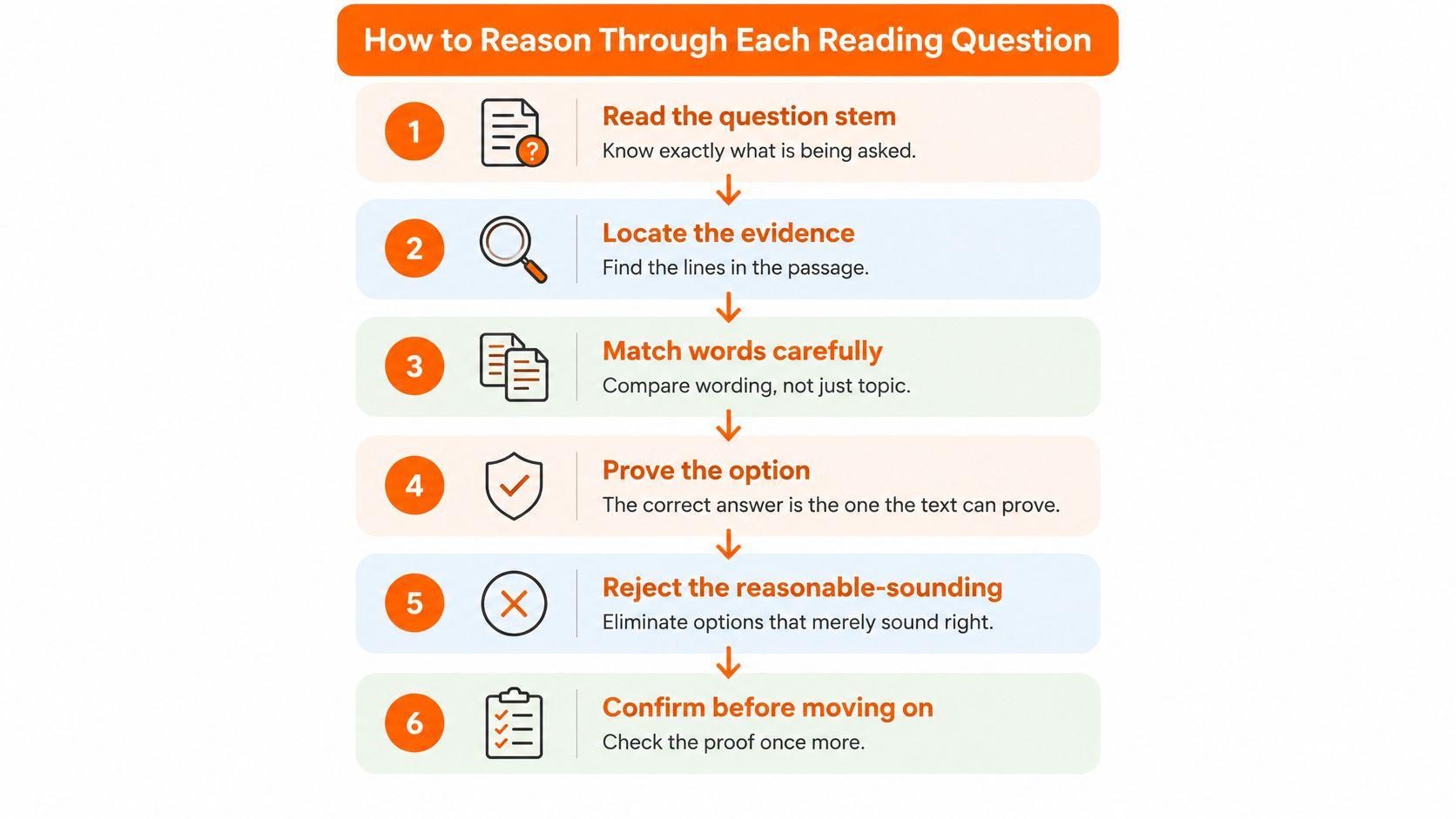
That sounds obvious, and yet most wrong answers come from choosing on feel rather than proof. The sequence below turns a vague sense of "this one looks right" into a decision you can defend in one sentence.
-
Read the stem first and underline its target. Identify whether you're hunting a date, a name, a reason or a writer's stance. Know that before you touch the passage, because it stops you reading every sentence as if it carried equal weight. The common slip is reading all four options first, which fills your working memory with three wrong answers before you've found the evidence.
-
Skim for the evidence zone. Answers live in one or two sentences. Fight the urge to read the whole passage closely twice; the second read usually produces the same understanding and costs you two questions at the end.
-
Restate the evidence sentence in your own words. Test writers paraphrase, so the correct option rarely reuses the passage's wording. The slip here is hunting for the synonym you'd have chosen rather than the one the writer used.
-
Eliminate options that overreach, reverse the claim, or borrow passage words in the wrong context. Three checks catch most distractors. Does it say more than the text says? Does it flip who did what, or when? Does it lift a phrase from the passage and attach it to a different subject?
-
Choose the option the evidence fully supports. If two options survive, reread only the evidence sentence rather than the whole passage. The most common last-second error is switching to the answer that sounds more polished.
-
If it's still unclear after one reread, mark it and move on. Every item is worth the same single point, so a hard item parked for later costs you nothing, while a hard item you refuse to leave costs you whatever comes after it.
Notice how much of that sequence is about restraint. Two of the six steps tell you to read less, not more.
Self-check before you move on: can you point to the exact sentence that proves your answer? If the proof lives only in your head, you've guessed.
The same sequence handles viewpoints. Restate each writer's position in one line, then check the option against those lines instead of against your memory of the whole passage.
Pacing Your 38 Questions Under the Clock
Divide the clock by the item count and the arithmetic gets blunt. Thirty-eight questions across 43 to 56 minutes works out to roughly 68 to 88 seconds per item, and that budget has to cover reading the passage, locating the evidence, weighing four options and confirming your choice.
Nothing is subtracted for a wrong answer, and a blank is scored exactly the same as a wrong answer. So a considered guess is never worse than an empty line, and leaving something blank out of caution achieves nothing.
Where pacing goes wrong is the hard item that swallows three minutes. Those three minutes don't just cost you that question if the answer turns out wrong. They often leave the final three or four questions unread, and unread is unanswered.
A working budget with two checkpoints
Aim for about 80 seconds per item and check your position twice. You should be around question 15 at the 20-minute mark and around question 28 at the 37-minute mark. If you're behind at either checkpoint, the next few items get a faster first pass: answer what's provable, mark what isn't, and keep moving.
Sort every answer into one of three buckets
Keep a practice log with three columns rather than a score. Mark each question as correct under normal timing, correct only with extra time, or incorrect even with extra time. The second bucket is a pacing problem, so the fix is drill speed on that question type. The third is a knowledge problem, so the fix is instruction and review. Treating both as "I need to practise more" wastes weeks on the wrong drill.
Practical rule: any question that has taken longer than two minutes gets a considered guess and a mark, and you move to the next one.
Reading Score Levels 9 and 10 Explained
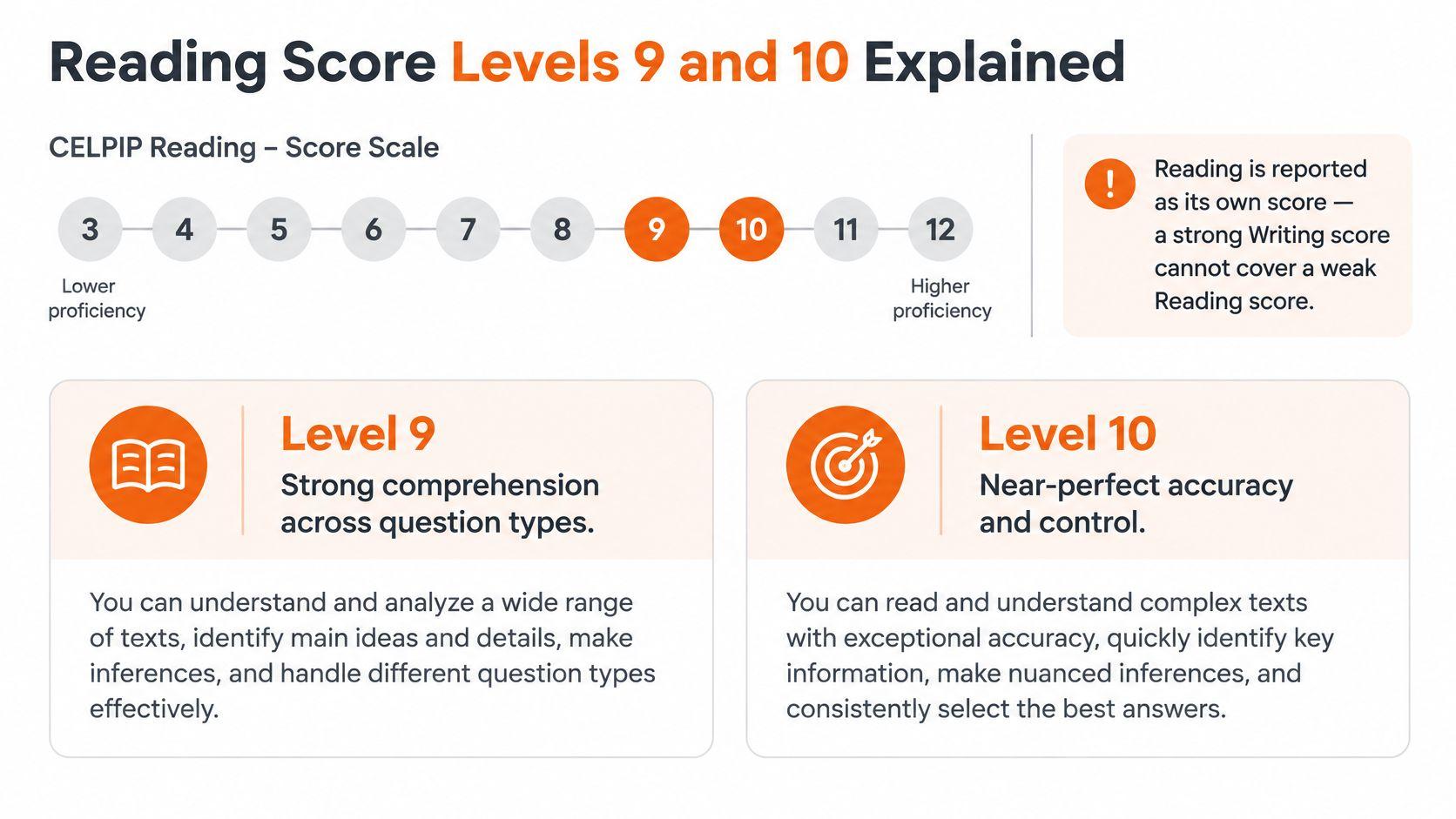
A Reading 9 and Reading 10 sit beside each other on the score report, but they describe different levels of consistency under demanding conditions. That difference matters when a requirement names a Reading minimum: the component stands on its own, and a stronger Writing, Listening or Speaking score cannot lift it.
| CELPIP Reading level | CEFR band | CLB level | What the level signals |
|---|---|---|---|
| CELPIP 9 | B2 | CLB 9 | Effective handling of demanding material |
| CELPIP 10 | C1 | CLB 10 | Highly effective handling of demanding material |
| CELPIP 11–12 | C1 and above | CLB 11–12 | Performance above Level 10 |
Reading is reported as its own component score. The CELPIP test overview describes Level 9 as effective proficiency in some high-stakes social, educational or workplace contexts, describes Level 10 as highly effective proficiency in some high-stakes contexts, and lists an Australian DHA proficiency category with Reading at 8, Listening at 9, Writing at 10 and Speaking at 8.
That added “highly” works like a consistency requirement. Level 9 indicates that you can deal effectively with demanding reading situations. Level 10 expects that effectiveness to hold more reliably across the harder passages and question types.
At the top end, a small cluster of errors can carry more weight because there is less room for inconsistency. Treat one practice-set percentage as a rough signal rather than a verdict. Several timed sets give a clearer picture, especially when each miss is reviewed as a reasoning error instead of being blamed automatically on vocabulary.
For a compact reference to the level labels, use this CELPIP Reading score chart, then define your target from the required Reading minimum. After each practice set, identify the reasoning step that failed: finding the evidence, interpreting a restatement or rejecting a familiar-sounding option. A repeated failure points to the skill that needs repair before you add more practice volume.
Review Reading separately from the other components. A four-part average can hide the one component that has to meet a specific minimum.
Why Detail Questions Keep Going Wrong
When a candidate misses detail questions, the reflex is to assume a vocabulary gap and start memorising word lists. That diagnosis is usually wrong, and acting on it wastes a month.
Evidence for that comes from a 2025 study of 26 English learners, which found that identifying detailed information was the hardest of five comprehension skills and accounted for 40% of incorrect answers. The same study pointed to inadequate reading strategies alongside limited vocabulary as internal factors, which suggests strategy work and word study belong together rather than as substitutes for each other.
Vocabulary isn't innocent. It's just not the whole story, and it doesn't explain why two candidates with the same word knowledge score differently.
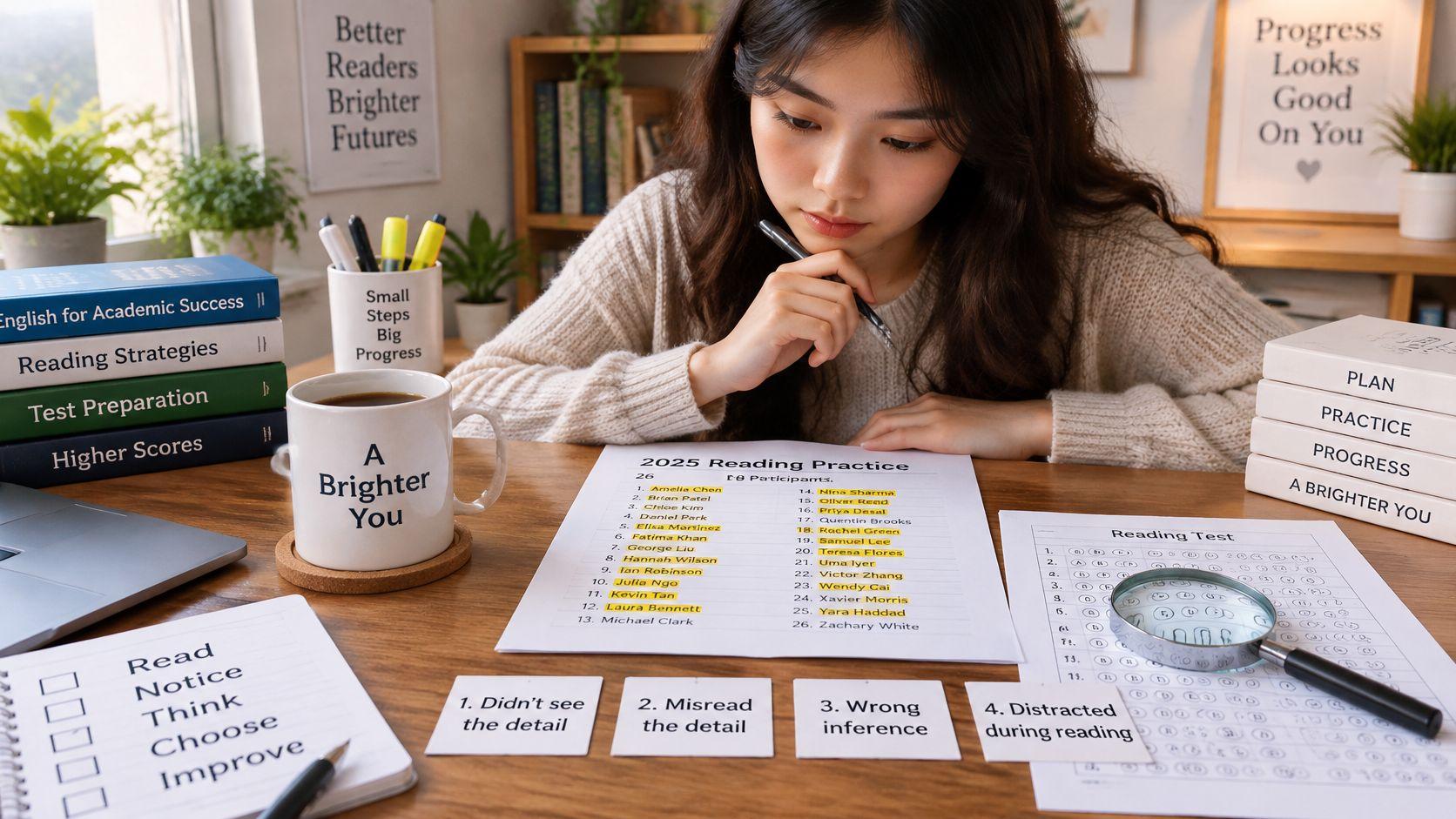
A missed detail question leaves a fingerprint. Four causes cover most of them, and each one produces a different sign.
| Error type | Sign you made it | Targeted fix |
|---|---|---|
| Paraphrase miss | You searched for the exact word and found nothing | Map synonyms and restate the question in your own words |
| Distractor wording | The option repeats passage words but changes who, when or what condition | Check the subject, time and condition of each option against the evidence sentence |
| Unfamiliar vocabulary | You understood the sentence structure but not one key word | Note the word, infer its meaning from context, then recheck the evidence sentence |
| Paragraph tracking | The answer sits in a different paragraph from where you searched | Mark paragraph boundaries and return to the paragraph that holds the question stem |
Here's how the diagnosis works on a real item shape. The question asks when a meeting moves. The passage says the session is pushed to Thursday after the room is booked. One option says the meeting is cancelled, and it reuses both meeting and room, so it looks familiar. It changes what happens, which makes it a distractor-wording error rather than a comprehension failure.
You tag that in the log as distractor wording, and the intervention is narrow. Reread the evidence sentence and check the subject, the time and the condition of each option against it. Cancel is not booked. Thursday is not today.
A wrong detail answer is a fingerprint. Read it before you decide what to study.
Run the tag for a week of practice and the pattern usually concentrates in one row of that table. That row tells you what to drill.
Targeted Practice Plan for Each Weak Skill
Your log decides the week, not a generic reading schedule. One focus per day, one source of evidence per day, and a weekend review that uses the same three buckets throughout.
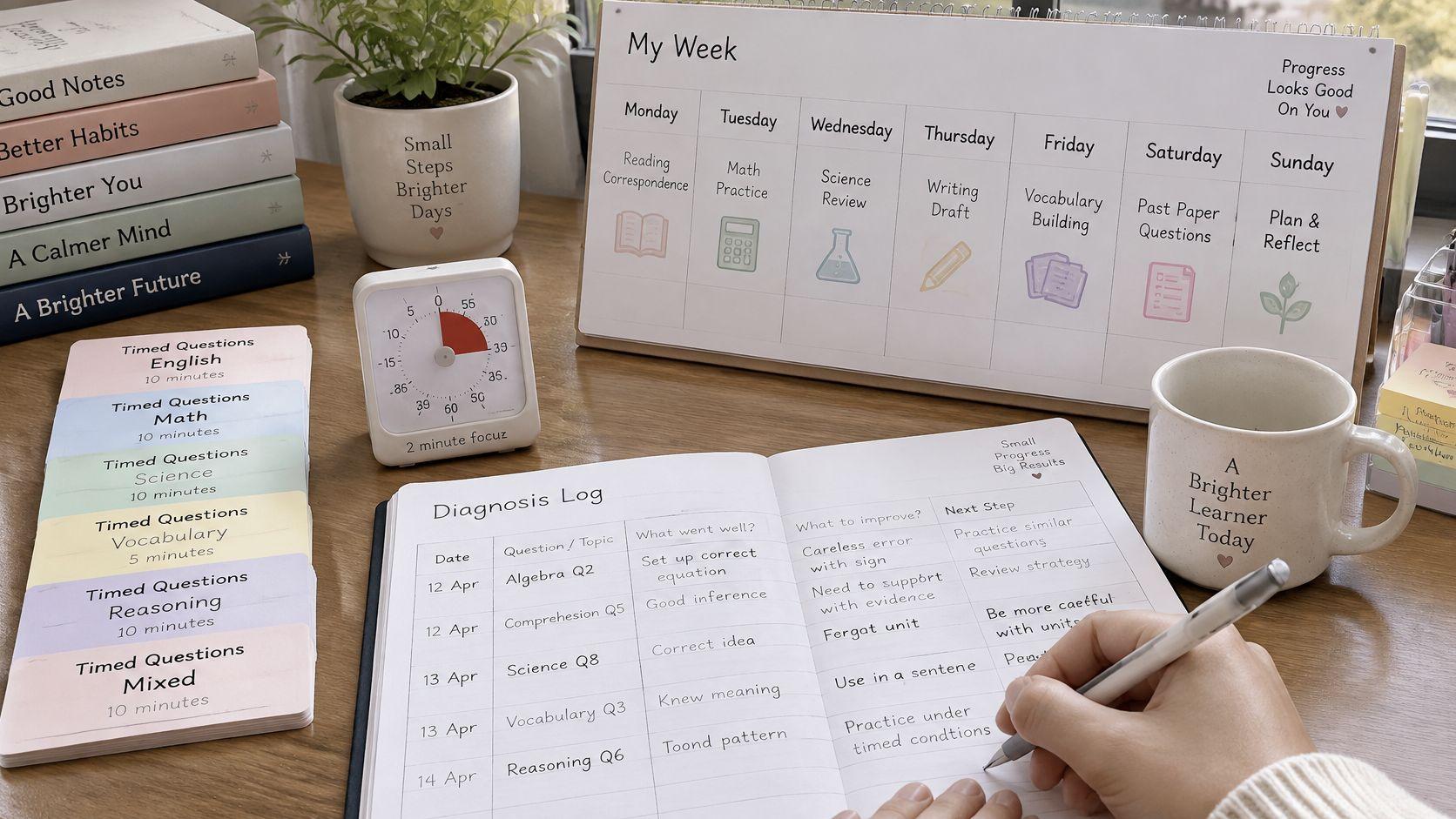
- Monday, correspondence: a timed set of six items with a two-minute cap per question, so the short-text area becomes your fastest.
- Tuesday, diagrams: match each visual to the stated conditions out loud before checking options. Say which schedule, room or time fits and why.
- Wednesday, information passages: mark the evidence sentence for every single answer, including the ones you get right.
- Thursday, viewpoints: state each writer's stance in one line before you look at the questions. If you can't, the reading isn't finished.
- Friday, mixed set: 15 items under timing, logged in the three buckets.
- Weekend, full run: all 38 questions under test timing, then a review that starts with the second and third buckets.
The video below walks through CELPIP reading practice in real time, which is a useful check on whether your process survives under a clock.
One caution about reading too much into any single result. A 2025 Rasch analysis of a 30-item reading test found item reliability of 0.52 and participant reliability of 0.39, with 13.3% of questions classified as misfitting. That's a different test from CELPIP, and it's still a useful limit: a short set is a noisy instrument, so one low percentage doesn't prove you've got worse and one high percentage doesn't prove you're ready.
Repeat comparable sets instead. Compare trends by question type, and read the trend rather than the single score. The study methods that make those comparisons meaningful are worth setting up before your third practice test, not after.
If you qualify for extra time, scheduled breaks, a reader or another accommodation, the preparation answer is to practise under matching conditions rather than standard ones. Confirm eligibility and the request process through official CELPIP channels, since the timing you rehearse should be the timing you'll get.
Start Your Reading Practice This Week
One action beats a study plan you haven't started. Take a timed 38-question reading set this week and log every answer in the three buckets. Then use the log to name your single weakest task area and pick the matching day from the schedule above.
If you want structured support for that, the Reading coach builds comprehension with correspondence, diagrams, and viewpoint analysis exercises that match the exam. The free plan includes 1 exercise per task type across Writing, Reading, Listening and Speaking, 3 starter templates, one vocabulary bundle per section, and 3 submissions a day, which is enough to test whether a platform fits how you study before you commit to anything.
Celprep is an independent preparation resource rather than the official test provider, so treat it as one route through the plan and confirm current features, pricing and registration details with the official channels. A CELPIP practice test that gives you timed conditions and a log you can review is what makes the difference, whichever route you use.
Hold three things after one week: one timed score, one named weakest area, and the next practice set already booked. Run that second set under the same conditions as the first, same time limit, same three buckets, or the comparison you're about to make means nothing.
Celprep is built for exactly the part of reading prep that answer keys skip: a Reading coach that walks you through correspondence, diagram and viewpoint tasks, plus timed practice and full mock exams under real test conditions. Every answer gets explained, so a miss becomes a diagnosis instead of a guess. Visit Celprep to start with the free plan and see which question type is holding your Reading band down.